Buying Guide
The best mm combination wrenches are not all shaped for the same job. Every product in this comparison is listed as an 18 mm combination wrench, but the box-end mechanism, head movement, beam length, and fastener-contact design can change how useful it is in a particular repair. This guide separates those features so you can choose from the selected products without treating one design as universally suitable.
A standard fixed box end is the simplest arrangement. It requires lifting and repositioning the wrench after each turn, but it gives a direct, rigid connection to the fastener. The TEKTON 18 mm Combination Wrench and DEWALT 18 mm Combination Wrench use this general format, with offset geometry intended to provide finger clearance and access around obstructions.
A ratcheting box end lets you continue turning without removing the wrench after every partial rotation. The GEARWRENCH 18 mm 90T Ratcheting Combination Wrench, Jetech 18 mm 72-Tooth Ratcheting Wrench, and Capri Tools 18 mm 120-Tooth Ratcheting Wrench document this feature. Ratcheting is particularly useful when the fastener can only be moved through a small arc, although a ratcheting head adds a mechanism that is not present on a conventional fixed wrench.
The Urrea 18 mm 6-Point Combination Wrench takes a different approach. Its six-point box end is specifically described for stubborn and damaged fasteners. Six-point engagement can be preferable when matching the fastener shape is more important than gaining additional engagement positions. By contrast, many selected models use 12-point ends for quicker engagement and broader positioning.
Match swing arc to available space
Swing arc describes how far the handle must move before the next useful engagement. Smaller stated arcs can be more helpful in confined areas. The Capri Tools 18 mm 120-Tooth Ratcheting Wrench lists a 3-degree swing arc, while the GEARWRENCH 18 mm 90T Ratcheting Combination Wrench lists a 90-tooth mechanism. Several 72-tooth models, including the Jetech 18 mm 72-Tooth Ratcheting Wrench, WORKPRO 18 mm Flex-Head Ratcheting Wrench, and DURATECH 18 mm Flex-Head Ratcheting Wrench, list a 5-degree swing arc.
A small swing arc does not automatically solve every access problem. The handle still needs room to move, and nearby components may require a different approach angle. That is where a flex head can help. The WORKPRO 18 mm Flex-Head Ratcheting Wrench and DURATECH 18 mm Flex-Head Ratcheting Wrench both document 180-degree head pivoting. This can reduce the need to reposition the tool, but a flexing head may not be the preferred choice when you want the fixed feel of a conventional wrench.
Consider reach and leverage
Longer beams can help when a fastener is recessed or when the work position benefits from additional reach. The GEARWRENCH 18 mm Long-Pattern Combination Wrench lists improved reach, leverage, and torque as long-pattern benefits. The DEWALT 18 mm Combination Wrench also lists a longer panel design. Both are fixed designs, so they are more appropriate when reach and a conventional wrench feel matter more than continuous ratcheting.
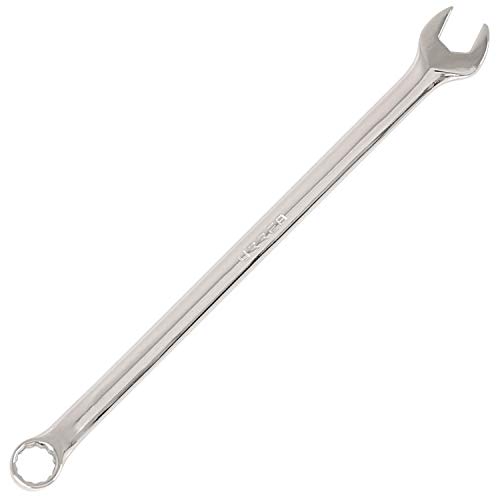
The Urrea 18 mm Extra-Long 12-Point Wrench is listed at 14 inches, making it a clearly extended option in the selection. That length can be useful around deep or obstructed fasteners, but it can also be inconvenient in a crowded engine bay or other restricted area. The Capri Tools 18 mm 120-Tooth Ratcheting Wrench offers a different balance: its XL long-series format adds reach while its ratcheting box end addresses repeated turning.
Several listings describe off-corner or side-contact designs. These features place force on flatter portions of a fastener rather than directly on corners, with the stated goal of helping reduce rounding. TEKTON, GEARWRENCH, Capri Tools, and Jetech all document related fastener-contact features in their listings.
A 12-point end generally provides more engagement positions than a 6-point end. That can make initial alignment quicker, especially when the available movement is limited. However, point count should be considered alongside the condition of the fastener and the intended task. The Urrea 18 mm 6-Point Combination Wrench is the selected example whose listing specifically emphasizes stubborn and damaged fasteners.
Check markings, finish, and construction details
Clear markings matter when several metric tools are stored together. TEKTON and DEWALT document markings on both sides, while the DURATECH 18 mm Flex-Head Ratcheting Wrench specifies double-sided stamping.
Material and finish descriptions are also useful, although they do not replace inspection of the actual tool. The selected listings mention forged or heat-treated chrome vanadium steel for several ratcheting models, hot drop-forged USA steel for the two Urrea options, and chrome or nickel-chrome finishes across the group. These details can help distinguish a tool’s documented construction, while warranty terms provide additional purchase context without proving real-world performance.
How to use the rankings
For the smallest documented swing arc, start with the Capri Tools 18 mm 120-Tooth Ratcheting Wrench. For a pivoting head, compare the WORKPRO 18 mm Flex-Head Ratcheting Wrench with the DURATECH 18 mm Flex-Head Ratcheting Wrench. For long fixed-wrench reach, the Urrea 18 mm Extra-Long 12-Point Wrench and GEARWRENCH 18 mm Long-Pattern Combination Wrench are clear matches. If stubborn fasteners are the priority, the Urrea 18 mm 6-Point Combination Wrench has the most specific supporting description.
Final Recommendation
Capri Tools 18 mm 120-Tooth Ratcheting Wrench ranks first overall in this specification-based comparison under the published weighted criteria.
Capri Tools 18 mm 120-Tooth Ratcheting Wrench is the highest-scoring specification-based choice among the best mm combination wrenches. Its documented 3-degree swing arc, reversible ratcheting box end, XL long-series format, 15-degree offset, and anti-slip open end cover more documented access needs than the other selected products. The GEARWRENCH 18 mm 90T Ratcheting Combination Wrench is a strong alternative for general ratcheting work, while the WORKPRO 18 mm Flex-Head Ratcheting Wrench is suited to changing approach angles. Among the top mm combination wrenches, the right choice depends on whether your priority is swing arc, pivoting access, reach, or six-point engagement.
Frequently Asked Questions
Among the best mm combination wrenches, what size fastener does an 18 mm combination wrench fit?
An 18 mm combination wrench is listed for 18 mm fasteners. The selected tools pair an 18 mm open end with a box end; specific point counts and mechanisms vary by model.
Are ratcheting combination wrenches better for tight spaces?
They may be more convenient when the handle has limited room to swing because the box end can continue turning without being removed after every movement. The Capri Tools 18 mm 120-Tooth Ratcheting Wrench lists a 3-degree swing arc, while multiple selected 72-tooth models list 5 degrees. Actual suitability still depends on surrounding clearance.
Should I choose a 6-point or 12-point box end?
Choose a 6-point design when the listing’s stated focus on stubborn or damaged fasteners matches your work. Choose a 12-point design when quicker engagement positions are more useful. The Urrea 18 mm 6-Point Combination Wrench represents the first use, while the TEKTON 18 mm Combination Wrench represents the second.
When is a flex-head wrench useful?
A flex-head wrench can help when nearby parts prevent a straight approach. The WORKPRO 18 mm Flex-Head Ratcheting Wrench and DURATECH 18 mm Flex-Head Ratcheting Wrench both document 180-degree pivoting. A fixed head may be preferable when you want a rigid, predictable position.
Is a long wrench always the better choice?
No. A long wrench can provide more reach, but it may be awkward where clearance is limited. The Urrea 18 mm Extra-Long 12-Point Wrench is listed at 14 inches, whereas shorter fixed and ratcheting designs may be easier to position in crowded areas.