Buying Guide
The best adjustable welding helmets are easier to compare when their controls are separated into the features that affect visibility, task coverage, and fit. The products above are ranked from public listing specifications only. No hands-on testing, customer sentiment, or independent performance verification was used. Specifications can also vary by model revision or listing update, so treat the supplied details as a comparison starting point and confirm the current manufacturer information before purchase.
Start with the shade range
Shade control is the central distinction in this category. A helmet with a single fixed shade may work for a narrower set of tasks, while a model with multiple shade ranges can cover welding, cutting, and grinding through one hood. The Miller Classic Series lists weld shades 8-13, cut shades 5-8, and grind shade 3. StartPro lists DIN current listing information-9 and 9-13, and Sunstac lists current listing information-9 and 9-13. These are not interchangeable specifications: one listing may describe separate task modes, while another may describe selectable ranges.
Look for both shade range and the controls used to change it. Sensitivity adjustment can help tailor arc detection to the working environment, and delay adjustment controls how long the lens remains dark after the arc ends. StartPro, YESWELDER LYG-L600A, YESWELDER LYG-M800H, ARCCAPTAIN GT995, and TOOLIOM TL-M800D all document some combination of these settings. If you frequently move between processes, prioritize a helmet that documents both a broad range and convenient mode selection.
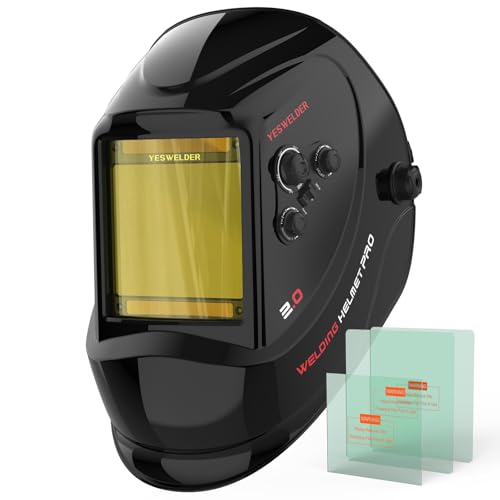
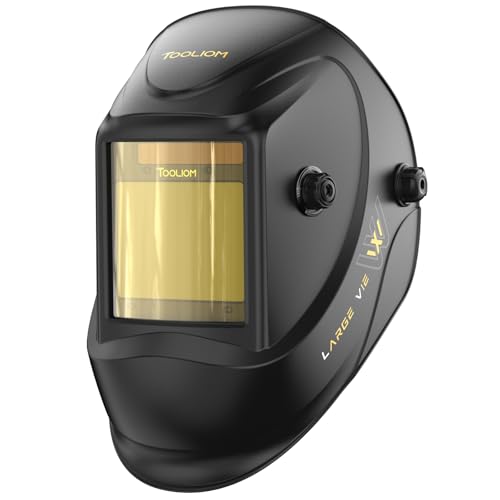
A larger window can make it easier to see the weld zone and surrounding joint, but window size alone does not describe optical quality. Several selected models list 1/1/1/1 optical clarity, including the YESWELDER LYG-L600A, YESWELDER LYG-M800H, ARCCAPTAIN GT995, YESWELDER LYG-31800H-LED, Sunstac SS-A800D, and TOOLIOM TL-M800D. BESTCLUB lists 1/1/1/2, while StartPro provides a viewing-area measurement without an optical classification.
The listed viewing areas range from the Miller’s 6-square-inch description to screens around 3.94 by 3.66 inches. A large-view helmet may suit users who want more surrounding visibility, while a smaller window can still be useful when the optical specification and fit are the priority. If close-up work matters, the YESWELDER LYG-L600A, YESWELDER LYG-M800H, and YESWELDER LYG-31800H-LED document compatibility with magnifying or cheater lenses. Sunstac also lists cheater-lens compatibility, but its listing says the lens is sold separately.
Auto-darkening helmets use sensors to detect the arc. The selected products document two or four sensors, and the four-sensor designs include StartPro, BESTCLUB, both ARCCAPTAIN models, both YESWELDER LED or large-view models, Sunstac, and TOOLIOM. More sensors are a documented design difference, not a guarantee of better results in every position, so compare that information with the helmet’s other specifications.
Response figures are also listing claims rather than independent test results. Miller lists 1/23,000 second, YESWELDER LYG-L600A and LYG-M800H list 1/30,000 second, StartPro and BESTCLUB list 1/25,000 second, and ARCCAPTAIN GT995 lists 1/25,000 second. TOOLIOM documents sensors but does not state a switching time in the supplied evidence. Avoid choosing by response figure alone; shade adjustment, optical clarity, and the intended process still matter.
Match modes to your work
For a helmet that can stay on through several operations, check whether the listing explicitly documents welding, cutting, grinding, or plasma modes. StartPro lists welding, cutting, and grinding modes. BESTCLUB lists weld, grind, and plasma-cut modes. Sunstac lists stick, TIG, MIG, cutting, MMA, plasma, and grinding, while the two ARCCAPTAIN models document combinations of ARC, MIG, TIG, cutting, and grinding.
The Miller Classic Series is also notable because its listing separately specifies weld, cut, and grind shades. The YESWELDER LYG-L600A supports TIG, MIG, MMA/ARC, and grinding, and the LYG-M800H adds cutting. If your work is mainly one process, you may not need every mode. If you handle repairs or general fabrication, documented multi-process coverage can reduce the need to change equipment.
Consider lighting and maintenance features
Auxiliary lights are a distinct design choice. ARCCAPTAIN’s LED model has a USB-powered light with two brightness levels, while the YESWELDER LYG-31800H-LED lists a removable adhesive LED with two brightness levels. These features are intended to help in darker work areas, but they add another component to attach, power, or maintain.
Power details also vary. Many selected helmets list solar cells or panels paired with a replaceable lithium battery, including StartPro, YESWELDER LYG-L600A, YESWELDER LYG-M800H, ARCCAPTAIN GT995, ARCCAPTAIN’s LED model, and Sunstac. StartPro additionally lists a low-battery LED indicator and an ADF self-check button. Those features can make routine checks more straightforward, but they do not replace following the helmet’s instructions.
Prioritize a stable fit
A helmet should remain positioned correctly while you work. The supplied listings mention adjustable headgear on the Miller, StartPro, ARCCAPTAIN, YESWELDER, BESTCLUB, and other models. Miller specifies ratchet headgear, BESTCLUB specifies pivot-style headgear, and several models describe padding or ergonomic adjustment. Weight data is not consistent across the pool, and one ARCCAPTAIN listing contains conflicting supplied weight fields. Treat weight claims cautiously and verify fit, headgear adjustment, and replacement-part availability before committing.
Final recommendation
YESWELDER LYG-31800H-LED ranks first overall in this specification-based comparison under the published weighted criteria.
The final choice among the best adjustable welding helmets depends on the documented features that match your intended use.
Miller Classic Series Metal Matrix is the highest-scoring returned product and the first overall specification-based choice. It combines a large viewing area, ClearLight optics, adjustable shade, delay and sensitivity controls, multiple task shades, named standards, and ratchet headgear. Among the top adjustable welding helmets, YESWELDER LYG-M800H is a strong alternative when a very large screen and 1/1/1/1 optical clarity are the priority. Choose ARCCAPTAIN’s LED model or the YESWELDER LYG-31800H-LED when auxiliary lighting is useful, and consider StartPro or Sunstac for broad process and shade coverage. For detailed work, YESWELDER LYG-L600A offers the clearest documented optical classification and cheater-lens compatibility.
Frequently Asked Questions
What makes the best adjustable welding helmets different from fixed-shade hoods?
Adjustable helmets let the user select or switch among documented shade settings, often with sensitivity and delay controls. The selected examples include helmets with ranges such as current listing information-9 and 9-13, as well as models with separate weld, cut, and grind shades. A fixed-shade design may be adequate for a narrower task, but it offers less documented flexibility.
Is a larger viewing area always better?
Not necessarily. A larger window can provide more surrounding visibility, but optical classification, true-color information, fit, and shade controls also matter. The Miller Classic Series lists a 6-square-inch viewing area, while several other selected helmets list screens near 3.94 by 3.66 inches and 1/1/1/1 optical clarity. Compare the full specification set rather than screen dimensions alone.
Do four arc sensors guarantee better auto-darkening?
No. Four sensors are a documented design feature that may provide broader detection coverage, but the supplied data does not establish a universal performance guarantee. Compare sensor count with the listed switching figure, shade range, sensitivity control, optical details, and the process you plan to use.
Which selected helmet is suited to dark work areas?
The ARCCAPTAIN Large View with LED Light and YESWELDER LYG-31800H-LED both document auxiliary LED lighting. ARCCAPTAIN lists a USB-powered light with two brightness levels, while YESWELDER lists a removable adhesive LED with two brightness levels. These features may help illuminate nearby work, but they do not replace normal workspace lighting.
Should I choose a helmet that supports a cheater lens?
If you need magnification for close-up work, documented compatibility can be useful. YESWELDER LYG-L600A, YESWELDER LYG-M800H, and YESWELDER LYG-31800H-LED list magnifying-lens compatibility, and Sunstac lists cheater-lens compatibility. Check the specific lens size and whether the accessory is included or sold separately.