Buying Guide
The best aluminum flood lights are not defined by housing material alone. The right choice depends on how much area must be illuminated, whether the fixture will be hardwired, how much aiming range is useful, and whether automatic controls are wanted. The products above are ranked from supplied specifications, not hands-on testing or customer sentiment.
Start with the mounting location
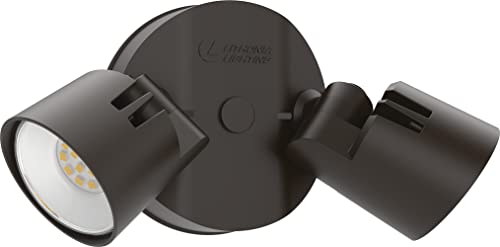
Confirm where the fixture will attach before comparing brightness. A recessed junction box installation is specifically documented for the Lithonia HomeGuard, including wall or ceiling mounting and several 4-by-4 box shapes. The Philips and Onforu multi-head models are described for wall mounting, while the NUWATT and CINOTON fixtures use adjustable knuckle or swivel-style mounting. A suitable junction box, wiring path, and mounting surface remain important installation considerations.
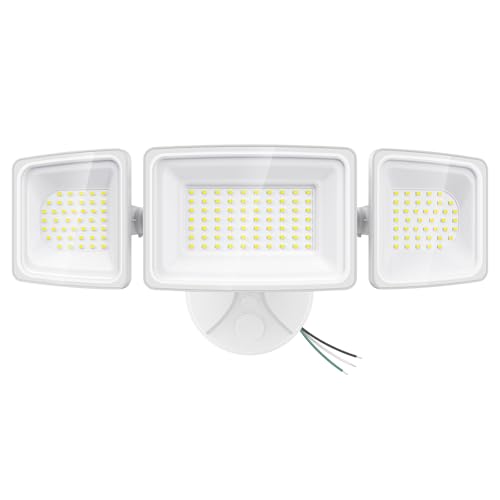
Compact fixtures generally make more sense at an entryway or along a walkway. The LUTEC 6222W has a dual-head format and moderate output for those spaces. Larger properties may benefit from the three-head Philips or LUTEC models, the four-head Onforu BDS90, or the high-output Onforu BDB150. More heads can spread light across different directions, but they also need enough mounting clearance for adjustment.
Compare brightness with coverage
Lumens indicate the listed light output, but they do not by themselves establish how evenly a fixture will illuminate a property. The Onforu BDB150 lists 15,000 lumens, while the BDS90 lists 10,000 lumens and up to 300 degrees of head coverage. The Philips motion model lists 7,400 lumens and three rotatable heads. These options are better suited to expansive areas than the 2,750-lumen Lithonia or 3,200-lumen Onforu BDR35-2.
Aiming is equally important. The NUWATT uses a 180-degree knuckle range, the CINOTON 55W model specifies a 180-degree swivel mount, and the LUTEC 6222W documents 360-degree adjustable dual heads. When a wall, driveway, or yard has several angles to cover, adjustable heads can be more useful than simply choosing the highest lumen figure.
Check aluminum construction and heat handling
Aluminum is useful in outdoor flood-light construction because it can form a durable fixture housing and help manage heat. The evidence here varies by model. Philips lists an aluminum body with rear heat-dissipation fins. Onforu describes die-cast aluminum construction and heat dissipation on both selected models. NUWATT, CINOTON, and Lithonia also document die-cast or aluminum construction.
Look for the construction detail that matches the intended use. A powder-coated or corrosion-resistant finish may be helpful in exposed locations, but the listing should document it rather than assume it. The selected products include IP65 and IP66 designs, along with wet-location listings on Lithonia. These are technical specifications, not guarantees that every installation will perform identically in every environment.
Choose the control method
Control style is one of the biggest differences among these fixtures. Switch-controlled models such as the Philips manual version, both selected Onforu models, and the CINOTON fixture in manual mode provide direct user control. They are appropriate when the light should turn on only when someone operates a wall switch.
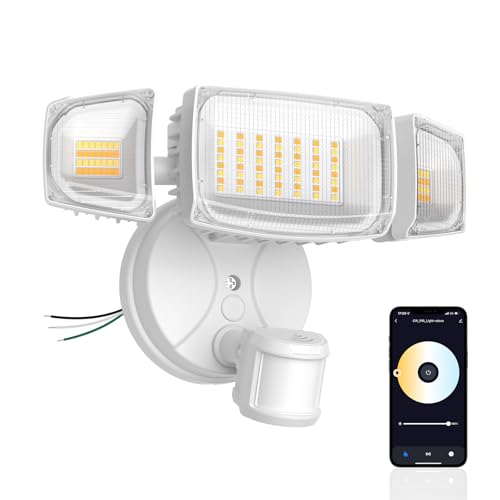
Motion-equipped products can automate security lighting. The Philips motion model and LUTEC 72W model document PIR detection, 180-degree sensing, and adjustable timing. The Philips model also lists test, security, dusk-to-dawn, and manual override modes. These features offer flexibility, but sensor positioning and settings can affect how the fixture behaves in a real installation.
Photocell operation is different from motion activation. A photocell is useful when automatic nighttime scheduling is preferred without motion-triggered switching. The CINOTON 55W model documents dusk-to-dawn and manual modes, while the NUWATT model emphasizes 0-10V dimming, which requires compatible control equipment.
Consider color temperature
The listed color temperatures range from warm white to daylight. The NUWATT and CINOTON 55W fixtures offer selectable 3,000K, 4,000K, and 5,000K settings. This gives one fixture more flexibility for patios, residential areas, or security-oriented placement. The Philips, Onforu, and LUTEC security models use 5,000K or 6,500K daylight-style specifications, while Lithonia uses 4,000K.
Color temperature is a preference and application decision rather than a simple quality ranking. Warm white can suit a more relaxed setting, while cooler daylight specifications may be preferred for visibility-focused locations. Selectable-color models are useful when the installation purpose may change.
Review electrical and weather details
Check the available supply and any dimming or sensor requirements before purchase. NUWATT lists a 120-277V range. Do not assume a fixture has universal-voltage compatibility unless its listing says so.
For exposed areas, compare IP ratings and wet-location information. The Onforu BDS90 and Onforu BDR35-2 list IP66 protection; Philips, NUWATT, CINOTON, Lithonia, and LUTEC models document IP65 or weather-related protection. Lithonia additionally lists UL/cUL wet-location certification. These specifications help narrow the options, but local electrical requirements and installation instructions still apply.
Match the fixture to the project
For the widest manually controlled spread, the Onforu BDS90 is a strong fit. For maximum listed output, the Onforu BDB150 is the more specialized choice. The Philips motion model is better suited to a security setup that needs several modes, while the Philips switch-controlled model favors predictable manual operation. NUWATT and CINOTON are useful when color selection or broader voltage compatibility is central. For smaller residential spaces, LUTEC 6222W and the Onforu BDR35-2 keep the design simpler.
Final Recommendation
Philips 72W LED PIR Flood Light, 3 Heads ranks first overall in this specification-based comparison under the published weighted criteria.
The final choice among the best aluminum flood lights depends on the documented features that match your intended use.
Philips 72W LED PIR Flood Light, 3 Heads is the highest-scoring returned product and the first overall specification-based choice. It combines documented aluminum construction, rear heat-dissipation fins, 7,400 lumens, three adjustable heads, motion sensing, and four operating modes. Among the top aluminum flood lights, it offers one of the most complete combinations of coverage and control.
Choose the Onforu BDS90 when broad manual coverage is the priority, or the Onforu BDB150 when the largest listed output matters more than compactness. NUWATT is the better fit for selectable color temperature, dimming, and wide-voltage projects. Lithonia and LUTEC 6222W are more practical for smaller residential locations. Before installation, verify the junction box, supply voltage, mounting clearance, control requirements, and applicable local electrical rules.
Frequently Asked Questions
Are aluminum flood lights suitable for outdoor use?
They can be, provided the individual fixture documents appropriate outdoor protection. In this selection, products list IP65 or IP66 ratings, weather resistance, or wet-location listings. Aluminum construction alone does not establish a fixture’s weather suitability, so check the complete specification for the model being installed.
How bright should the best aluminum flood lights be?
The answer depends on the area and desired coverage. The Lithonia HomeGuard lists 2,750 lumens for residential locations, while the Philips and LUTEC multi-head models list about 7,400 to 7,500 lumens. The Onforu BDB150 lists 15,000 lumens for larger areas. Higher output may be unnecessary for a small entryway and can require more careful aiming.
Should I choose motion sensing or a wall switch?
Choose motion sensing when automatic activation is useful; the Philips motion and LUTEC 72W models document PIR detection, timers, and multiple modes. Choose a wall switch when predictable manual operation is preferred. The switch-controlled Philips and Onforu fixtures avoid motion-triggered operation, while the CINOTON 55W model provides dusk-to-dawn and manual modes.
What does an IP65 or IP66 rating indicate?
Those are technical enclosure protection ratings documented by the product listings. IP65 and IP66 fixtures in this comparison are marketed for outdoor weather exposure, with IP66 representing the higher water-jet protection level in the rating system. The rating does not replace correct mounting, wiring, sealing, or compliance with local installation requirements.
Do adjustable heads matter on an aluminum flood light?
Adjustable heads can help direct light toward separate areas and reduce wasted illumination. The selected models range from dual-head designs such as the LUTEC 6222W and Onforu BDR35-2 to three- and four-head fixtures. The useful adjustment range varies, so compare the documented head movement and available mounting space rather than assuming every multi-head light provides the same coverage.