Buying Guide
Choosing the best weather-resistant flood lights starts with the installation location, not the lumen figure alone. A driveway, side path, detached garage, and wide backyard can require different power systems, coverage patterns, and controls. The products above are compared from supplied listing specifications and feature descriptions. They were not hands-on tested, and this guide does not summarize customer opinions.
Start with the power method
Hardwired models are the most permanent option in this comparison. The ALUSSO, Onforu wired fixtures, Olafus, and LUTEC products are designed around a 120V or junction-box connection, although the exact installation details vary by model. That format is suitable when an existing exterior electrical box is available and you want consistent operation without relying on sunlight or a rechargeable battery. Installation work involving household wiring should follow local requirements and, where appropriate, be handled by a qualified electrician.
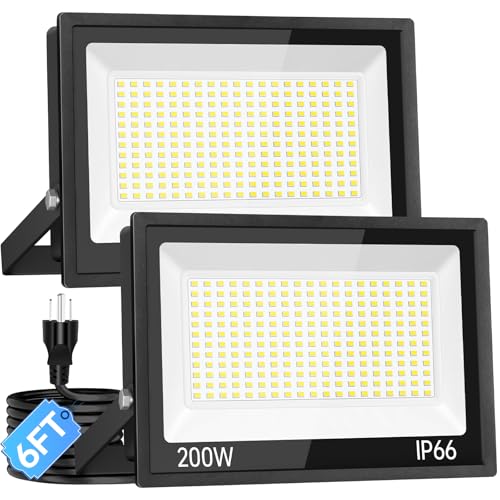
Plug-in lighting offers a different compromise. The ISUERFY fixture uses a standard US plug and power cord, so it can be used where an outlet is available without the same junction-box wiring process. Its cord still needs a suitable route and outdoor-appropriate protection. Plug-in designs can be useful for temporary, seasonal, or workshop-area lighting, but they may be less visually tidy than hardwired fixtures.
Solar products are the most flexible for locations without convenient electrical power. The SZPOWER and Tuffenough lights use solar panels and rechargeable batteries, so placement is critical. The supplied evidence specifically connects charging to sunlight, and Tuffenough provides recommended mounting height and panel orientation guidance. Shaded walls, roof overhangs, and locations facing away from direct sun may not be suitable for a solar design.
Compare weather protection correctly
IP ratings are among the clearest documented specifications in this group. IP65 models are represented by the LUTEC, Onforu, SZPOWER, and Tuffenough selections. IP66 appears on the Onforu 90W, ISUERFY, and Onforu 32W fixtures. These ratings are technical protection classifications, not a promise that every installation will perform identically in every climate. The mounting surface, seals, cable entry, and installation quality still matter.
Some listings use terms such as waterproof, weatherproof, or wet-location use without providing the same level of detail. Focus on the specific protection evidence supplied for the model you choose, and inspect mounting instructions before installation.
Match brightness to the area
Lumen figures help compare stated output, but they do not independently describe usable illumination. Beam angle, head position, mounting height, lens design, and the shape of the area all affect how light is distributed. The Olafus and ISUERFY listings provide particularly high output figures for broad areas. They may suit a large backyard, work zone, or property edge better than a compact 3200-lumen fixture.
For an entryway, porch, or small garage, the Onforu 32W or ALUSSO may be easier to match to the space. Their stated outputs are lower than the largest fixtures, but the smaller formats and adjustable heads can help avoid selecting more light than the location needs. The LUTEC motion model occupies a middle position with a documented 7500-lumen output and several operating modes.
Color temperature also affects the appearance of the light. Several selected models specify 5000K or 6500K daylight output. ALUSSO is more flexible because it provides 3000K, 4000K, and 6500K choices. A warmer setting may be preferable for a more residential look, while daylight settings are commonly chosen when a crisp security-light appearance is wanted. Do not assume that a higher wattage automatically creates better coverage; use the documented lumens and beam information together.
Look for useful aiming flexibility
Multiple adjustable heads are valuable when one fixture must cover a doorway and driveway, two sides of a garage, or a broad wall. The Onforu 90W has four independently adjustable heads and a stated 300-degree coverage range. Olafus has five adjustable heads and a stated 360-degree beam angle. Solar selections also provide several heads: SZPOWER has four and Tuffenough has three, both with a stated 270-degree lighting angle.
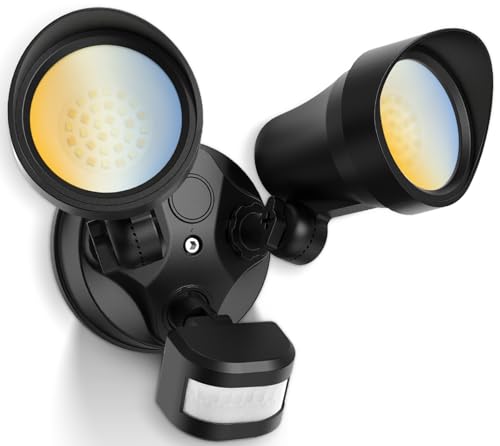
A dual-head fixture can be more compact and easier to position. The Onforu 32W uses two adjustable heads, while ALUSSO also documents dual heads and a 100-degree beam angle. Before buying, consider whether the mounting position lets each head point toward the intended zones without creating unwanted glare. Matte or opaque lens designs, documented on selected Onforu and Olafus models, may help distribute light more evenly, but the listings do not provide independent glare measurements.
Choose controls for your routine
Switch-only models are simple and predictable. The Onforu 90W, Onforu 75W, and Onforu 32W are operated through a wall switch, which works well when you already have a convenient control location or want the light available continuously. Their limitation is that they do not provide the automatic activation offered by sensor or photocell models.
Motion controls can reduce unnecessary operating time. LUTEC lists a 180-degree sensor and adjustable timers, while ALUSSO lists auto mode, adjustable detection range, and duration settings. Solar models also use motion control, with SZPOWER documenting dual sensors and Tuffenough offering sensor modes through its remote. Sensor placement matters: movement direction, mounting height, nearby roads, and vegetation can affect how well the detection area matches your needs.
Photocell and dusk-to-dawn control are better for automatic nighttime illumination without waiting for movement. The Onforu 80W uses a photocell and also offers a switch-controlled mode when the sensor is covered. LUTEC includes a dusk-to-dawn mode alongside motion and manual settings. These options are useful for entrances or paths that should remain illuminated, but they may use more operating time than motion-only settings.
Final recommendation
Onforu 90W 4-Head LED Flood Light ranks first overall in this specification-based comparison under the published weighted criteria.
The final choice among the best weather-resistant flood lights depends on the documented features that match your intended use.
ALUSSO 30W 3-Mode Motion Flood Light is the highest-scoring returned product and the first overall specification-based choice. Its combination of selectable color temperatures, multiple modes, adjustable motion settings, dual heads, and documented wet-location construction gives it the most adaptable profile for many residential locations. Among the top weather-resistant flood lights, the Onforu 90W is the stronger alternative for broad wired coverage, while Olafus is a logical choice when maximum stated output and five-head positioning matter.
Choose the Onforu 32W when a smaller IP66 fixture is enough. Select LUTEC or the Onforu 80W when automatic operation is more important than switch-only simplicity. For locations without practical wiring, SZPOWER offers the most specification-aligned solar head adjustability in this selection, and Tuffenough adds remote mode selection. Confirm the mounting surface, power route, sunlight exposure, and desired control method before ordering.
Frequently Asked Questions
What should I check before buying the best weather-resistant flood lights?
Check the documented IP or wet-location rating, power method, lumen output, beam or head adjustment, and control type. Also verify that the mounting location has the required junction box, outlet, or direct sunlight. A high output specification is not enough if the fixture cannot be aimed at the area you need to illuminate.
Are IP65 and IP66 flood lights suitable for outdoor use?
The selected listings describe both IP65 and IP66 fixtures for outdoor applications. IP66 appears on the Onforu 90W, ISUERFY, and Onforu 32W models, while several other selections list IP65. Treat the rating as one part of installation planning: use the supplied mounting and sealing guidance, protect cable entries, and follow applicable electrical requirements.
Are solar flood lights a good choice when wiring is unavailable?
They can be, provided the solar panel receives suitable sunlight. SZPOWER and Tuffenough both document rechargeable battery systems, motion modes, and wireless installation. Tuffenough specifically recommends direct sunlight and a defined mounting height. Shaded or obstructed locations may favor a plug-in or hardwired fixture instead.
Is a motion sensor better than a dusk-to-dawn control?
Neither is universally better. Motion activation is useful when illumination is needed in response to movement, while dusk-to-dawn operation keeps a path or entrance lit through the night. LUTEC supports both types of operation, and the Onforu 80W uses a photocell with a switch-controlled alternative. Choose based on whether continuous nighttime lighting or event-based lighting better fits the location.
How many adjustable heads do I need?
One fixture with two heads may be enough for a doorway and a nearby path. Three or more heads can help cover separated zones or a wider wall. The Onforu 90W and Olafus provide four and five heads respectively, while selected solar models provide three or four. More heads add aiming options, but the mounting position and stated beam coverage still determine how useful that flexibility will be.