Buying Guide
The best waterproof flood lights are easier to compare when you separate weather protection from brightness and control features. A high IP number can help with outdoor placement, but it does not tell you whether a fixture is plug-in, hardwired, solar-powered, motion-activated, or suitable for a small entryway. Start with the location, then narrow the choices by power access, coverage, and desired operating method.
Choose the power connection first
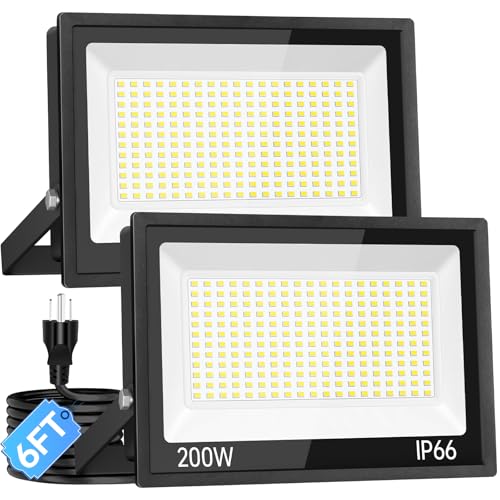
Plug-in models are usually the most flexible for garages, workshops, temporary work areas, and rental properties where changing fixed wiring is undesirable. The Onforu DB100, ISUERFY 200W, MUCLUD, and NEWREACH options all document plug-and-play operation or a standard US plug. A nearby outlet and a suitable cord path are still necessary. Plug-in fixtures may also be easier to reposition, but the cord can affect appearance and routing.
Hardwired fixtures are better suited to a permanent security-light installation. ALUSSO, the Onforu 90W model, and LUTEC fixtures are described as wall-mounted or wired products. Hardwiring can provide a cleaner finished setup, but it requires an appropriate junction box, electrical connection, and installation plan. The supplied evidence does not establish installation difficulty beyond the stated connection requirements, so consult a qualified professional when needed.
Solar models remove the need for an outlet or household wiring. Tuffenough and MIHANI include solar charging, rechargeable batteries, motion functions, and multiple lighting modes. Their placement is more dependent on daylight exposure than wired products. Tuffenough specifically provides placement guidance for the solar panel and mounting height, while MIHANI documents a tempered-glass panel and tool-free installation. Treat solar as a location-dependent solution rather than a universal replacement for wired lighting.
Match brightness to the area
Lumens provide a useful starting point, but listed output is not a complete prediction of usable illumination. The selected products range from compact fixtures such as the 2,800-lumen CINOTON and 3,600-lumen NEWREACH to high-output options such as the 10,000-lumen Onforu 90W, 11,000-lumen MUCLUD, and 24,000-lumen ISUERFY package. A small path or doorway may not need the output intended for a court, warehouse, or large yard.
Also consider color temperature. Many selected fixtures list daylight-white output around 5000K or 6500K. ALUSSO provides three selectable color temperatures, from warm white through daylight, which is useful when you want to balance atmosphere and visibility. The other models generally specify one fixed color temperature. A cooler daylight setting can appear more conspicuous, while a warmer setting may better suit a porch or residential façade; the supplied listings do not establish comparative visual performance.
Evaluate beam and head adjustment
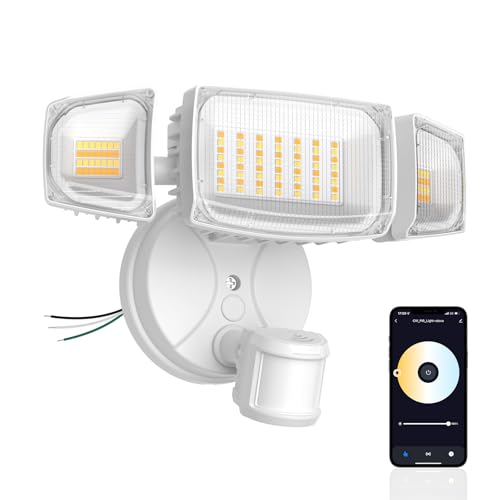
Coverage depends on more than lumen figures. A 120-degree beam is documented for several plug-in flood lights, including Onforu DB100, ISUERFY, MUCLUD, and NEWREACH. Adjustable brackets help aim that beam toward a yard, wall, work surface, or driveway. Multi-head designs provide another type of flexibility: Onforu 90W documents four heads and up to 300-degree coverage, while LUTEC, Tuffenough, and MIHANI use multiple adjustable heads for wider directional placement.
For a narrow target, a compact single-head fixture may be easier to position. For a broad perimeter, multiple heads can spread light across different directions. Avoid assuming that a stated coverage angle means every point will receive equal brightness. Use the published beam and head-adjustment information as planning guidance, then consider mounting height and nearby obstructions.
Understand IP ratings and construction
IP65 and IP66 are the documented protection levels across the selected range. Both are intended for outdoor-oriented use, but the listings use different ratings and construction details. IP66 appears on several die-cast aluminum fixtures, including Onforu, ISUERFY, MUCLUD, and NEWREACH products. IP65 appears on ALUSSO, LUTEC, Tuffenough, and MIHANI selections. Product descriptions also mention tempered glass, sealing gaskets, aluminum housings, and heat-dissipation fins.
An IP rating does not remove the need for sensible placement. Follow the installation instructions, protect connections as required, and avoid treating a flood light as submersible equipment. For solar products, the panel and control areas also need appropriate exposure and positioning. Heat management matters for LED fixtures, and several listings specifically describe die-cast aluminum or finned designs intended to dissipate heat.
Decide whether automation is useful
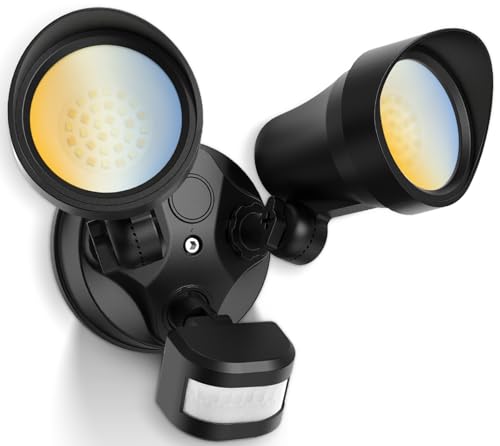
Manual switch control is appropriate when you want light on demand and do not want sensor activation. The Onforu 90W and 90W four-head model emphasize wall-switch operation. Dusk-to-dawn and motion controls are more useful for security or hands-off operation. LUTEC documents motion detection, dusk-to-dawn, a timer, and manual override. ALUSSO documents three modes, adjustable detection range, and adjustable duration. Tuffenough and MIHANI add solar motion modes, with Tuffenough including a remote control.
Automation adds flexibility but also introduces setup considerations. Sensor placement, detection range, timer settings, and daylight conditions can affect how a system operates. If reliable continuous illumination is the priority, a manually controlled or plug-in fixture may be more straightforward. If you need occasional security lighting, motion or dusk-to-dawn modes can reduce unnecessary operation.
Final recommendation
Onforu 90W 4-Head IP66 Flood Light ranks first overall in this specification-based comparison under the published weighted criteria.
The final choice among the best waterproof flood lights depends on the documented features that match your intended use.
ALUSSO 30W 3-Mode Motion Flood Light is the highest-scoring returned product and the first overall specification-based choice. It combines documented IP-rated wet-location use, dual adjustable heads, selectable color temperature, motion detection, dusk-to-dawn operation, manual control, and hardwired installation. For large areas, the ISUERFY 200W offers the highest listed output, while the Onforu 90W is a strong choice when broad four-head coverage is more important than automated controls. Tuffenough and MIHANI are the top waterproof flood lights here for locations where solar power is preferable to wiring.
Frequently Asked Questions
What should I look for in the best waterproof flood lights?
Start with the installation location and power source. Check the documented IP rating, listed lumen output, beam angle, head adjustment, and whether the product is plug-in, hardwired, or solar. Then decide whether you need motion, dusk-to-dawn, remote, or simple switch control.
Are IP65 and IP66 flood lights suitable for outdoor use?
The supplied listings describe both IP65 and IP66 fixtures for outdoor applications and weather conditions. Choose a product according to its documented rating and follow the mounting and connection instructions. An IP rating should not be interpreted as permission to submerge the fixture.
Are plug-in flood lights easier to install than hardwired models?
Plug-in products such as NEWREACH and Onforu DB100 are described as plug-and-play and do not require the same hardwired connection. They still need a suitable outlet, mounting surface, and safe cord routing. Hardwired products can provide a more permanent installation but require an appropriate electrical connection.
Do solar flood lights work without an outlet?
Yes. Tuffenough and MIHANI are described as solar-powered and use rechargeable batteries, so they do not need a household power cord. Their usefulness depends on positioning the solar panel where it can receive suitable daylight, and their documented output is below the highest-output wired selections.
Is a multi-head flood light better for wide coverage?
A multi-head design can provide more directional adjustment. Onforu 90W documents four adjustable heads and up to 300-degree coverage, while LUTEC, Tuffenough, and MIHANI document multiple adjustable heads. The best choice still depends on mounting position, beam angle, obstructions, and the size of the area.