Buying Guide
The best bathroom marble tiles are not one single material or installation type. The supplied options divide into genuine marble mosaic, marble-look wall panels, peel-and-stick backsplash pieces, and vinyl floor tiles. Start by deciding whether the project is a wall, shower surround, backsplash, or floor. Then compare the documented surface, substrate requirements, coverage, and format rather than judging the marble pattern alone.
Choose real marble or a marble-look surface
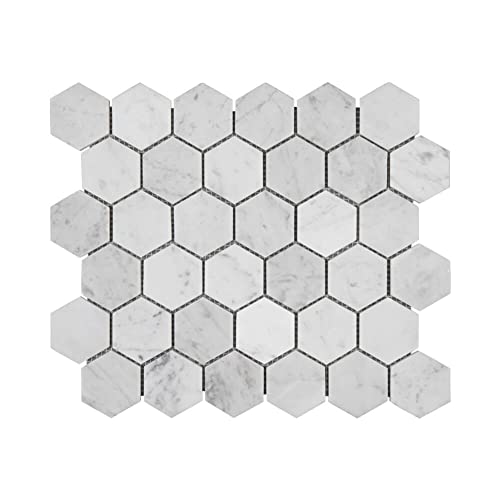
Adolif is the only selected product explicitly identified as Carrara white marble. Its 2-inch hexagon pieces arrive on mesh-backed sheets, which can help maintain a repeating layout while allowing the sheet to be cut and positioned. Genuine stone gives the project a materially different surface from PVC, PET, foam, or vinyl, but the listing does not provide sealing or care instructions. Buyers considering natural marble should therefore confirm installation and maintenance requirements before ordering.
The other selections are synthetic marble-look products. These include PVC composite laminate, PVC and EVA laminate, PET with IXPE foam, and vinyl flooring. Their advantage is specification simplicity: several list waterproof, stain-resistant, heat-resistant, washable, or easy-clean features. These claims describe the supplied listing evidence, not independent testing. They also do not make synthetic products interchangeable. A floor tile and a wall panel may have different support, adhesive, and wear needs.
Square panels around 11.8 or 12 inches are a convenient visual starting point for larger uninterrupted wall areas. LVSHI, Vieshful, WAPANE, and similar panel formats are designed around quick peel-and-stick installation. Their larger pieces can reduce the number of visible joints compared with small subway pieces, though the final appearance still depends on wall dimensions, cuts, and alignment.
Subway formats create a more articulated backsplash. Vamos Tile documents 3-by-6-inch Statuary White pieces with white grout styling, while Art3d uses 3-by-6-inch black marble pieces. URCOLOR uses a larger 4-by-8-inch black-and-gold format. These products are useful when the layout itself is part of the design. They also create more seams than a large panel, so plan cuts around corners, outlets, plumbing, and transitions.
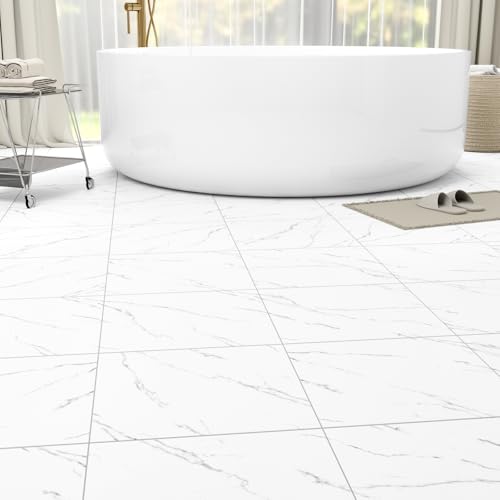
For floors, use a product specifically presented as flooring. WESTICK, Spiareal, and the ZRJT white vein option are all described as vinyl floor tiles for bathroom use. Their 12-by-12-inch format makes area calculations straightforward. Spiareal documents 48 square feet per pack, while the ZRJT and WESTICK options document 20 square feet per pack. Coverage figures should be treated as planning estimates, since real installations need cuts and may require extra pieces.
Check moisture and cleaning claims carefully
Bathroom placement makes moisture-related information important. Many selected wall products list waterproof or water-resistant features, and several also mention easy cleaning, stain resistance, or heat resistance. These details are useful for splash zones and backsplashes, but they do not automatically establish suitability for every shower or wet-room installation. Confirm the manufacturer’s installation guidance, especially around seams, corners, plumbing penetrations, and direct water exposure.
Floor products have a separate set of considerations. Spiareal lists a waterproof and stain-resistant surface, while WESTICK lists waterproof, washable, scratch-resistant, and oil-resistant features. The ZRJT white vein floor option adds a documented 0.05-inch PVC layer intended to provide support and cover slightly uneven surfaces. These are product-level claims from the supplied listings; they are not a substitute for checking the existing floor and following installation instructions.
Prepare the substrate before using adhesive tile
Peel-and-stick products are convenient only when the surface is compatible. WESTICK requires a completely flat and clean floor. Several wall products specify clean, dry, smooth surfaces. URCOLOR is more specific: its listing says it can adhere to smooth and lightly textured walls but excludes brick, oily glossy painted walls, textured walls, and uneven rough surfaces.
Clean away dust, grease, soap residue, and loose material before measuring. Dry-fit the layout, identify the visible edges, and plan cuts before removing backing paper. For sheets or panels, check how the pattern repeats. Buying enough pieces from one batch can help reduce visible color variation; the supplied listings for some products specifically warn that different batches may vary.
Compare coverage, seams, and waste
Coverage is more useful than pack count alone. Adolif documents 4.1 square feet for five mesh-backed sheets, while LVSHI and Vieshful document roughly 19.4 and 19.2 square feet respectively for 20 square panels. Vamos Tile lists about 12.08 square feet for 100 subway pieces, and URCOLOR lists about 7.11 square feet for 32 pieces. For floors, Spiareal’s 48-square-foot pack is the largest documented coverage among the selected options.
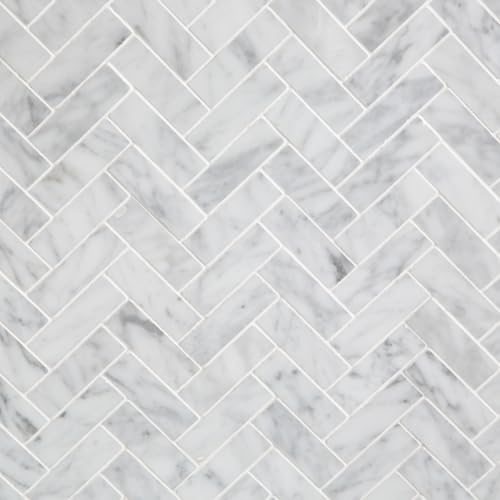
Measure the actual area, subtract permanent openings, and add allowance for cuts. Subway patterns can generate more waste around corners than square panels. A large panel may cover an area quickly but require careful handling around outlets and fixtures. A mosaic sheet can follow a more complex design, yet its many small pieces increase joint count. Choose the format that fits the room’s geometry, not just the pack with the largest stated coverage.
Decide whether removability matters
Spiareal specifically describes removable adhesive that leaves no sticky residue, making it the clearest choice for a temporary floor refresh. Other products use self-adhesive or peel-and-stick installation but do not provide the same removal statement.
Synthetic panels are also lighter than natural marble. LVSHI explicitly emphasizes lightweight construction, and several PVC products are presented as easy DIY updates. That can simplify handling, but the evidence does not quantify long-term adhesion or compare installation outcomes. Treat lightweight construction as a handling feature, not proof of superior durability.
Final Recommendation
Adolif Carrara White 2-Inch Hexagon Marble Mosaic ranks first overall in this specification-based comparison under the published weighted criteria.
The final choice among the best bathroom marble tiles depends on the documented features that match your intended use.
Adolif Carrara White 2-Inch Hexagon Marble Mosaic is the highest-scoring returned product and the first overall specification-based choice for buyers who want explicitly identified genuine marble. Its mesh-backed sheet format, bathroom and shower applications, and Carrara design make it the most distinctive selection in this comparison.
For a floor, the ZRJT White Vein Marble Peel-and-Stick Floor Tiles offer a strong specification mix of a thickened PVC layer, waterproof and stain-resistant features, and 20-square-foot coverage. Spiareal is the more relevant alternative when removable adhesive is the priority. For a classic wall layout, Vamos Tile supplies a Statuary White subway appearance, while Art3d and URCOLOR provide darker black marble looks with different subway proportions.
The top bathroom marble tiles for a quick wall refresh are the larger peel-and-stick panels from Vieshful, WAPANE, or LVSHI, depending on the preferred color and material description. Before choosing, verify the substrate, calculate coverage with cutting allowance, and confirm whether the product is intended for the exact wet or floor area in your project. The evidence supports comparison of listed specifications, not hands-on performance results.
Frequently Asked Questions
Are these products real marble?
Only Adolif is explicitly identified in the supplied evidence as Carrara white marble. The remaining selected products are described as vinyl, PVC, PET, foam-backed, or marble-look synthetic panels and tiles. Several listings explicitly state that their products are not real marble or real tile.
Which of the best bathroom marble tiles are intended for floors?
WESTICK, Spiareal, and the ZRJT white vein option are specifically described as bathroom floor tiles. Their listings provide 12-by-12-inch dimensions and floor-oriented coverage information. The wall panels and backsplash products should not be assumed to be suitable for floors without separate manufacturer guidance.
Can peel-and-stick marble tiles go directly in a shower?
Some selected wall products explicitly mention showers or shower walls and list waterproof or water-resistant features. However, the evidence does not establish that every product is suitable for continuous direct water exposure. Check the installation instructions, prepare the surface, and pay close attention to seams and edges before using any peel-and-stick product in a shower.
The needed allowance depends on the room shape and pattern. Subway pieces and hexagon mosaics may create more cutting waste around corners and fixtures than square panels. Measure the installation area, account for openings, and follow the product’s own guidance. One selected listing recommends purchasing at least 10% extra for design cuts and patterns.
What surface is best for self-adhesive tile?
The supplied listings generally call for clean, dry, smooth, or flat surfaces. URCOLOR specifically excludes brick, oily glossy painted walls, textured walls, and uneven rough surfaces. WESTICK likewise requires a completely flat and clean floor. Surface preparation is therefore a central buying and installation consideration, not an optional step.