Buying Guide
The best battery alarm clocks are useful when a bedside outlet is unavailable, when you want a clock that keeps working through an outage, or when a cord would make a travel setup less convenient. The products in this comparison are genuine battery-operated alarm clocks, not plug-in models that merely use batteries to retain settings. That distinction matters: a backup battery may preserve memory, but it does not necessarily power the display or alarm as a standalone clock.
Choose true battery operation or backup power
Start by checking how the listing describes power. The Acedeck T01 can run from four AA batteries and also accepts USB-C power, giving it either cordless or fixed-location use. The Srubambi T02-1, both Peakeep digital clocks, the MeesMeek 6201, the CHEREEKI 2119-1, the two analog models, and the Sharp SPC483CAMZ are also described as battery-operated.
Battery format affects both preparation and portability. One-AA analog clocks are the simplest on paper, while two- or three-AAA digital models can be lighter or thinner. Four-AA clocks may offer a larger illuminated display and more controls, but they require more batteries. The MeesMeek 6201 stands out because two AAA batteries are included and the display provides a low-battery alert. CHEREEKI also documents three included AAA batteries. For the other models, the listed batteries are not included unless stated otherwise.
Match display style to how you read time
Digital LED models are generally the most direct choice for reading time from bed. The Peakeep MHP6010 documents two-inch digits, and the Acedeck T01 documents 1.8-inch digits. Both are better suited to shoppers who want a quick across-the-room glance than the one-inch Sharp display or the smaller LCD-oriented models.
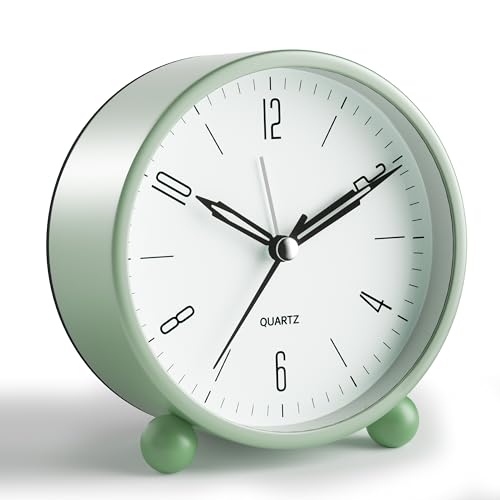
Analog clocks remain useful when you prefer a traditional dial and fewer settings. The Peakeep MHP-301-Aqua and JALL Di-AlCK20 both document four-inch faces, while their hands avoid the bright always-on effect associated with some LED displays. However, dial readability depends on room lighting and personal eyesight, so shoppers should not assume a four-inch face provides the same glanceability as two-inch digital numerals.
The MeesMeek foldable clock uses a 3.54-inch LCD display and adds date, weekday, and temperature information. The CHEREEKI clock also shows temperature, date, and day of the week. These displays are useful when more than the time matters, but additional information can make a small screen feel busier than a simple time-only clock.
Look for controllable alarm behavior
Alarm control includes volume range, sound progression, snooze duration, and the number of alarms. The Peakeep MHP6010, Peakeep MHP6020, and Acedeck T01 each document multiple volume levels. The MHP6010 and MHP6020 list five levels, while Acedeck lists three. That flexibility helps accommodate different sleeping arrangements, although this comparison does not test how loud any clock sounds in a real room.
Progressive alarms are another documented feature. The Peakeep MHP-9060 and MHP-301-Aqua describe alarms that become faster or louder, and CHEREEKI describes a gradually increasing sound. JALL states that its alarm can last up to 30 minutes. MeesMeek offers two volume levels plus weekday mode, which may be more useful for a weekday routine than an unusually broad volume range.
Snooze intervals vary. Acedeck and Srubambi document snooze without specifying a duration in the supplied listing points, while Peakeep’s digital models and MeesMeek specify nine minutes. The MHP-9060 specifies eight minutes, CHEREEKI five minutes, and Sharp five minutes. If snooze timing is important, verify the exact interval before buying rather than relying on a general product title.
Control brightness for sleep
A clock that is easy to read during the day can be distracting at night. Auto dimming is documented for Acedeck, Srubambi, and both selected Peakeep digital models. Acedeck adds three manual brightness levels and a display-off option; Peakeep MHP6020 provides four manual levels plus off; and MHP6010 documents three manual settings. These are strong choices when room brightness changes across the day.
Some clocks use illumination only when requested. Sharp provides a five-second blue backlight, and both analog clocks use a press-to-light night-light function. MeesMeek also lights for five seconds when the snooze button is pressed. These designs may suit sleepers who want a darker room, but they require a button press when checking the time at night.
The CHEREEKI model uses an automatic light sensor and keeps the display very low in darkness. Peakeep MHP-9060 offers a selectable night light with low, high, and off settings. These features are useful when a small amount of nighttime illumination is preferable to a completely dark display.
Consider controls, dimensions, and extras
Simple controls can matter as much as the display. Acedeck and Srubambi describe clearly labeled buttons, while Sharp places easy-to-use controls on top. MeesMeek uses six front controls and a large snooze button. Peakeep MHP6020 adds a key lock to prevent accidental presses while traveling. These details can reduce the need to turn a clock around or search through menus.
Measure the available surface before choosing a model. Srubambi documents a 4.88-inch length, MeesMeek states a compact foldable size, and Peakeep MHP6020 measures 5.4 inches long. Acedeck is 5.6 inches wide, while Peakeep MHP6010 is seven inches long. The analog clocks are four inches in diameter, but their listed depth and height still affect how they sit on a narrow nightstand.
Extra features should support your use rather than complicate it. Temperature information appears on Peakeep MHP-9060, MeesMeek, and CHEREEKI. Calendar information appears on MeesMeek and CHEREEKI. A wood case gives CHEREEKI a decorative angle, while the analog models provide a traditional look. None of these extras replaces the need to confirm battery type, alarm behavior, and display visibility for your room.
Final Recommendation
Peakeep Big-Number Battery Alarm Clock MHP6010 ranks first overall in this specification-based comparison under the published weighted criteria.
Acedeck Battery Operated Alarm Clock T01 is the first overall specification-based choice among these best battery alarm clocks. Its 1.8-inch digits, auto dimming, manual brightness settings, display-off option, three alarm-volume levels, snooze, and dual-power design create the most balanced feature set in the comparison. The four-AA requirement and advice to avoid rechargeable batteries are important setup considerations.
For maximum digital visibility, choose the Peakeep MHP6010 because its two-inch digits and five volume levels are clearly documented. Peakeep MHP6020 is a better fit for travel when a key lock, small footprint, and broad dimming controls matter. CHEREEKI is the distinctive decorative option, with a wood case, calendar information, temperature display, and included batteries.
The analog alternatives remain worthwhile when quiet operation and simplicity are priorities. Peakeep MHP-301-Aqua offers a silent movement and progressive alarm, while JALL provides a similarly quiet, basic format with a press-to-light function. Together, these are practical top battery alarm clocks for shoppers who do not need a bright digital display.
Frequently Asked Questions
What are the best battery alarm clocks for a power outage?
A true battery-operated model such as Acedeck, Peakeep MHP6010, Srubambi, or CHEREEKI can continue operating without a wall outlet when fitted with the required batteries. Check the battery type and whether cells are included. A clock described only as having battery backup may preserve settings without running its normal display or alarm, so it should not be treated as a fully cordless model.
Are battery alarm clocks better than plug-in clocks?
They are better when portability, outlet-free placement, or outage operation is the priority. Battery models can sit on a shelf, travel in a bag, or move between rooms without a cable. Plug-in clocks may offer larger displays, USB charging, or continuous power, but backup batteries often provide only limited functions. Choose based on whether you need standalone battery operation or simply memory protection.
Which selected clock is easiest to read from across a room?
The Peakeep MHP6010 documents two-inch digits, making it the clearest choice for shoppers prioritizing large numerals. Acedeck documents 1.8-inch digits, while Peakeep MHP6020 has a large LED display without a supplied digit-height measurement. The one-inch Sharp display and small LCD designs may be better for close bedside viewing than across-room reading.
Do battery alarm clocks have to stay lit all night?
No. Several selected designs document dimming or on-demand lighting. Acedeck, Srubambi, and the Peakeep digital clocks include automatic or manual brightness controls. Sharp, JALL, and Peakeep MHP-301-Aqua use a button-activated light, while CHEREEKI uses an automatic sensor. MeesMeek lights the display for five seconds when activated. These approaches let shoppers balance nighttime visibility with a darker sleep environment.
Confirm the battery size, quantity, inclusion status, and any manufacturer guidance. The selected clocks use AA or AAA batteries: analog models use one AA, Sharp and MeesMeek use two AAA, CHEREEKI uses three AAA, and several digital models use four AA or three AAA. Acedeck’s listing specifically recommends brand-name alkaline batteries and says not to use rechargeable batteries; comparable guidance should be checked for any model before setup.