Buying Guide
Choosing among the best glass alarm clocks starts with deciding whether you want a traditional analog face or a modern mirror-style digital display. The supplied listings include both types, but they are not interchangeable. Analog clocks emphasize decorative materials, quiet quartz movement, and battery portability. Digital models generally offer larger numerals, dimming, USB charging, and more alarm scheduling options.
Choose the face style first
Traditional glass-lens clocks use a transparent cover to protect an analog dial. Howard Miller Regent documents a beveled glass arch and glass base, while Westclox Big Ben, Fountain Designs Jensen, SHISEDECO, Veemoon, and both Maxspace entries document a glass lens or glass face. These designs suit rooms where the clock is also part of the decor.
Digital alternatives use mirror-style fronts rather than explicitly documented traditional glass lenses. Peakeep, JALL, and WulaWindy provide large LED numbers behind those surfaces. Their appeal is functional: a digital display avoids interpreting hands, and brightness settings help adapt the clock to dark or bright rooms. If the material itself is essential, verify the manufacturer’s exact surface construction.
Match readability to the room
For an analog clock, look for large numerals, strong contrast, and visibility aids. Westclox has a large white face with bold black numerals and luminous hands. Howard Miller adds Roman numerals, black hands, and luminous inserts. The Maxspace models use Arabic numerals, and SHISEDECO adds a button-activated backlight.
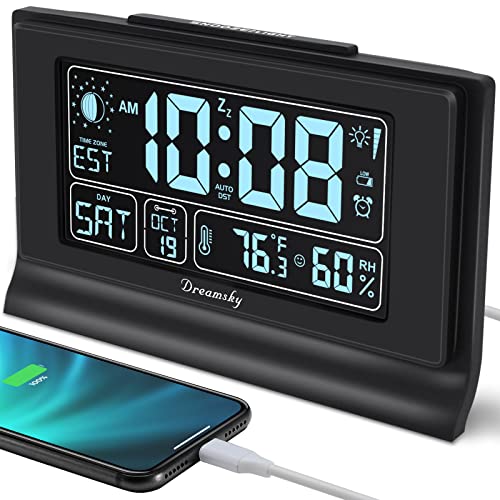
Digital clocks can be easier to scan from a distance when their displays are large. Peakeep documents a six-by-three-inch display, JALL uses a 6.7-inch mirror-like screen, and WulaWindy lists a 6.5-inch LED screen. Brightness control matters at night: Peakeep has six levels, JALL has four, and WulaWindy documents manual and automatic adjustment.
Consider sound and wake-up behavior
Movement noise is a major dividing line. Howard Miller, Maxspace, Fountain Designs, SHISEDECO, and Veemoon describe quiet or non-ticking quartz movement. That makes them more suitable for sleepers or workspaces where a recurring tick could be unwelcome. Quiet movement does not necessarily mean a quiet alarm, so check the alarm description separately.
Westclox emphasizes a loud alarm. Peakeep provides five alarm-volume levels, while JALL documents five volume levels ranging from 55 to 100 dB. WulaWindy lists a large snooze control but does not document adjustable alarm volume. Do not assume that every glass-front analog clock offers crescendo, snooze, or volume adjustment; those features must be listed for the specific model.
Review power requirements
Battery operation is convenient for flexible placement. Westclox, Maxspace, SHISEDECO, and Fountain Designs specify AA battery operation, although batteries are not included in the supplied evidence. Digital models generally need a cord for normal operation. Peakeep includes an AC/DC adapter and uses batteries for backup, while JALL documents memory support and USB charging. WulaWindy states that USB power is required for operation and that its battery is for memory.
Think about placement and proportions
Measure the available surface before selecting a clock. Howard Miller is listed at 6.25 inches high and 5 inches wide, making it a noticeable decorative piece. Westclox is listed at 5 inches high and 3.75 inches long. Fountain Designs documents a removable stand and hanging hole, so it supports more placement options than most analog entries.
Compact clocks such as SHISEDECO and the Maxspace designs are easier to fit on crowded nightstands. Digital mirror clocks are often wider and flatter, with Peakeep listed at six inches long and JALL at roughly 6.4 inches long. A broad digital screen may improve viewing but occupy more horizontal space.
Separate appearance from documented function
A glass or mirror surface can make an alarm clock look like room decor, but appearance does not establish alarm quality. For a decorative analog centerpiece, Howard Miller, Fountain Designs, and Westclox offer clearly documented design identities. For a retro metal frame, Maxspace and SHISEDECO fit that style. For a digital room accent, JALL and WulaWindy add mirror-like fronts, while Peakeep focuses on display control.
This is a specification-based guide, not a hands-on test. It does not verify actual alarm loudness, long-term durability, glass thickness, display glare, or setting difficulty beyond the supplied listing information. Confirm the current product page for included batteries, dimensions, warranty terms, and exact face material before ordering.
Final Recommendation
JALL Slim LED Mirror Alarm Clock ranks first overall in this specification-based comparison under the published weighted criteria.
JALL Slim LED Mirror Alarm Clock ranks first under the published weighted criteria in this specification-based comparison.
The final choice among the best glass alarm clocks depends on the features that match your intended use. Howard Miller Regent Table Clock is the clearest fit for shoppers seeking traditional beveled-glass construction, a glass base, silent-sweep movement, readable dial details, and versatile tabletop placement. Choose Westclox Big Ben if a loud alarm and large analog dial matter more than digital scheduling. Choose Fountain Designs Jensen if wall-and-tabletop flexibility matters.
Maxspace and SHISEDECO are compact retro alternatives, while Veemoon is the more rustic choice. Among the top glass alarm clocks with modern digital features, JALL documents dual alarms, several scheduling modes, dimming, memory, and two USB ports. Peakeep suits shoppers who want six-level brightness and adjustable alarm volume. WulaWindy keeps operation simple with three buttons and a large snooze control, but its listing requires USB power for normal use.
Shoppers who require actual glass should prioritize models whose listings explicitly say glass lens, glass face, glass cover, or beveled glass. The digital selections are mirror-surface alternatives, not proof that every reflective display is made from glass.
Frequently Asked Questions
Are the best glass alarm clocks always analog?
No. The analog products explicitly document glass lenses, glass faces, glass covers, or beveled glass construction. Peakeep, JALL, and WulaWindy are digital alternatives with mirror-style surfaces. If actual glass is essential, confirm the material specification rather than relying on a reflective appearance.
Which selected clocks are described as quiet?
Howard Miller, both Maxspace models, Fountain Designs, SHISEDECO, and Veemoon describe quiet, non-ticking, or silent-sweep quartz movement. The listings do not provide independent noise measurements, so this conclusion is limited to the supplied feature descriptions.
Which selected model has the most alarm scheduling flexibility?
JALL documents dual alarms and separate weekday, workweek, and weekend modes. Peakeep also documents multiple alarm-volume settings and snooze. The analog models generally provide simpler built-in alarms, with fewer controls documented in their listings.
Do these clocks work during a power outage?
The answer depends on the model. Battery-operated analog clocks such as Westclox and Maxspace do not rely on an outlet during normal use. Peakeep, JALL, and WulaWindy document battery or memory support, but their listings also describe corded or USB-powered normal operation. Check whether the backup powers the display, preserves settings, or supports only the alarm.
What should I verify before buying?
Confirm the exact face material, dimensions, battery type, whether batteries are included, alarm controls, brightness options, and placement method. For digital mirror models, also check whether the clock is USB-only or includes an AC adapter.