Buying Guide
The best electric-start generators in this comparison are not interchangeable. They range from compact inverter units for RVs and electronics to large-frame tri-fuel machines intended for substantial home backup. Start by identifying the loads you need to run at the same time, then compare starting and continuous output rather than relying only on the largest wattage in a product title.
Match starting and continuous watts
Starting watts cover the temporary surge created when a motor-driven appliance begins operating. Continuous, rated, or running watts describe the power the generator is designed to provide during ongoing operation. The difference matters for refrigerators, sump pumps, air conditioners, compressors, and power tools, which may need additional starting capacity. The Generac 12,500-Watt Tri-Fuel Portable Generator documents 12,500 starting watts and 9,500 running watts on gasoline, while the WEN DF8000X lists 8,000 surge and 6,500 rated watts. Smaller inverter models provide less headroom but may be easier to transport.
Make a list of essential loads and their starting requirements before buying. Do not assume that a high peak figure means the generator can continuously supply the same amount. Confirm whether your planned connection requires 120V, 240V, or both.
Choose the fuel arrangement
Gasoline-only models can be straightforward, but dual-fuel generators let you choose between gasoline and propane. The selected WEN, Westinghouse, DuroStar, and Champion products document dual-fuel operation. Propane may be useful when stored fuel availability or longer storage life is important, but the listings show that propane output can differ from gasoline output. Check the individual ratings instead of treating the two fuels as equivalent.
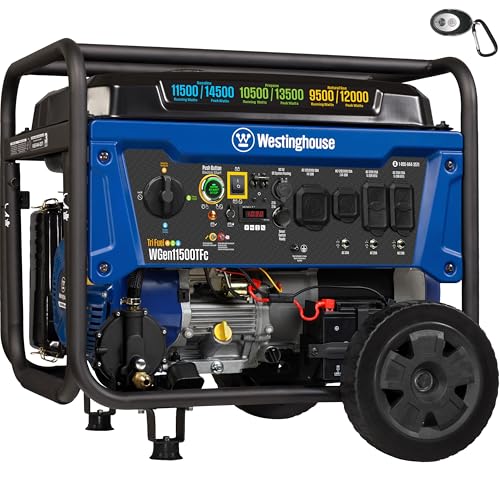
Tri-fuel models add natural gas. The Generac and Westinghouse WGen11500TFc support gasoline, propane, and natural gas according to their listings. This can be useful for a fixed home-backup plan, but natural-gas connection requirements are not detailed here. Confirm installation and transfer-equipment needs with a qualified professional before connecting a generator to household circuits.
Compare outlet and transfer-switch connections
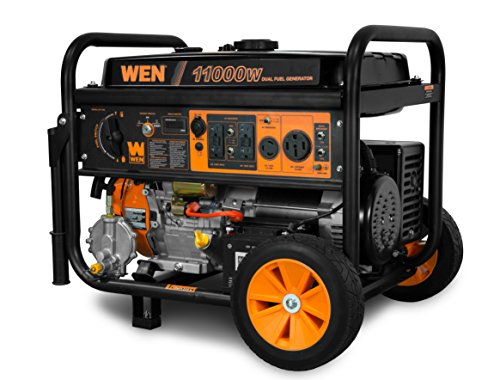
Outlet design should follow the equipment you intend to power. A 30A RV receptacle is useful for compatible travel trailers, while a 120/240V twist-lock or 50A receptacle may be relevant to transfer-switch installations. The DuroStar DS13000MX includes a 50A outlet and is described as transfer-switch ready. The WEN DF1100T includes 120V/240V capability, a 50A receptacle, and a 120V 30A twist-lock outlet. The Champion and WEN inverter selections focus more on 120V household, RV, USB, and DC connections.
Transfer-switch readiness in a listing does not mean every installation is automatically complete. Check the receptacle type, amperage, voltage, neutral configuration, and local electrical requirements. Never connect a portable generator to household wiring through an improvised method.
Decide whether an inverter design fits
Inverter generators are represented by the WEN DF680iX, Champion 201319, and WEN 56480iX selections. The listings describe clean or stable power for sensitive electronics, and the Champion and Westinghouse inverter listings provide specific low-THD claims. Inverter construction can suit electronics, camping, and RV use, but the selected conventional-frame models generally offer more output and more extensive 240V or transfer-switch connections.
The WEN DF680iX has a documented bonded-neutral 240V configuration for low-power Level 2 electric-vehicle charging. That is a specialized feature, so verify vehicle, charger, grounding, and connection compatibility before purchase. The Champion supports parallel operation with an optional kit, which can provide an expansion path without immediately choosing a much larger unit.
Review safety and monitoring features
Look for automatic low-oil shutdown, overload protection, carbon-monoxide monitoring, covered outlets, and clear operating displays. Several selected models document CO shutdown systems: WEN calls its feature Watchdog, Champion uses CO Shield, DuroStar lists CO Alert, and Generac lists COsense. These are useful safety features, but they do not replace outdoor operation, ventilation, and safe placement.
Monitoring also varies. The Generac includes a digital hour meter and fuel gauge; the Westinghouse WGen9500DF lists a display for voltage, frequency, and lifetime hours; the Champion includes an Intelligauge; and several Westinghouse models list rotating data displays. These features help track operation, but they are not substitutes for reading the manual or following maintenance instructions.
Consider movement, storage, and runtime
Large output usually comes with a heavier frame. The Generac, DuroStar, and Westinghouse WGen11500TFc are all listed above the current price, making them better viewed as movable-with-assistance units than casual camping equipment. By comparison, the WEN 56480iX is listed at the current price, and the WEN DF680iX at the current price.
Runtime figures depend on fuel, load, and operating mode, so compare like-for-like figures. The WEN DF475T lists up to 11 hours at half load, the WEN DF8000X up to 10.5 hours at half load, and the Champion lists different runtime figures for gasoline and propane. Fuel gauges, economy modes, and fuel shutoff features can make operation easier, but the supplied data does not establish real-world runtime beyond the published claims.
Final recommendation
Generac 12,500-Watt Tri-Fuel Portable Generator ranks first overall in this specification-based comparison under the published weighted criteria.
The best electric-start generators differ according to the documented features that match your intended use. The Generac offers fuel choice, AVR, COsense shutdown, a 50A outlet, 9,500 gasoline running watts, and electric start. Its weight and larger footprint make it less suitable for casual transport.
For greater output, the Westinghouse WGen11500TFc and DuroStar DS13000MX are specification-based alternatives. The Westinghouse adds natural-gas support and high listed peak capacity, while the DuroStar combines high output with remote start, a 50A connection, and CO Alert. The Westinghouse WGen9500DF and WEN DF1100T are useful choices when dual-fuel operation and substantial 120V/240V connectivity matter without selecting the largest tri-fuel models.
Among the top electric-start generators for midrange use, the WEN DF8000X and Westinghouse 6,600-watt model offer a useful mix of output, outlets, and safety features. RV users should examine the WEN DF680iX, Champion 201319, and WEN 56480iX: each has an RV-oriented connection, while the WEN DF680iX adds a documented EV-charging-oriented configuration. Choose based on the loads, fuel, outlet type, and handling requirements you can verify for your installation.
Frequently Asked Questions
What are the best electric-start generators for whole-home backup?
The Generac 12,500-Watt Tri-Fuel Portable Generator, Westinghouse WGen11500TFc, DuroStar DS13000MX, Westinghouse WGen9500DF, and WEN DF1100T are specification-aligned matches in this selection for larger backup loads. They document substantial starting output and include connections intended for transfer-switch or higher-amperage use. The appropriate choice depends on the loads, fuel source, and electrical setup, not just the peak-watt figure.
Is dual-fuel or tri-fuel better?
Tri-fuel provides the broadest documented fuel choice because it adds natural gas to gasoline and propane. Dual-fuel models may be simpler when natural-gas connection is not part of the plan. Compare the output on each fuel: several listings specify lower propane figures than gasoline figures, so the fuel option can affect usable capacity.
Are inverter generators better for sensitive electronics?
An inverter model may be a good fit when the listing documents clean or low-THD power and your loads are moderate. The WEN DF680iX, Champion 201319, and WEN 56480iX are selected inverter examples. Larger conventional-frame models may provide more output and broader 240V connections. Match the generator’s documented configuration to your electronics, RV, or home-backup requirements.
What safety features should I look for?
Carbon-monoxide shutdown, low-oil shutdown, overload protection, covered outlets, and operating displays are useful features to compare. The Generac, DuroStar, Champion, and selected WEN models document CO-related shutdown systems. Regardless of equipment, operate a portable generator outdoors and follow the manufacturer’s clearance, grounding, fueling, and connection instructions.
Can I use a generator with a transfer switch?
Only when the generator, transfer equipment, receptacle, wiring, and installation are compatible. Several selected products are described as transfer-switch ready, including the Generac, DuroStar, Westinghouse WGen9500DF, and WEN DF1100T. Confirm voltage, amperage, neutral configuration, and local requirements with a qualified electrician before connecting a generator to a building.