Buying Guide
The best bi-pin fluorescent light bulbs should be selected by the complete lamp code and fixture requirements, not by length alone. A tube can have the same approximate length as another bulb but use a different diameter, pin base, wattage, or ballast system. Start by removing the existing lamp and recording its printed designation, such as F32T8, F17T8, F13T5, or F14T12. That code usually identifies the family, wattage, and tube format.
Match the pin base first
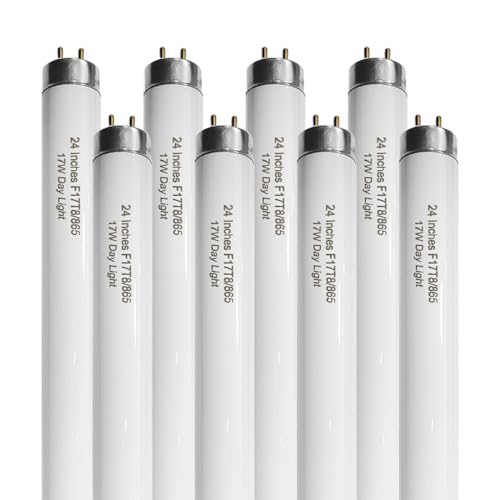
The two base families represented here are G13 medium bi-pin and G5 miniature bi-pin. G13 appears on the selected T8 and T12 lamps, including the Luxrite LR20732, Circle F17T8/841, Konideke F32T8/841, Philips 423087, Konideke F17T8/865, and Flyercatch F14T12. G5 appears on the compact T5 products from New Lights, Konideke, and Circle.
These bases are not interchangeable. A G5 lamp is designed for a smaller socket arrangement than a G13 tube, even when both products are fluorescent and have two pins at each end. Check the socket itself and the old lamp marking before ordering. If the fixture has a starter or ballast, its requirements also matter. The Luxrite listing specifically requires a T8 fluorescent ballast, while the Circle 24-inch T8 listing identifies instant-start and rapid-start compatibility. Other listings advise checking or replacing a failed ballast or starter when flickering or failure continues.
Confirm tube diameter and length
Length should be measured from end to end, including the pin-to-pin dimension where relevant. The selected products cover compact tubes, 18-inch and 21-inch lamps, 24-inch tubes, and 48-inch linear lamps. A 24-inch T8 is not a substitute for a 48-inch T8, and a T5 tube should not be treated as a T8 replacement simply because the overall length appears close.
Diameter is equally important. T8 tubes are identified in the supplied listings as approximately one inch in diameter, while the Flyercatch F14T12 listing specifies a 1.5-inch T12 diameter. The Luxrite product expressly warns that it is not compatible with T12 fixtures. Measure the existing tube or compare its printed family code before buying. The short F14T12 is useful only when both the length and larger T12 format match the fixture.
Choose color temperature for the room
Color temperature affects the appearance of the space. The selected products include warm white at 3,000K, cool white at 4,100K, and daylight at 6,500K. Warm white, as documented for the Circle F8T5/WW, Konideke F8T5/WW, and Flyercatch F14T12, is positioned for kitchens, bathrooms, vanities, closets, and other areas where a softer appearance is preferred.
The 4,100K tubes from Luxrite, Circle, Konideke, and New Lights are a middle-ground choice for offices, garages, counters, workshops, and general utility lighting. Daylight products such as Konideke F17T8/865 and Flyercatch F15T8-D are specified for brighter, cooler applications including displays, reading, plants, and aquarium use. The ideal choice depends on the existing fixture and the visual effect required; a higher Kelvin number does not automatically mean greater brightness.
Compare lumens and wattage together
Lumens describe listed light output, while wattage describes electrical consumption. Compare both rather than assuming a higher wattage always produces more light. In this selection, the 48-inch T8 products list around 2,800 to 2,850 lumens at 32W. The 24-inch T8 tubes list approximately 1,400 to 1,460 lumens at 17W. Compact tubes are lower in absolute output but can be appropriate for under-cabinet or enclosed fixtures.
The Circle F8T5/WW and Konideke F8T5/WW list 460 lumens, while New Lights F13T5/CW lists 1,000 lumens. The short Flyercatch F14T12 lists 1,200 lumens. These differences show why the intended application matters. For a task area, compare the lamp’s documented lumens with the original tube. For a decorative or compact fixture, a lower-output lamp may be appropriate if it matches the original specification.
The supplied listings state rated lives from 9,000 to 20,000 hours. Circle’s 24-inch T8 and 12-inch T5 products list up to 20,000 hours, while Konideke’s 48-inch T8 lists 15,000 hours and several other tubes list 10,000 to 12,000 hours. Rated life can help estimate replacement frequency, but it is not a guarantee of service in every fixture. Ballast condition, operating cycles, temperature, and installation can affect actual operation.
A longer life is particularly useful in hard-to-reach under-cabinet, closet, or commercial fixtures. Pack size also matters. Six- and eight-pack options provide spares, while a single lamp may be more suitable when only one tube is needed or when the fixture is unusual.
Check ballast, dimming, and fixture condition
Most selected products are traditional fluorescent lamps, not LED retrofit tubes. Confirm that the fixture still has a compatible fluorescent ballast and starter arrangement. The Luxrite listing explicitly says it is not an LED retrofit. Several compact listings caution that a failed ballast can prevent a new tube from lighting. If an old lamp flickers, lights at only one end, or fails after replacement, the fixture may need attention rather than another bulb.
Dimming is another specification to verify. The Luxrite and Circle F8T5/WW listings identify their lamps as non-dimmable. Do not assume a fluorescent replacement will work with an existing dimmer unless the bulb and fixture documentation support it. Turn the power off before removing or installing a tube, and handle fluorescent glass carefully.
How this comparison was scored
This is a specification-based comparison using public listing data, not a hands-on test and not a summary of customer opinions. The editorial scores weigh fixture and base compatibility at 25%, size and format clarity at 20%, light output and color information at 20%, rated life at 20%, and application flexibility at 15%. No rating, review, purchase, or marketplace popularity information was used in the public criteria. Products with clearer evidence for matching a real fixture received stronger scores.
Final Recommendation
Circle F8T5/WW 12-Inch Warm White Tube ranks first overall in this specification-based comparison under the published weighted criteria.
The final choice among the best bi-pin fluorescent light bulbs depends on the documented features that match your intended use.
Luxrite LR20732 F32T8/841 is the highest-scoring returned product and the first overall specification-based choice for a compatible 48-inch T8 fixture. It documents the G13 base, 32W rating, 4,100K color, 2,800-lumen output, 13,000-hour life, and T8 ballast requirement in one listing.
For a 24-inch fixture, Circle F17T8/841 is the most specification-aligned all-around specification match because it combines G13 compatibility, 1,400 lumens, 4,100K light, CRI 83, and a stated life of up to 20,000 hours. Circle F8T5/WW is the more targeted pick for a 12-inch G5 under-cabinet fixture and warm 3,000K light. New Lights F13T5/CW suits a 21-inch G5 fixture when higher listed output is useful.
The top bi-pin fluorescent light bulbs in this comparison span T5, T8, and T12 formats, so the right choice remains dependent on the original tube code and fixture. Buyers needing daylight can consider Konideke F17T8/865 or Flyercatch F15T8-D, while the Philips 423087 addresses a specialized U-bent T12 design. Always verify the base, length, diameter, ballast, wattage, and color before purchase. These checks are more important than choosing a bulb based on appearance or pack size alone.
Frequently Asked Questions
What are the best bi-pin fluorescent light bulbs for a 48-inch T8 fixture?
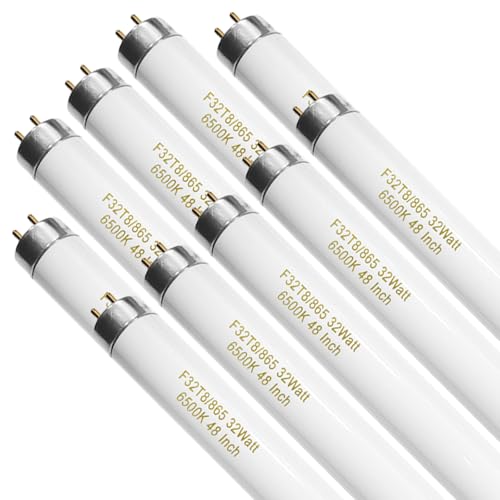
Luxrite LR20732 F32T8/841 and Konideke F32T8/841 are the selected 48-inch T8 options. Both use a G13 medium bi-pin base and specify 32W and 4,100K cool white light. Luxrite lists 2,800 lumens and a 13,000-hour life, while Konideke lists 2,850 lumens and a 15,000-hour average life. Confirm that the fixture uses a T8 fluorescent ballast before ordering.
Is a G5 miniature bi-pin bulb interchangeable with a G13 bulb?
No. G5 and G13 describe different pin-base sizes and fixture socket arrangements. The Circle F8T5/WW, Konideke F8T5/WW, and New Lights F13T5/CW use G5 miniature bi-pin bases, while the selected T8 and T12 lamps use G13 medium bi-pin bases. Match the replacement to the old tube and socket rather than relying on the number of pins alone.
Should I choose 3,000K, 4,100K, or 6,500K fluorescent light?
Choose based on the desired appearance and the original fixture specification. The Circle F8T5/WW, Konideke F8T5/WW, and Flyercatch F14T12 provide 3,000K warm white light. Several T8 and T5 options provide 4,100K cool white light for general utility areas. Konideke F17T8/865 and Flyercatch F15T8-D provide 6,500K daylight light for selected display, plant, aquarium, reading, or task applications.
Can a new fluorescent tube fix flickering?
It may not. A replacement tube can address a failed lamp, but the supplied listings also note that a defective ballast or starter may prevent lighting or cause flickering. If the new tube still flickers, lights at one end, or fails to start, inspect the fixture’s ballast and starter. Turn off power before installation or removal.
How do I identify the correct replacement size?
Read the original lamp code and measure the tube. Confirm the family, such as T5, T8, or T12, as well as the overall length, diameter, wattage, base, and color temperature. For example, the Luxrite listing distinguishes a 48-inch T8 from T12 products, while the Flyercatch F14T12 listing documents a 14.75-inch length and 1.5-inch diameter. Matching every major specification reduces the risk of ordering an incompatible tube.