Buying Guide
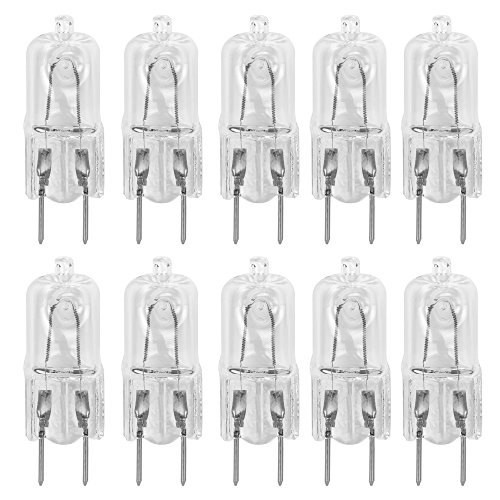
Choosing the best bi-pin incandescent bulbs starts with matching the socket, voltage, and physical envelope. A two-pin base describes the contact arrangement, not a universal fit. G4, G8, and G9 lamps use different pin spacing or contact shapes, and miniature indicator lamps can be much smaller than household capsule bulbs. Read the fixture label and compare the old bulb’s marking before choosing a replacement.
Confirm the base family
G4 bulbs are commonly used in compact low-voltage fixtures. The 12Vmonster soft-frosted G4 is listed for 12-volt AC or DC lamps, while the abulber G4 is specifically described for 12-volt oven, range-hood, and microwave applications. These products should not be treated as interchangeable with 120-volt lamps simply because both use two pins.
G8 bulbs generally use an 8 mm pin spacing and appear in puck lights, under-cabinet fixtures, range hoods, and some appliances. The Feit Electric BPQ20/G8/RP, AHEVO G8, Flaspar G8, and 12Vmonster G8 listings identify the G8 format. Check the fixture voltage separately: these products are listed for 120-volt use, while a low-voltage fixture needs a bulb designed for its transformer output.
G9 bulbs use looped contacts rather than the straight-pin style found on many G4 and G8 capsules. The Lacnooe and Sunlite products document G9 bases. Measure the socket and compare the capsule length, especially in chandeliers and decorative fixtures.
Match voltage and wattage
Voltage is the most important electrical match. A 120-volt bulb belongs in a compatible household-voltage fixture; a 12-volt bulb belongs in a low-voltage circuit. Using the wrong voltage can lead to poor operation, premature failure, or an unsuitable electrical load. The CEC Industries 7371, for example, is a 12-volt miniature lamp with a 480 mW rating, making it a specialist component rather than a substitute for a 20-watt cabinet bulb.
Wattage also affects heat and fixture compatibility. A 50- or 60-watt halogen capsule may provide more listed light, but it can place a greater thermal load on a small enclosure than a 20-watt lamp. Follow the fixture’s maximum wattage marking. The 20-watt Feit G8 options suit applications that specify a lower lamp rating, while the AHEVO, Sunlite, and Lacnooe products serve fixtures designed for higher-wattage capsules.
Compare light output and color
Lumens provide a useful comparison of listed brightness. The selected listings include products rated at 170, 280, 500, 550, 660, and 900 lumens. Treat those figures as listing specifications and compare them with the original bulb or fixture requirement.
Color temperature is another practical choice. The 2700K and 2800K products offer a warmer appearance, while 3000K is a cleaner warm white. Sunlite’s 3200K specification is brighter in character than the warmest choices. High CRI claims are useful where color matters: Feit Electric lists CRI 99 or 90-plus depending on the model, and AHEVO, Flaspar, and Lacnooe list CRI 100. These figures describe color-rendering capability, not brightness.
Lens treatment changes the appearance of the light. Clear capsules are common in directional or decorative fixtures, while Sunlite’s frosted bulb and 12Vmonster’s soft-frosted G4 are intended to diffuse the source. Make sure the finish suits the fixture and desired visual effect.
Check dimming and fixture controls
If the fixture has a dimmer, choose a product whose listing explicitly supports dimming. The Feit, AHEVO, Flaspar, Lacnooe, Sunlite, and 12Vmonster G8 products identify dimming support in the supplied evidence. The abulber G4, 12Vmonster G4, and CEC miniature lamp do not provide the same confirmation, so they should not be presented as documented dimmable choices.
Compatibility still depends on the fixture and control. A bulb marked dimmable may require a suitable dimmer and correctly matched voltage. If a product is intended for an oven or range hood, confirm that the appliance socket and heat environment meet the listing’s intended use rather than assuming general household dimmer compatibility.
Consider service life and replacement quantity
A stated life rating helps estimate maintenance, but it is not a guarantee of actual service in every fixture. AHEVO, Lacnooe, Sunlite, and Feit BPQ20/G8/RP listings specify up to or around 2,000 hours. The CEC miniature bulb lists a 20,000-hour average life, but its tiny 480 mW format serves a different purpose. The 12-bulb abulber and Sunlite packs can make sense when a fixture has many sockets or the bulb is used in an appliance that requires periodic replacement.
Pack size should not override compatibility. A large pack of the wrong base or voltage creates more unused stock than useful coverage. First match the socket, voltage, shape, and wattage; then select a quantity that fits the number of fixtures you maintain.
Verify dimensions before ordering
Bi-pin bulbs can look similar while differing in length, diameter, or pin arrangement. The selected products include compact T3 and T4 capsules, G9 looped-pin bulbs, and the much smaller T-1 3/4 CEC lamp. Compare the listed dimensions with the fixture cavity and any glass cover. This is especially important when replacing one capsule with another from a different base family.
Final Recommendation
Lacnooe G9 60W 120V T4 JCD ranks first overall in this specification-based comparison.
Feit Electric BPQ20/G8/RP 20W T4 JCD is the first overall specification-based choice among these best bi-pin incandescent bulbs because it combines a clearly identified G8 and 120-volt format with color-rendering information, dimming support, compact sizing, and a documented service-life figure. For higher-output G8 lighting, AHEVO G8 50W 120V T4 JCD offers a higher listed output and CRI 100. Lacnooe G9 60W 120V T4 JCD is the suitable choice when the fixture requires a looped G9 base.
The top bi-pin incandescent bulbs are not interchangeable across base families or voltages. Use abulber G4 for the documented high-temperature, 12-volt oven role; choose the 12Vmonster soft-frosted G4 for a diffused low-voltage capsule; and reserve the CEC Industries 7371 for miniature 12-volt equipment. For a multi-bulb installation, Sunlite, AHEVO, Flaspar, or 12Vmonster G8 pack options may provide more replacement coverage, subject to the fixture’s markings.
Frequently Asked Questions
What are the best bi-pin incandescent bulbs for a 120-volt G8 fixture?
The Feit Electric BPQ20/G8/RP, AHEVO G8, Flaspar G8, and 12Vmonster G8 products all document G8 compatibility and 120-volt use. Select among them by wattage, output, color temperature, dimming support, and pack format. Confirm the fixture’s maximum wattage before choosing the 50-watt or higher-wattage options.
Are G4, G8, and G9 bulbs interchangeable?
No. They are different bi-pin formats with different contact arrangements or spacing. A G4 replacement should match a G4 socket and its required voltage; a G8 product should match a G8 fixture; and a G9 capsule requires the appropriate looped-contact socket. Physical resemblance is not enough to establish compatibility.
Which bi-pin bulb is suitable for an oven?
The abulber 12V 20W G4 halogen is the selected product with explicit oven-focused evidence, including a stated high-temperature design and use up to 300°C. Confirm the appliance model, socket, voltage, and wattage marking before installation. A general-purpose cabinet bulb should not be assumed to have the same heat suitability.
Does a bi-pin bulb need to be dimmable?
Only if you plan to use it with a dimmer. Several selected halogen products explicitly list dimming support, including models from Feit Electric, AHEVO, Flaspar, Lacnooe, Sunlite, and 12Vmonster. If the listing does not document dimming compatibility, choose a confirmed dimmable alternative or use a simple on-off control.
How do I choose between clear and frosted capsules?
Clear capsules may preserve a more direct or decorative appearance, while frosted products can provide a softer, more diffused look. Sunlite documents a frosted finish, and the 12Vmonster G4 is described as soft frosted. The correct choice depends on the shade, reflector, and visual effect of the existing fixture.