Buying Guide
Choosing the best boom headphones starts with the microphone, but the right model also depends on connection type, wearing style, device compatibility, and the controls you need. The products above range from wireless work headsets to simple classroom sets, so comparing the documented specifications is more useful than treating every boom headset as interchangeable.
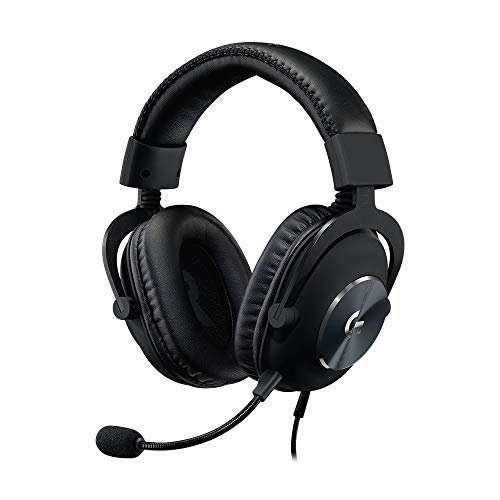
A boom microphone places the pickup point near the speaker’s mouth and can be practical for calls, games, lessons, and voice recording. The Back Bay Audio ClearCall 70 and Logitech G PRO X use detachable boom microphones. That can be useful when you want a cleaner headphone-only setup after a call or game. The JLab JBuddies Play uses a retractable boom, allowing the microphone to be stored inside the headset when it is not needed.
Attached microphones can still be convenient. The Logitech H390 has a rotating microphone that tucks away, while the Logitech G321 uses a flip-to-mute boom. The JBL Quantum 100 lists a detachable directional microphone, and the Cyber Acoustics AC-204 uses an ambidextrous boom that can suit different microphone positions. For school use, SIMOLIO’s 330-degree swiveling microphone and Barks’ rotating microphone provide positioning features suited to shared or changing users.
Choose wireless or wired connectivity
Wireless headphones are convenient when you want to move around or switch between a computer and phone. The ClearCall 70 is a Bluetooth model listed as compatible with PC, Mac, iPhone, and Android. The Logitech G321 adds Bluetooth to Lightspeed wireless, giving it two documented wireless paths. The JLab JBuddies Play combines Bluetooth with an AUX cable, which is useful for consoles or situations where a wired connection is preferred.
Wired headsets remain practical when battery charging is undesirable. The Logitech H390 connects through USB-A and is described as plug and play, while the Logitech G PRO X includes a USB external sound card and a separate mobile cable. The JBL Quantum 100, SIMOLIO, Cyber Acoustics AC-204, and Barks use 3.5mm connections. Check whether your computer has a combined headset jack or separate microphone and headphone ports. The AC-204 includes a Y-adapter, and SIMOLIO lists a Y-audio adapter for compatible desktop setups.
Match the design to the environment
Over-ear cups can provide a more enclosed wearing style. The ClearCall 70 lists soft over-ear cups, while the Logitech G PRO X includes memory-foam ear pads in two material choices. The JBL Quantum 100 also lists memory-foam ear cushions. These features may be useful for longer sessions, although the supplied data does not establish how any headset feels in actual use.
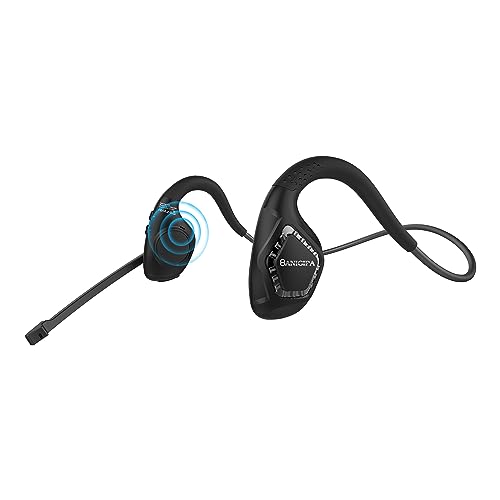
Open-ear construction is a different choice. The BANIGIPA G2 uses air conduction and an open-ear design, with a listed weight of 28 grams. This avoids the enclosed ear-cup format, but open-ear headphones may provide less passive isolation than over-ear models. For users who prefer a lightweight design for calls, the G2 offers a documented alternative to conventional headsets.
For children and students, fit and handling features may matter more than advanced gaming functions. SIMOLIO lists a retractable headband, foldable construction, and a carrying pouch. JLab specifies cushion support and a design for ages 6 and up. Barks lists an adjustable headband for student sizes from elementary through high school. The best boom headphones for a classroom should also match the way devices are shared and stored.
Mute controls reduce the need to open software during a call. The H390 places volume and mute controls inline. JLab includes a quick-mute button, Logitech G321 provides flip-to-mute operation, and SIMOLIO lists one-key mute. These controls are useful for online lessons and team communication.
Some models list volume-limiting features rather than ordinary volume controls. JLab documents an 85 dB regulator, while SIMOLIO lists 75, 85, and 94 dB settings. These are specification features, not a substitute for sensible listening habits, and the settings should be selected for the user’s age and environment.
Gaming headsets can include features that are unnecessary for office calls. The Logitech G PRO X lists Blue Voice processing, a USB sound card, downloadable EQ profiles, onboard EQ storage, and surround-sound support requiring specified software and hardware. The JBL Quantum 100 lists compatibility with Windows Sonic Spatial Sound. The Logitech G321 emphasizes wireless gaming, Bluetooth, a 16 kHz microphone specification, and simple physical controls.
For school or office use, simpler connectivity may be preferable. The H390 requires no software installation for its listed USB-A plug-and-play setup. The AC-204 uses an analog plug and includes an adapter. Barks is oriented toward shared classrooms and testing, with individually bagged units. These examples show why a feature-heavy gaming headset is not automatically the right choice for every buyer.
Check included accessories and limitations
A product’s useful range depends on what is included. The Logitech G PRO X includes a carrying bag, USB sound card, mobile cable, and two ear-pad options. SIMOLIO includes a carrying pouch and Y-audio adapter. The JLab and JBL listings document cables that support wired use, while the ClearCall 70 listing emphasizes removable microphone use and Bluetooth compatibility.
Also note what the listing does not establish. Stated battery life is available for the ClearCall 70, JLab JBuddies Play, and Logitech G321, but not every wireless model provides a runtime figure in the supplied data. Noise-canceling language may describe the microphone rather than active noise cancellation for the listener. Avoid assuming a feature beyond the wording of the listing.
Final Recommendation
Back Bay Audio ClearCall 70 ranks first overall in this specification-based comparison under the published weighted criteria.
Back Bay Audio ClearCall 70 is the first overall specification-based choice in this comparison.
The final choice among the best boom headphones depends on the documented features that match your intended use. The ClearCall 70 suits buyers seeking wireless work headphones with a removable boom microphone, over-ear cups, claimed 45-hour battery life, and broad device compatibility. The Logitech G PRO X fits PC users who want software-assisted microphone and EQ features, while the Logitech G321 is a wireless gaming alternative with Lightspeed and Bluetooth.
Among the top boom headphones for younger users, JLab JBuddies Play adds volume regulation, Bluetooth, AUX connectivity, and a retractable microphone. SIMOLIO is the classroom-oriented choice when volume settings and a swiveling boom are priorities. For straightforward computer calls, Logitech H390 keeps setup simple with USB-A and inline controls. BANIGIPA G2 is the open-ear option, while Cyber Acoustics AC-204 and Barks serve basic analog and shared-classroom needs.
Before buying, confirm the device port, required cable type, microphone preference, and whether the headset will be used by one person or distributed among students. The specifications support different use cases, but they do not replace hands-on testing of comfort, sound, or microphone performance.
Frequently Asked Questions
What are the best boom headphones for work calls?
The Back Bay Audio ClearCall 70 is the most specification-aligned specification-aligned choice for wireless work because it lists Bluetooth, a removable boom microphone, over-ear cups, sound modes, and compatibility with computers and mobile devices. The Logitech H390 is a simpler USB-A alternative with inline mute and volume controls.
Are wired or wireless boom headphones better for gaming?
It depends on the setup. Wireless models such as the Logitech G321 and JLab JBuddies Play allow movement and list Bluetooth-related features. Wired models such as the Logitech G PRO X and JBL Quantum 100 avoid wireless charging and offer direct cable connections. Check the gaming platform and available ports before choosing.
Which best boom headphones have a detachable microphone?
The Back Bay Audio ClearCall 70 and Logitech G PRO X list removable or detachable boom microphones. The JBL Quantum 100 also lists a detachable directional microphone. A detachable design is useful when you want to use the headphones without the boom attached, but the supplied data does not indicate how often removal should be performed.
Are open-ear boom headphones suitable for calls?
The BANIGIPA G2 is the selected open-ear model and lists Bluetooth 5.4, a 270-degree rotating boom microphone, and air-conduction operation. Its open-ear design may suit users who prefer a less enclosed fit, but it may provide less passive isolation than an over-ear headset. Consider the surrounding noise and your preferred wearing style.
What should schools check before buying boom headsets?
Schools should check connection type, fit range, microphone positioning, cable durability, cleaning features, and whether a bulk pack is appropriate. Barks lists individually bagged 3.5mm headsets and chew-resistant braided cables. SIMOLIO lists a foldable design, carrying pouch, volume settings, and a swiveling microphone. Compatibility with the school’s tablets, laptops, or Chromebooks should be confirmed separately.