Buying Guide
The best dong quai capsule supplements are easiest to compare when the label answers four practical questions: what part of the plant is used, how much is supplied, what else is in the capsule, and how the finished product is checked. The listings in this guide do not establish clinical effectiveness, and they should not be treated as substitutes for individualized medical advice. They do provide enough specification detail to separate clearly documented formulas from products with important unknowns.
Most selected products identify dong quai root, while Pure Mountain Botanicals specifies organic root powder and Nature’s Answer identifies dong quai root associated with Angelica sinensis. These distinctions matter because “root,” “root powder,” and “extract” are not interchangeable descriptions. A powder listing generally tells you the material included, while an extract may require additional information about extraction or concentration to make a direct comparison.
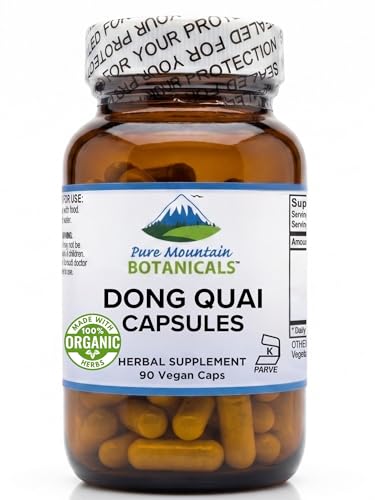
Pure Mountain Botanicals is the clearest root-powder example in this group: it states 500 mg per capsule and identifies the material as certified organic dong quai root powder. Nature’s Answer gives 1,000 mg per serving but does not state how many capsules make that serving in the supplied evidence. That is still useful information, but it should be read differently from a capsule-level declaration.
Compare dose and serving language carefully
Dose clarity is one of the most important differences across these listings. Nutricost states 565 mg per capsule, Best Naturals states 530 mg per capsule, and NusaPure lists 100 mg with 150 servings from 150 capsules. Those descriptions make the products relatively easy to compare on paper. Swanson lists 530 mg, while NOW Foods lists 520 mg and directs users to take two capsules once daily; the supplied evidence does not fully resolve whether the amount is per capsule or serving.
Horbäach and Carlyle describe potent dong quai root but do not provide a milligram amount in the supplied listing. Like Mine also omits a dose. Their lack of a stated amount does not prove the products are weaker or less suitable; it simply limits a specification-based comparison. If precise quantity matters to your selection, favor a product whose current label clearly identifies both amount and serving size.
Decide whether simplicity or a blend fits your needs
This top 10 emphasizes products where dong quai is presented as the central ingredient. Several other candidates are multi-herb formulas containing dong quai alongside ingredients such as black cohosh, chasteberry, red clover, or ashwagandha. A blend may be relevant to someone specifically seeking a combination, but it makes it harder to isolate the dong quai quantity and evaluate the role of each ingredient.
Like Mine and Pure Mountain Botanicals emphasize a one-ingredient approach. NusaPure also presents a streamlined formulation. By contrast, Swanson describes a full-spectrum, plant-based formula, which is a different design choice rather than a simple powdered-root claim. Read the ingredient panel if avoiding added herbs, or if you want to know whether dong quai is the main component rather than one part of a broader formula.
Check capsule materials and dietary certifications
Dietary suitability is not uniform. Nutricost identifies vegetarian capsules and gluten-free status. Pure Mountain Botanicals provides the most extensive documentation, including vegan, KOF-K Kosher, gluten-free, and non-GMO descriptions, along with a hypromellose vegetarian shell. NusaPure describes its capsules as vegetarian and vegan-compatible. Nature’s Answer lists vegan, kosher certified, gluten-free, and non-GMO attributes.
Best Naturals, Horbäach, and Carlyle provide broad exclusion lists. These include combinations of gluten, wheat, yeast, dairy-related ingredients, artificial flavors, preservatives, soy, or other common components, depending on the product. An exclusion list is not the same as a certification, so check the current package when a particular allergen or dietary standard is essential. Like Mine states gluten-free but does not identify its capsule material in the supplied evidence.
Give testing claims the right weight
Testing language varies from general assurances to specific procedures. Pure Mountain Botanicals describes HPLC potency verification, ICP-MS heavy-metal screening, pesticide-residue testing, and allergen testing. Best Naturals states that it is third-party lab tested for purity and quality. Swanson and NOW Foods describe independent laboratory or laboratory-method quality assurance, while Nutricost identifies a GMP-compliant, FDA-registered facility.
Horbäach and Carlyle use laboratory-tested language, and Like Mine states that products are tested for purity and quality. These statements are useful listing evidence, but they do not supply a complete certificate of analysis or establish that every batch has identical results. Compare the specificity of the documentation rather than assuming that a general testing phrase means the same thing as a named analytical method.
Capsule count can affect how often a bottle must be replaced, but count alone does not reveal the daily serving. Carlyle lists 250 capsules, Nutricost 240, Best Naturals 180, and Horbäach and NusaPure 150. Pure Mountain Botanicals and Nature’s Answer list 90 capsules, while Swanson, Like Mine, and NOW Foods use 100-capsule formats or equivalent pack structures.
NOW Foods is distinct because the selected listing is a two-pack of 50-count bottles and gives a two-capsule daily direction. Pure Mountain Botanicals also gives a serving guide of two capsules one to two times daily with meals. When comparing supply, calculate from the stated serving directions rather than treating capsule count as a complete measure of duration.
The supplied evidence includes directions for Pure Mountain Botanicals and NOW Foods, but not every selected product provides the same detail. Follow the current package instructions rather than copying directions from another brand. Herbal supplements can be inappropriate for some people or can interact with medicines and health conditions. Ask a qualified healthcare professional before use, particularly if you are pregnant, nursing, taking medication, using hormone therapy, or managing a medical condition. Product listings are not a substitute for that conversation.
Final Recommendation
Pure Mountain Botanicals Dong Quai 500mg ranks first overall in this specification-based comparison under the published weighted criteria.
The final choice among the best dong quai capsule supplements depends on the documented features that match your intended use.
Pure Mountain Botanicals Dong Quai 500mg is the highest-scoring returned product and the first overall specification-based choice. Its listing combines a defined capsule dose, certified organic root powder, one-ingredient positioning, vegan and kosher details, and named testing procedures. It is a strong fit for shoppers who want the most complete documentation in this comparison.
The top dong quai capsule supplements otherwise divide into clear use cases. Nutricost and Best Naturals suit shoppers who prioritize precise capsule-level amounts and substantial bottle counts. Nature’s Answer offers a clearly stated 1,000 mg serving with broad dietary certifications, while NusaPure gives a simpler vegan format with 150 stated servings. Swanson and NOW Foods provide more distinctive full-spectrum or serving-format information.
Horbäach and Carlyle are reasonable choices for shoppers focused on quick-release capsules and larger counts, but their supplied evidence does not state milligrams. Like Mine is the most ingredient-minimal option after the products with fuller dose documentation, though its amount is also unspecified. Before choosing, compare the current Supplement Facts panel, serving directions, capsule materials, and any testing information relevant to your requirements.
Frequently Asked Questions
What should I look for in the best dong quai capsule supplements?
Look for a clearly identified plant material, a stated amount per capsule or serving, transparent ingredient information, and capsule materials that fit your dietary needs. Testing and manufacturing details can add useful context, but a general quality statement is not the same as a named analytical method. The listings for Pure Mountain Botanicals, Nutricost, and Best Naturals provide especially clear dose or testing information.
No. Root powder and extract describe different forms, and the supplied listings do not provide enough standardized extraction information to treat their milligram amounts as directly equivalent. Pure Mountain Botanicals specifically lists root powder, while some other products use extract language or do not clarify the form. Compare like with like and read the current label.
Which selected product documents vegan capsules?
Pure Mountain Botanicals, NusaPure, and Nature’s Answer provide vegan-related information in their listings. Pure Mountain Botanicals also identifies a hypromellose vegetarian shell and KOF-K Kosher certification. Nutricost states that its capsules are vegetarian. If a dietary certification is important, verify the current package because listing details can change.
Do higher capsule counts indicate a better supplement?
No. A larger count does not establish a better formula or a longer supply unless the serving size is also known. Carlyle and Nutricost list large counts, but the practical duration depends on the product’s directions. Compare capsule count together with dose, servings, and the number of capsules used per serving.
Should I ask a healthcare professional before using dong quai?
Yes, especially if you are pregnant, nursing, taking medication, using hormone therapy, or have a medical condition. The evidence supplied here is product-listing information, not medical guidance. Use the current label and discuss whether dong quai is appropriate for your circumstances with a qualified healthcare professional.