Buying Guide
Choosing the best carbon steel boring drill bits starts with identifying the hole shape, depth, diameter, and material involved. The supplied products fall into three practical families: Forstner bits for flat-bottom holes, auger bits for long wood bores, and brad-point bits for smaller, accurately located holes. Carbon steel appears across the selected listings, but construction details differ considerably, so the material label alone is not enough for a useful comparison.
Match the bit design to the hole
Forstner bits are the clearest choice when the job calls for a flat-bottomed or pocket hole. The COMOWARE listing describes clean holes, a center spur, and an X-wing design, while the IRWIN Marples listing specifically identifies flat-bottomed and pocket holes. The Joyangy bit extends this design to a 1-1/2-inch opening for large mortises, speaker mounts, ventilation holes, or pipe access. These bits are generally more specialized than augers, but their stated geometry is better aligned with flat-bottom work.
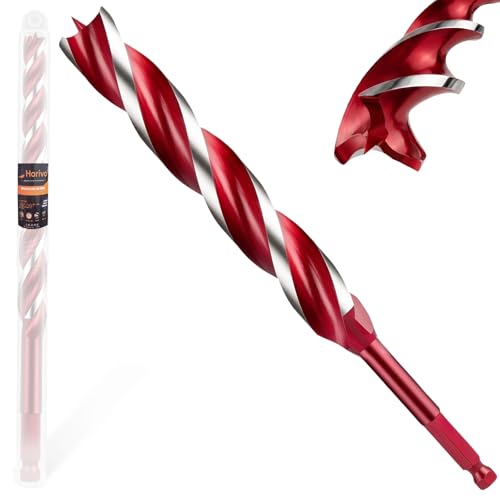
Auger bits are better suited to long holes through lumber, framing stock, landscape timber, or similar wood products. The selected augers include compact six-inch formats, 12-inch versions, 16- and 17-inch single bits, and a 24-inch set. Horivo and METOTY document three-cutter designs, while WOBLLMX uses tri-flute channels and a solid center. These features are presented as ways to move chips through a deep bore, but the listings do not establish actual drilling speed or durability through independent testing.
Brad-point bits serve a different purpose. Gunpla’s set covers 3mm to 10mm and uses a center pin with outlining spurs. That combination is explicitly intended to reduce wandering and produce accurately sized holes in wood products. It is a better fit for smaller woodworking holes than for large access bores.
Evaluate carbon steel construction
Several listings specify high-carbon or 1045 carbon steel, and some add heat treatment or hardening processes. COMOWARE, Horivo, Joyangy, and the WOBLLMX auger products provide particularly clear treatment or material language. These are useful specification distinctions, but they should not be treated as independent proof of service life.
A heat-treated bit may be attractive for repeated workshop use, yet the correct choice still depends on geometry and workload. A large Forstner bit such as Joyangy’s 38mm model is designed around a substantial opening, whereas Gunpla’s smaller brad-point sizes are more appropriate when hole diameter and placement matter more than reach. For plastic or PVC, use only the applications explicitly listed by the product and follow the maker’s operating guidance.
Look closely at centering features
A self-feeding screw point, center spur, guide tip, or center pin can make the start easier to control, according to the product listings. Horivo describes a four-hex guide tip, while SOMADA and QWORK identify coarse screw points. The WOBLLMX 24-inch set uses self-positioning tips, and Gunpla uses a brad-point center pin. These features are especially relevant when starting on a smooth board or beginning a deep hole.
The presence of a centering feature does not eliminate the need to secure the workpiece. Long augers can amplify alignment errors, and large Forstner bits may need more rigid equipment than a small brad-point bit. Start with the speed and tool setup recommended for the bit, keep the work supported, and stop if the bit binds or the material shifts.
Compare chip removal and cutting geometry
Chip evacuation is a major difference between boring designs. COMOWARE calls out an X-wing layout and rapid chip removal. Horivo uses wide flutes, while METOTY and the WOBLLMX products describe tri-flute or three-cutter arrangements. SOMADA and QWORK use solid-center auger construction, with QWORK’s listing emphasizing stability rather than a multiple-cutter layout.
For a deep hole, flute shape and clearance are more relevant than simply choosing the longest bit. A long bit with inadequate chip space can clog, while a shorter bit may be easier to control. The listings support comparing these design claims, but they do not provide measured torque requirements, feed rates, or tested performance. Treat the specifications as selection guidance rather than a guarantee of results.
Confirm size, depth, and shank fit
Check both the diameter and the usable depth before ordering. A 24-inch overall length does not necessarily equal 24 inches of drilling depth; SOMADA, for example, states a working depth of up to 15 inches for its 17-inch bit. The 12-inch and 16-inch augers may be more manageable for routine installation work, while the 24-inch WOBLLMX set is aimed at unusually deep bores.
Shank style also matters. Several augers use 3/8-inch hex shanks, and some listings describe quick-change hex compatibility. WOBLLMX’s SDS Plus model is distinct because it is intended for SDS Plus hammer drills. The COMOWARE round shank is described for handheld drills and drill presses, and IRWIN Marples uses a reduced shank for 3/8-inch and larger drills and drill presses. Always compare the stated shank with the chuck or holder on your tool.
Choose a set or a single bit
A set is useful when projects vary in diameter. COMOWARE and IRWIN Marples cover multiple Forstner sizes, Gunpla covers small metric brad-point sizes, and METOTY and WOBLLMX provide groups of augers. A single bit can be the more focused option when the required bore is known: Horivo, Joyangy, SOMADA, and QWORK each target a defined diameter and use case.
Storage is another practical distinction. Several listings mention a case, pouch, or reusable PVC tube. This matters more for long augers, where protected storage can help keep the set organized. It does not, however, replace checking the cutting edges before use.
Final Recommendation
METOTY 8-Piece 12-Inch Tri-Flute Auger Set ranks first overall in this specification-based comparison under the published weighted criteria.
COMOWARE 16-Piece Forstner Bit Set is the first overall specification-based choice among these best carbon steel boring drill bits because it combines heat-treated carbon steel, clean-hole geometry, centering control, broad size coverage, and stated drill compatibility. It is the most versatile selection when a workshop needs several flat-bottom hole sizes.
For deep work, METOTY’s 12-inch tri-flute set offers the most specification-aligned combination of size variety and auger-specific features, while WOBLLMX’s 24-inch set is the more specialized reach option. Horivo is a logical single-bit choice for a one-inch deep hole. IRWIN Marples suits fine woodworking and cabinet-making, Joyangy covers an oversized Forstner opening, and Gunpla handles smaller brad-point holes. Together, these are practical examples of the top carbon steel boring drill bits for different documented applications rather than a universal ranking based on customer sentiment.
Frequently Asked Questions
What are the best carbon steel boring drill bits for flat-bottom holes?
A Forstner design is the most directly documented fit. COMOWARE and IRWIN Marples both list flat-bottom hole capability, while Joyangy specifies a 1-1/2-inch flat-bottomed opening. Select the size range that matches your work and verify the shank against your drill or press.
Are auger bits suitable for deep holes in wood?
Yes, the selected auger listings are specifically described for deep wood boring. Horivo is 12 inches long, SOMADA is 17 inches long with up to 15 inches of stated hole depth, and WOBLLMX offers a 24-inch set. Actual usable depth depends on the workpiece, tool, alignment, and chip clearance.
What is the difference between a Forstner bit and a brad-point bit?
Forstner bits are documented for flat-bottomed or pocket holes and are available here in larger diameters. A brad-point bit, such as Gunpla’s set, uses a center pin and spurs for smaller, accurately positioned holes in wood. The choice should follow the required hole shape and diameter.
The supplied evidence primarily lists wood and, for some products, plastic, PVC, resin, chipboard, or drywall. WOBLLMX’s 24-inch listing explicitly says it is not for metal, so these products should not be treated as metal-drilling bits without separate manufacturer guidance.
How do I confirm drill compatibility before buying?
Compare the listed shank with your tool. Round-shank Forstner bits are described for handheld drills or drill presses; several augers list hex shanks; and the WOBLLMX SDS Plus model is intended for SDS Plus hammer drills. Also verify diameter, overall length, and the clearance available around the workpiece.