Buying Guide
The best carbide forstner drill bits should be selected by the hole you need, the machine holding the bit, and the material being cut. Carbide-tipped construction is common across this comparison, but the designs differ: some are compact single sizes, some cover a wide diameter range, and others add a hex shank, multiple cutters, or an adjustable stop.
Match the bit to the hole
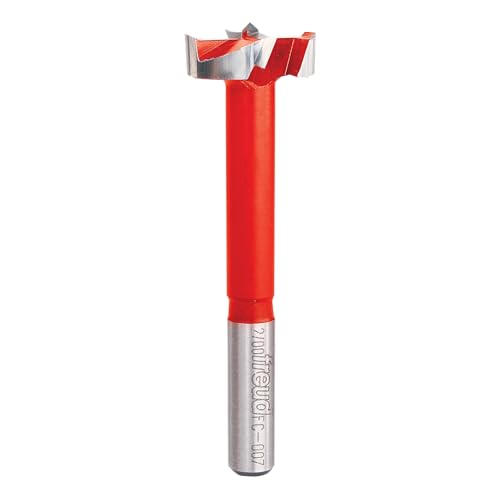
Forstner bits are useful when a project calls for a flat-bottom hole rather than the pointed exit produced by many general-purpose drills. They can also suit pocket, hinge, overlapping, angled, or edge-entry work when the product listing specifically supports those applications. Freud FC-007 is a focused 1-inch example with a center locating spur and explicit flat-bottom, pocket, and overlapping-hole coverage. KOWOOD identifies pocket and overlapping work while offering a 1/4- to 2-inch range.
Single bits are sensible when the required diameter is already known. WOBLLMX targets 30mm, STORMCUBE targets 40mm, and the REKCKRUL, METOTY, and Vouyar options cover 2, 3-1/2, and 3 inches. This format avoids unused sizes, but it does not provide flexibility for future projects.
Compare set coverage carefully
A set is more useful when its listed sizes match the work you do. REKCKRUL’s 16-piece set reaches from 1/2 to 3 inches, while XDENGP also offers 16 pieces and includes sizes up to 3 inches. KOWOOD’s 14-piece set begins at 1/4 inch and reaches 2 inches.
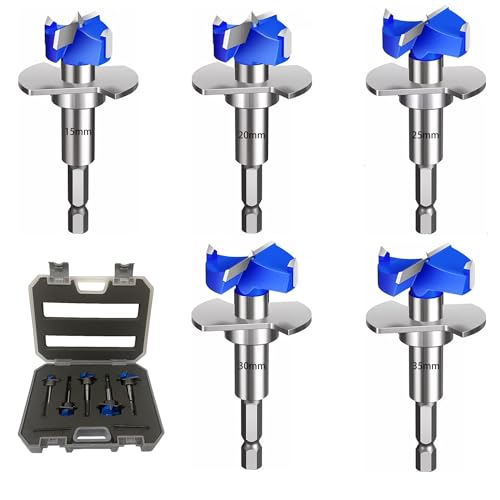
Metric sets take a different approach. Before choosing any set, compare the supplied diameters with the hinges, knobs, dowels, or other hardware used in the project. A larger piece count is less useful if the needed size is missing.
Check carbide and cutter details
Carbide is described differently across the listings. Freud identifies thick micro-grain carbide/titanium tips, KOWOOD specifies C2 carbide, XDENGP identifies YG6X carbide inserts, and STORMCUBE describes K35 monolithic tungsten carbide cutters. These details distinguish construction, but they do not constitute a hands-on durability test.
Cutter geometry also matters. WOBLLMX, METOTY, STORMCUBE, and Vouyar document three-cutter or triple-flute designs. REKCKRUL’s set and 2-inch bit describe dual spurs with a center point. These are useful design distinctions when comparing hole-location and chip-removal features, but drilling results also depend on setup, feed, speed, and the workpiece.
Choose the right shank
Shank style affects how a bit interfaces with the drill. Freud lists a 3/8-inch shank, STORMCUBE lists a 9mm shank, and WOBLLMX lists an 8mm round shank. Several options use hex shanks, including the REKCKRUL products and the HUBANGBIAO adjustable-depth set. Hex designs are described as helping prevent rotation in the chuck, but buyers should confirm chuck capacity and machine compatibility.
HUBANGBIAO is relevant when repeatable setup matters: it uses a 1/4-inch hex shank and includes two hex keys for its adjustable collar. XDENGP lists use with bench drills, handheld electric drills, impact drills, and CNC carving machines, but its listing also provides an RPM limit. Vouyar specifically says not to use its 3-inch bit with an impact driver.
Large Forstner bits demand more attention to stability than small ones. The REKCKRUL 16-piece set recommends a high-power drill and fixed-base vise for bits above 1-3/8 inches during handheld use.
The largest selected options are specialist tools. METOTY is 90mm, Vouyar is 3 inches, and REKCKRUL’s single bit is 2 inches. Their size makes them useful for wide openings, but the workpiece should be secured and the machine should be appropriate. STORMCUBE states that the material must be fixed and the bit kept perpendicular.
Review material compatibility
Most selected products identify wood, hardwood, softwood, plywood, or MDF as primary materials. Some extend the list to plastic, acrylic, particleboard, composites, rubber, or fiberglass. Freud names hardwoods, softwoods, and plywood. XDENGP lists wood, MDF, plywood, compact panels, acrylic, and particleboard, while Vouyar includes composites and veneered plywood.
Do not infer metal-cutting capability from carbide construction. XDENGP expressly excludes steel, iron, sand, and other non-wood materials, and STORMCUBE says it cannot be used for metal processing. Follow the supplied material list for the exact bit.
How this comparison was scored
The editorial ranking uses six category-specific criteria: carbide cutting construction, size coverage, hole-cutting design, shank and tool compatibility, material application range, and depth or control features. The weights total 100. Scores reflect only supplied titles, features, and specifications. No hands-on testing, customer sentiment, rating data, review data, purchase activity, or marketplace labels were used in the published criteria.
Final recommendation
REKCKRUL 16-Piece Carbide Set, 1/2 to 3 Inches ranks first overall in this specification-based comparison under the published weighted criteria.
Freud FC-007 is the first overall specification-based choice for buyers seeking a focused 1-inch bit with clearly documented Forstner applications. Its center locating spur, carbide/titanium tips, and stated use across hardwoods, softwoods, and plywood make the evidence concise and relevant.
For broad size coverage, the REKCKRUL and XDENGP 16-piece sets are alternatives. KOWOOD suits buyers seeking a smaller starting diameter and furniture-oriented hole work, while HUBANGBIAO is the standout when adjustable depth control matters. The single-bit options from WOBLLMX, REKCKRUL, METOTY, STORMCUBE, and Vouyar suit projects built around a known diameter.
Among the top carbide forstner drill bits, the right choice depends on diameter, shank, cutter design, and machine guidance. Confirm the required hole size, secure the workpiece, and follow the selected listing’s compatibility and operating instructions. That approach makes the best carbide forstner drill bits easier to narrow down without relying on unsupported performance claims.
Frequently Asked Questions
Among the best carbide forstner drill bits, what are carbide Forstner bits used for?
They are designed for woodworking holes such as flat-bottom, pocket, hinge, and overlapping holes when those applications are documented by the specific product. Freud FC-007 lists flat-bottom, pocket, and overlapping holes, while Vouyar also lists angled holes. They are not automatically suitable for metal; STORMCUBE and XDENGP expressly exclude metal or other unsuitable materials.
Should I buy a set or a single bit?
Buy a set when you need several diameters. REKCKRUL and XDENGP reach 3 inches, while KOWOOD covers 1/4 to 2 inches. Choose a single bit when one size is central to the project, such as WOBLLMX at 30mm, STORMCUBE at 40mm, or METOTY at 90mm. A set offers range, while a single bit keeps the purchase focused.
Are hex-shank Forstner bits suitable for a handheld drill?
A hex shank can help resist rotation in the chuck when the product is designed that way. REKCKRUL describes an anti-slip hex shank, and HUBANGBIAO uses a 1/4-inch hex shank. However, shank style does not remove the need for a suitable drill, a secure workpiece, and careful handling. Check each listing’s tool guidance, especially for large diameters.
What should I check before drilling a large hole?
Confirm the bit diameter, shank size, machine compatibility, and any stated depth or RPM guidance. Large-bit listings recommend good fixing performance, and REKCKRUL advises a high-power drill plus fixed-base vise for larger sizes during handheld use. Secure the material and keep the bit aligned; STORMCUBE includes those precautions.
Which features matter most for clean holes?
Look for documented carbide construction, a center point or locating spur, and cutter geometry suited to the task. Freud lists a center locating spur, while REKCKRUL and Vouyar describe multi-edge designs. These features are specification indicators, not guarantees of a particular result, so setup, material, speed, and feed remain important.