Buying Guide
Choosing among the best cardstock industrial warning signs starts with the hazard message, not color alone. The selected products divide into two practical formats: square DOT placards for dangerous-goods identification and smaller PF-cardstock tags for temporary workplace warnings. Select the format that matches the information viewers must recognize and the way the sign will be installed.
Match the message to the hazard
The DOT placards provide specific legends. Accuform MPL122CT25 and MPL120CT25 identify different Division 3 explosives applications; MPL134CT1 identifies blasting agents; MPL401CT10 identifies flammable solids; MPL701CT1 identifies radioactive material; and MPL901CT1 identifies Class 9 miscellaneous dangerous goods. These labels are not interchangeable. Verify the required hazard class and division before ordering.
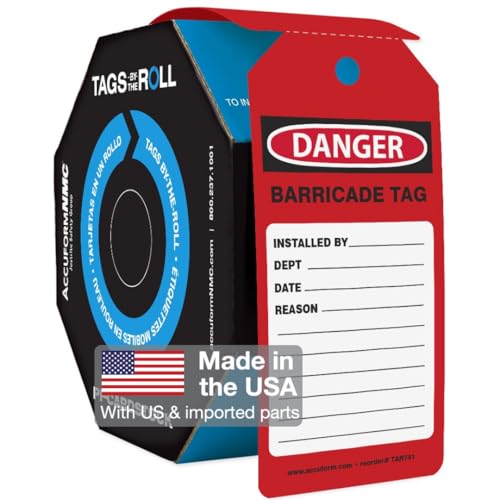
Accuform TAR741 serves a different purpose. It is a red barricade hazard-warning tag intended to alert people to a temporary danger around a barricade. It should not be treated as a substitute for a specific DOT placard. Its roll format, perforations, and dispenser are useful when tags must be issued repeatedly during maintenance, access control, or temporary hazard management.
Compare material construction
MPL736CT1, MPL732CT1, and MPL744CT1 provide detailed construction evidence. Their 10-mil poly-based material contains no wood-based paper content and is described as tear-resistant, waterproof, scuff-resistant, and resistant to cracking, distortion, and shrinkage. Those details make these three placards easier to evaluate for temporary outdoor use.
TAR741 also documents pulp-free PF-cardstock, waterproofing, tear resistance, and a mar-resistant matte surface. By contrast, the Class 1, Class 4, Class 7, and Class 9 placards have fewer environmental details in the supplied listings. That does not establish poor performance; it means the available specifications support a narrower comparison. Do not assume an outdoor service period that the listing does not state.
Check size and visibility
The square DOT products are listed at approximately 10-3/4 inches on each side. That shared format may simplify replacement planning and help maintain consistent placement across vehicles, containers, or work areas. Color and message vary by hazard: orange and black appear on the explosives placards, red and white on the flammable-solid placard, yellow and white on the radioactive placard, and black on white on the Class 9 option.
TAR741 uses smaller 6-1/4-by-3-inch tags. Its red format is intended for temporary warning, while the oversized hole and roll dispenser support hanging and distribution. A small tag may be more convenient around a barricade, but it does not provide the same visual area as a square placard. Consider viewing distance, mounting space, and whether the warning must remain visible from a vehicle or across a work zone.
Consider deployment and quantity
Pack size can matter as much as sign design. MPL122CT25 and MPL120CT25 are listed in 25-unit quantities, while MPL401CT10 is listed in a 10-unit quantity. The other square placards are single units. Multi-unit packs fit operations that need identical labeling at several locations; a single unit avoids unnecessary extras for a focused application.
TAR741 is listed as a 100-tag roll in a dispenser. Its perforated construction allows individual tags to be removed while keeping the remaining supply organized. The top hole is oversized at 3/8 inch, although the supplied data does not specify a particular fastener or mounting surface.
Review compliance statements carefully
The TAR741 listing states compliance with OSHA 29 CFR 1910.145 and ANSI Z535 requirements. That is useful documentation for its warning-tag design, but it does not determine whether the product satisfies every site-specific, transportation, or regulatory requirement. The DOT placards identify hazard classes and divisions, yet buyers should still confirm the applicable shipping and workplace rules for their operation.
Use a practical checklist
First, identify the exact hazard legend required. Second, choose the square placard or smaller barricade-tag format. Third, confirm whether the documented material and outdoor-use language match the environment. Fourth, select a unit quantity that fits the number of placements. Finally, verify dimensions, color, and mounting method before ordering. This keeps the decision tied to supplied specifications rather than unsupported assumptions.
Final recommendation
Accuform MPL736CT1 4-Digit DOT Placard ranks first overall in this specification-based comparison under the published weighted criteria.
The final choice among the best cardstock industrial warning signs depends on the documented features that match your intended use. MPL736CT1 is the first overall specification-based choice because its 10-mil poly-based PF-cardstock construction, stated resistance properties, matte surface, standard 10-3/4-inch square format, and short-term outdoor-use statement provide a well-supported profile for a temporary DOT placard. MPL732CT1 and MPL744CT1 are close alternatives with the same documented material platform.
For a hazard-specific need, choose the matching legend rather than relying on rank: MPL122CT25 or MPL120CT25 for their stated explosives divisions, MPL134CT1 for blasting agents, MPL401CT10 for flammable solids, MPL701CT1 for radioactive material, and MPL901CT1 for Class 9 goods. For repeated temporary barricade warnings, TAR741 is among the top cardstock industrial warning signs because its roll dispenser and perforations support repeated distribution. These recommendations are specification-based and should be checked against the requirements of the actual workplace or transport application.
Frequently Asked Questions
Are these the best cardstock industrial warning signs for permanent outdoor installation?
The supplied evidence does not establish permanent outdoor suitability. MPL736CT1, MPL732CT1, and MPL744CT1 are specifically described as appropriate for short-term outdoor use, while TAR741 is described as waterproof and tear-resistant without a stated permanent-installation duration. Confirm service-life requirements before using any selected product outdoors for an extended period.
Should I choose a DOT placard or a barricade tag?
Choose a DOT placard when the required message is a dangerous-goods class or division, such as “RADIOACTIVE 7” or “FLAMMABLE SOLID 4.” Choose TAR741 when the immediate purpose is a temporary danger warning at a barricade. The two formats serve different communication tasks and should not be substituted without confirming the application.
Which selected products have the most detailed material specifications?
MPL736CT1, MPL732CT1, and MPL744CT1 specify 10-mil poly-based material and list resistance to tearing, water, cracking, distortion, shrinkage, and scuffing. TAR741 also documents pulp-free PF-cardstock, waterproofing, tear resistance, and a mar-resistant matte surface. The remaining selected placards are identified as PF-cardstock but have fewer material details in the supplied listing data.
What size are the square placards?
The selected DOT placards are listed at approximately 10-3/4 by 10-3/4 inches. TAR741 is smaller, with tags measuring 6-1/4 by 3 inches. Compare those dimensions with the available mounting area and the distance from which the warning must be recognized.
Does a compliance statement guarantee suitability for my site?
No. TAR741 states compliance with OSHA 29 CFR 1910.145 and ANSI Z535, but site, transport, and hazard-control requirements can vary. Confirm the applicable rules and required legend before purchase and deployment.