Buying Guide
The best ceramic incense holders should be chosen by the way you burn incense, not by appearance alone. Public listings show several distinct formats: long stick trays, shallow bowls, covered burners, glass-enclosed holders, and multi-use ceramic bases. Start by identifying the incense formats you actually use, then compare ash control, fit, stability, and cleanup.
Match the holder to your incense
For standard sticks, long trays such as the FIELDTON Lotus Pond Ceramic Incense Tray and YIENENG 9-Inch Leaf Boat Ceramic Tray provide an extended landing area for falling ash. FIELDTON documents a 3 mm hole and a 9-inch tray, while YIENENG lists three hole sizes. These designs are useful when you prefer a simple, low profile and do not need a cone or wood-burning function.
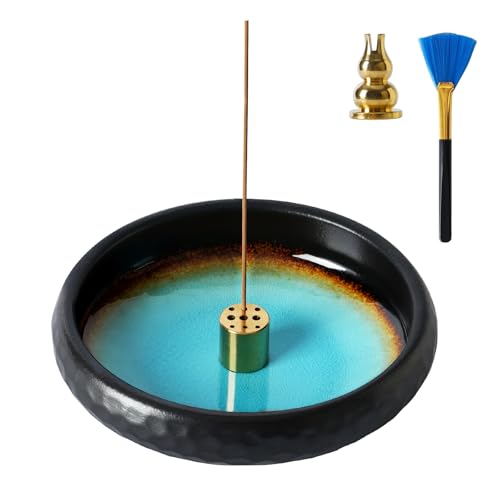
A bowl with interchangeable holes is more adaptable. The Anywind 6-Inch Crack Blue Ceramic Holder lists nine holes and use with sticks, coils, Palo Santo, sage, and cones. Pinehaven also uses a nine-hole insert, with graduated holes for standard and thicker sticks. Fancy Lemon takes a similar approach in a smaller 4.25-inch tray with nine copper socket holes. Check the listing details for fit rather than assuming every hole accepts every stick.
Consider ash containment
Ash control depends on the shape and size of the receiving surface. Deep or broad designs give falling ash more room. Pinehaven documents a 1.14-inch-deep dish, and Anywind identifies a 6-inch bowl. WhiteRhino lists a 6.06-inch base with curved edges. These details make them reasonable choices for users who want a larger collection area.
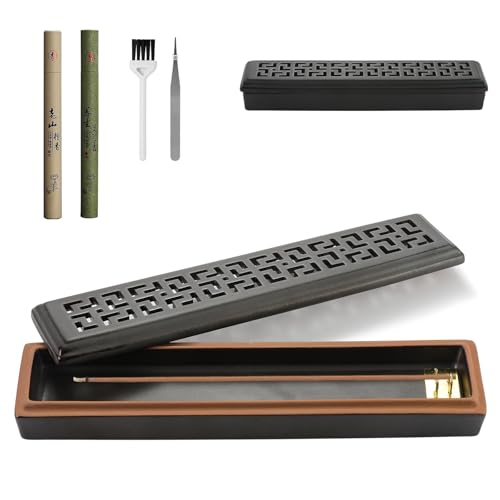
Covered designs address a different problem: moving air. The CEREMONY Ceramic Holder with Glass Ash Catcher uses a detachable glass cylinder to contain ash and block drafts from fans or air conditioning. The CEREMONY Japanese-Style Ceramic Incense Holder uses a lid and a horizontal lever. Enclosures can reduce exposed ash, but they also add glass or metal components that require careful cleaning and handling.
Do not interpret a stated ash-catching feature as permission to leave incense unattended. The Pinehaven listing specifically advises using a heat-resistant surface and never leaving burning incense unattended. Follow comparable precautions with every ceramic holder.
Check stability and heat-aware construction
A stable base matters because incense holders are used around a lit ember. Look for evidence such as a weighted base, a broad dish, a removable insert that sits securely, or an anti-skid bottom. RGBDOT identifies a weighted base, Pinehaven describes a weighted ceramic base, and YIENENG lists an anti-skid pad. WhiteRhino also documents a spacious base and curved edges.
Material language still needs to be read carefully. Several listings describe heat-resistant ceramic, including WhiteRhino, Fancy Lemon, RGBDOT, and YIENENG. That does not replace safe placement. Use a heat-resistant surface, keep flammable objects away, and wait until ash has cooled before emptying the tray. If a product includes metal, glass, or removable sockets, make sure those pieces are seated as described before lighting.
Decide whether multifunction features help
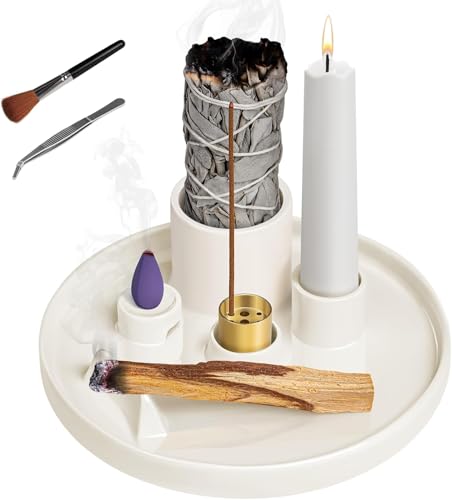
A multifunction holder can reduce the need for separate burners. WhiteRhino is the broadest documented option in this comparison: it supports sticks, cones, sage, Palo Santo, candles, and multiple stick-hole sizes. Fancy Lemon covers sticks, Palo Santo, sage, and candles in a smaller format. HGEKLIZV focuses on sticks, coils, and cones through a detachable lotus and coil-hanger system.
These features are useful only if they match your routine. A simple long tray may be easier to position and clean if you burn one stick at a time. A larger bowl is more suitable when you alternate among incense types or want a decorative centerpiece. A multifunction product may also have more components, so consider where you will store the insert, brush, lid, or hanger.
Plan for cleanup and placement
Glazed ceramic is generally presented in the listings as easy to wipe or rinse, but texture and construction vary. Fancy Lemon states that the tray can be wiped or rinsed. Anywind includes brushes, while WhiteRhino lists an included brush and a smooth ceramic surface. Pinehaven’s brass insert lifts out, which can make ash removal more direct.
Measure your surface before choosing. Long trays such as FIELDTON and YIENENG need horizontal room. WhiteRhino has a tall profile, while the Pinehaven and Anywind bowls use more width. The glass CEREMONY design requires clearance for its cylinder, and lidded burners need enough room to open or adjust their components.
Use design as a practical filter
A holder can serve as décor when it is not burning, but decorative claims should not outweigh function. Lotus forms from Pinehaven and HGEKLIZV provide sculptural styling alongside documented burning features. RGBDOT offers a crackle glaze and mini-chiminea form. The leaf designs from FIELDTON and YIENENG provide elongated silhouettes. Choose the visual style that fits your room only after confirming the ash area, incense fit, and placement requirements.
Final Recommendation
WhiteRhino 6-in-1 Ceramic Incense Burner ranks first overall in this specification-based comparison under the published weighted criteria.
The final choice among the best ceramic incense holders depends on the documented features that match your intended use.
WhiteRhino 6-in-1 Ceramic Incense Burner is the first overall specification-based choice because it combines the broadest documented compatibility with a large ash-catching base, multiple hole sizes, removable components, and a cleaning brush. It is one of the top ceramic incense holders for households that use more than one incense format.
Pinehaven is the better fit for a decorative deep dish, weighted base, and removable brass insert. Anywind is a strong alternative for a large multi-hole bowl, while Fancy Lemon offers similar flexibility in a more compact footprint. For stick-only routines, FIELDTON and YIENENG are more focused. Choose either CEREMONY model when draft or airborne ash is the main concern: the glass cylinder favors visible enclosure, while the lidded Japanese-style format favors horizontal burning.
HGEKLIZV is the design-led option for sticks, coils, and cones, and RGBDOT suits shoppers who want a handcrafted-looking ceramic form with broader material support. In every case, verify the listed hole size or holder format, use a heat-resistant surface, keep the burner attended, and allow ash and components to cool before cleaning.
Frequently Asked Questions
What makes the best ceramic incense holders different from a simple incense stick rest?
A ceramic holder normally provides a receiving surface for ash as well as a point for positioning the incense. Some models add a deep bowl, lid, glass enclosure, multiple holes, or support for cones, coils, sage, or Palo Santo. A simple rest may be enough for occasional short sticks, while a larger tray is more practical for frequent use.
Are ceramic incense holders suitable for cones and Palo Santo?
Some are, but not all. WhiteRhino, Pinehaven, Fancy Lemon, Anywind, and RGBDOT explicitly document compatibility with at least some combination of cones, sage, or Palo Santo. FIELDTON and YIENENG are presented primarily as stick trays. Match the holder to the material instead of assuming a stick hole or shallow tray will support larger burning items.
Which holder is best for incense near a fan or air conditioner?
The CEREMONY Ceramic Holder with Glass Ash Catcher is the clearest match because its listing says the detachable glass cylinder blocks drafts and contains falling ash. The lidded CEREMONY Japanese-Style Ceramic Incense Holder is another covered option. Even with an enclosure, place the burner on a suitable surface and supervise it while lit.
How should I choose between a long tray and a round bowl?
Choose a long tray when you burn sticks and have horizontal desk or shelf space. The FIELDTON and YIENENG trays are examples with elongated layouts. Choose a round bowl when you want a broader ash area or plan to use multiple incense types. Pinehaven, Anywind, and WhiteRhino document larger receiving surfaces, but they take more table width.
What should I check before using a ceramic incense holder?
Confirm that the stick, cone, coil, sage, or Palo Santo fits the documented holder. Check that removable inserts, lids, or metal pins are seated correctly. Use a heat-resistant surface, keep flammable materials away, do not leave burning incense unattended, and let the holder and ash cool before emptying or washing it.