Buying Guide
Choosing the best kitchen incense holders is less about decoration alone and more about matching the holder to the incense format, available counter space, and the amount of ash control you need. The products above fall into several practical groups: long open trays, compact multi-format burners, and vertical or enclosed glass designs.
First identify what you burn most often. Long open trays are generally the clearest fit for standard sticks because the stick can extend over a channel that catches falling ash. COTTON CRAFT lists support for both cones and sticks, while Kaizen Casa and NAGU focus more directly on long stick use. The Cacukap pair also documents stick compatibility and adds angle adjustment.
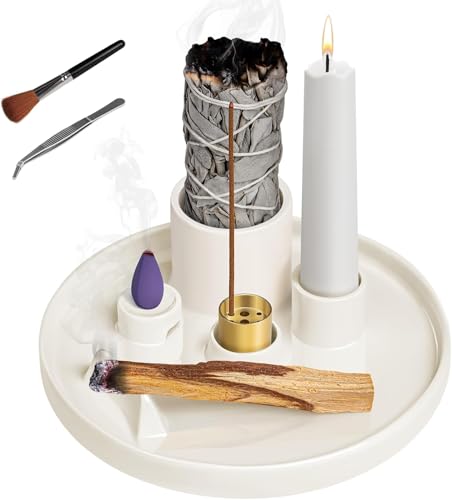
If your routine changes between sticks, cones, coils, or other formats, a compact multi-format burner may be more useful. GARMOLY documents five holes and use with sticks, cones, and coils. HOKPA lists several copper styles and names stick, cone, tower, and coil incense. MOUGIGI and RGBDOT go further by documenting use with formats such as Palo Santo, sage, and tealights. These broader claims come from the supplied listings; they do not establish that every format will fit every opening.
Compare ash containment
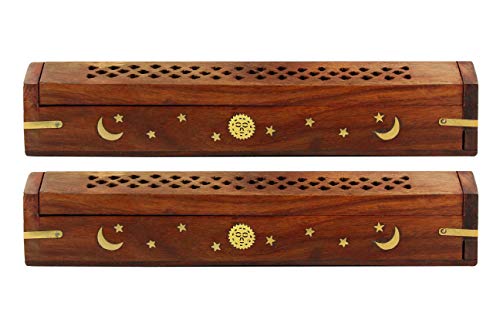
Ash control is especially important near food-preparation surfaces, cabinets, and frequently used counters. A long tray gives ash a broad landing area. The 11-inch Kaizen Casa and NAGU designs, along with the 12-inch COTTON CRAFT holders, are the most straightforward choices when you want an open surface under a burning stick.
Vertical glass designs take a different approach. GARMOLY’s glass bottle holder suspends the incense inside the catcher, while CEREMONY uses a glass catcher with a clip and brass support rod. These designs are intended to reduce scattered ash, but they also introduce height and glass components. Measure the intended location before choosing one.
Compact burners can still be useful, especially when the incense sits close to the center of a dish. GARMOLY’s detachable catcher and the HOKPA pieces are easier to place on smaller surfaces, but a small dish or individual holder may not capture ash from a long stick as broadly as a tray. This is a design trade-off, not a performance test.
Check dimensions and counter clearance
The listed dimensions provide a useful starting point. Long holders from COTTON CRAFT, Kaizen Casa, NAGU, and Cacukap need horizontal room. COTTON CRAFT is the longest listed option at 12 inches, followed by Kaizen Casa at 11 inches and Cacukap at 9.8 inches. NAGU’s supplied tray length is 11.22 inches. These designs may suit a countertop or shelf where the holder can remain undisturbed.
Vertical holders need a different check. The GARMOLY glass design lists a bottle height of 7.81 inches and a support rod height of 9.64 inches. CEREMONY lists a height of 10.4 inches, while RGBDOT lists 7.4 inches. Keep these measurements in mind around upper cabinets, shelves, and ventilation equipment. MOUGIGI’s supplied dimensions are internally inconsistent, so confirm the current product dimensions before assigning it a tight location.
Consider material and maintenance
Wooden holders bring a warm decorative finish and are represented by COTTON CRAFT, Kaizen Casa, and Cacukap. Their listings support wipe-clean care or describe a simple wooden ash-catching construction. Wood can be a good visual fit, but it should not be treated like a washable ceramic or metal dish unless the product instructions say so.
Ceramic options include NAGU, MOUGIGI, and RGBDOT. NAGU is described as high-temperature-fired ceramic, MOUGIGI as handcrafted ceramic clay, and RGBDOT as lead-free, heat-resistant ceramic with a weighted base. These details help distinguish the products, but they do not replace attentive burning practices. Ceramic can also be vulnerable to impact even when a listing describes it as durable.
Metal options include the pure-copper HOKPA set and the zinc-alloy GARMOLY lotus burner. GARMOLY also documents detachable parts for easier ash removal, while HOKPA emphasizes stability. Glass-and-wood holders provide a visible enclosure but need careful handling during assembly and cleaning. CEREMONY includes a brush, and the GARMOLY glass listing describes its catcher as easy to clean.
Match the design to your routine
For a simple stick-burning routine, choose a long tray such as COTTON CRAFT, Kaizen Casa, NAGU, or Cacukap. For varied incense formats, consider GARMOLY’s five-hole burner, HOKPA’s three-style set, MOUGIGI, or RGBDOT. For ash containment that surrounds the incense, compare the GARMOLY glass and CEREMONY vertical designs.
Decorative priorities also differ. NAGU uses a two-fish ceramic form, COTTON CRAFT adds Sun and Moon brass inlays, RGBDOT uses a crackle glaze with hand-painted florals, and MOUGIGI uses a dragonfly motif. These features are documented design details rather than evidence of superior burning results.
Use safely in a kitchen setting
None of the supplied listings should be interpreted as permission to burn incense beside food, flammable materials, children, or unattended appliances. Keep the holder on a stable, heat-tolerant surface, allow adequate clearance, and remain present while incense burns. Enclosed glass designs may help with ash management, but they still contain hot components. Open wooden, ceramic, and metal holders likewise require attentive placement. Follow any instructions supplied with the specific product and allow components to cool before cleaning.
Final Recommendation
COTTON CRAFT Sheesham Wood Incense Burners ranks first overall in this specification-based comparison under the published weighted criteria.
COTTON CRAFT Sheesham Wood Incense Burners is the first overall specification-based choice among these best kitchen incense holders because it combines a 12-inch ash-catching format, two holders, cone-and-stick compatibility, and hidden storage. Kaizen Casa is the better fit for an extra-long single-tray design, while GARMOLY’s lotus burner is more suitable for compact spaces and multiple incense formats. If surrounding the incense with glass is your priority, compare GARMOLY’s glass ash catcher with CEREMONY’s adjustable clip design. For the top kitchen incense holders, select based on the format you burn most, the clearance available, and how much ash containment your counter requires.
Frequently Asked Questions
What should I look for in the best kitchen incense holders?
Prioritize a documented ash-catching design, compatibility with your incense type, stable construction, and dimensions that fit the intended surface. Long trays are practical for standard sticks, while multi-format burners are more adaptable. Also consider whether the material supports the listed cleaning method and whether the holder needs vertical clearance.
Are long trays or enclosed holders better for ash control?
They solve the problem differently. Long trays such as COTTON CRAFT and Kaizen Casa provide a broad open landing area beneath a stick. Enclosed designs such as the selected GARMOLY glass holder place the burning incense inside a glass catcher. The best choice depends on available space, your preferred format, and whether you want a horizontal or vertical design.
Can I use cones in every holder in this comparison?
No. Cone compatibility is only included where the supplied evidence documents it. COTTON CRAFT, GARMOLY’s lotus burner, HOKPA, MOUGIGI, and RGBDOT provide explicit multi-format indications. The open stick trays from Kaizen Casa, NAGU, and Cacukap are primarily documented for sticks. Check the individual listing before using a different incense format.
How much space should I allow?
Measure both the holder’s footprint and the surrounding clearance. The selected long trays range from about 9.8 to 12 inches in listed length. Vertical options may require roughly 7 to 10 inches of height based on their supplied dimensions. Leave room for safe handling, ash cleanup, and separation from flammable objects.
How should these holders be cleaned?
Use the care method documented for the product. COTTON CRAFT specifies wiping with a soft damp cloth, while the GARMOLY lotus listing describes rinsing and drying. Glass catchers and detachable parts may simplify ash removal, and CEREMONY includes a cleaning brush. Let all components cool fully before cleaning, and do not assume a material is washable without supporting instructions.