Buying Guide
Choosing the best ceramic light sockets starts with the fixture, not simply the material. Ceramic and porcelain bodies are commonly selected for their heat-handling and insulating properties, but the mounting method, bulb base, wiring arrangement, and electrical limit determine whether a particular socket is a suitable replacement. This comparison uses public listing data only. It is not a hands-on test, and it does not incorporate customer opinions or volatile marketplace information.
Match the bulb base first
Most of the selected products use the standard E26 medium screw base, and several listings also identify E27 compatibility. E26 and E27 are closely related medium-base formats, but the existing fixture and bulb should still be checked before purchase. The SDQCLIIF snap-in socket, TWDRTDD surface-mount model, REXTiN ten-pack, and EMNOOTI four-pack all document compatibility with standard E26 bulbs.
Bulb type matters as well. Several selected sockets list compatibility with incandescent, halogen, CFL, and LED bulbs. The Generic four-pack goes further by naming brooder heat bulbs, ceramic heat emitters, and reptile basking bulbs. That makes it more relevant to specialized high-heat projects than a compact fixture socket with no stated wattage or temperature specification. Always compare the bulb’s requirements with the socket’s documented electrical limits rather than assuming every ceramic holder has the same capacity.
Choose the mounting style
The most important physical distinction among these top ceramic light sockets is how they attach to the fixture. A surface-mount socket, such as the TWDRTDD flange model, uses a base with two screw holes and is intended for walls, ceilings, cage tops, lamp posts, and other exposed surfaces. It is a better match when there is no recessed opening or lamp pipe available.
Snap-in designs serve a different purpose. The SDQCLIIF model uses a U-shaped mounting spring, while the TWDRTDD double-clip model uses snap-in clips. These can be useful for recessed fixtures or replacement openings designed for spring retention, but they are not universal. The opening must be the correct size and shape, and the socket must be supported as intended by the fixture.
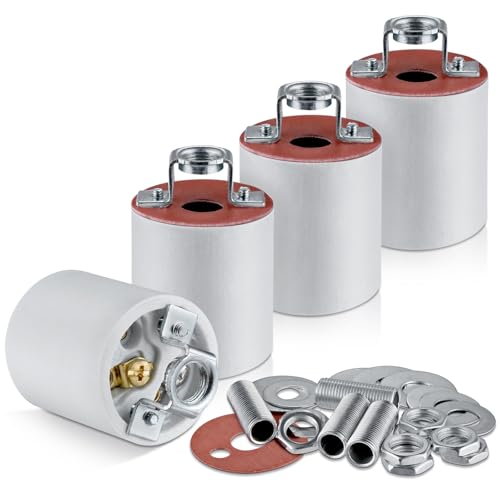
Threaded designs are useful for lamp construction and pendant-style assemblies. The TWDRTDD socket with hickey includes a threaded bracket for a 1/8-inch IPS lamp pipe. The EMNOOTI model includes a female threaded iron bracket, nipples, washers, and locknuts for each socket. These parts may reduce the need to source separate mounting hardware, but they are only helpful when the fixture uses compatible threading.
Outlet-box-mount models offer another installation path. The Leviton 9726-C identifies compatibility with 3-1/4-inch and 4-inch outlet boxes and uses a top-wired configuration. The Leviton 29816-C is also an outlet-box-mount porcelain lampholder and adds pull-chain operation. Check the existing box, screw locations, wiring route, and cover or fixture clearance before selecting this style.
Compare wiring and included parts
Pre-wired sockets can simplify a replacement when the supplied lead length and insulation type suit the project. The SDQCLIIF socket provides a six-inch silicone wire lead, and the TWDRTDD surface-mount socket provides 5.9-inch high-temperature silicone leads. These lengths may be convenient for compact fixtures, but they may not reach every junction point.
Other products use terminals instead of permanently attached leads. The Generic four-pack specifies screw-terminal connections, while the EMNOOTI four-pack specifies two screw terminals and gives live- and neutral-wire guidance. Terminal wiring can be useful when an existing wire run is already present, but it requires correct electrical preparation and connection.
Included hardware is another differentiator. The EMNOOTI package supplies a nipple, two locknuts, and two washers for each socket. The threaded hickey product includes its bracket. By contrast, a flange socket may require suitable screws, and a snap-in socket depends on a compatible fixture opening rather than separate fasteners. Read the package contents carefully so the listed installation method matches what is already on hand.
Check ratings conservatively
Electrical ratings should be treated as limits, not performance promises. The REXTiN listing provides a 12V-250V range and a 0-4A current range. The Westinghouse listing supplied here does not state a voltage or wattage rating, so it should be chosen only when its documentation or existing fixture requirements provide the missing information.
Temperature claims also vary. The surface-mount listing states resistance up to 250°C, the SDQCLIIF listing identifies silicone leads rated up to 200°C, and the Generic four-pack claims a porcelain body designed for temperatures up to 600°C. Those figures are listing specifications, not independent test results. Match the socket to the bulb and fixture environment, and follow applicable electrical requirements. Turn off power before replacement and use a qualified electrician when the wiring or box condition is uncertain.
Consider control and project use
Keyless sockets are intended for fixtures controlled by a wall switch, external switch, thermostat, or another separate control. They can provide a simple replacement format, especially in garages, closets, utility rooms, and DIY fixtures. Pull-chain models add local control. The Leviton 29816-C includes a pull chain and long pull cord, while the Leviton 9726-C combines pull-chain operation with a grounded outlet.
For repeated repairs, a multi-pack may be more practical than a single socket. The REXTiN set includes ten pieces, the EMNOOTI set includes four, and the Generic high-heat set includes four. Quantity does not replace fit, however: a large pack of incompatible mounting styles is less useful than a single socket that matches the fixture.
Final recommendation
SDQCLIIF E26 Snap-In Porcelain Socket ranks first overall in this specification-based comparison under the published weighted criteria.
SDQCLIIF’s E26 Snap-In Porcelain Socket is the first overall specification-based choice among these best ceramic light sockets because it combines E26 compatibility, UL-listed construction, a 250V/660W rating, heat-resistant leads, and a clearly defined recessed-fixture mounting method. It is the most specification-aligned match when the fixture accepts its spring clip.
For exposed installation, the TWDRTDD surface-mount socket is one of the top ceramic light sockets because its two-hole flange and silicone leads suit walls, ceilings, lamp posts, and DIY fixtures. The Generic four-pack is the better documented option for brooder or reptile heat-lamp applications, while the REXTiN ten-pack fits projects requiring multiple standard replacements.
Choose Leviton’s 29816-C or 9726-C when pull-chain control is important, with the latter offering stated outlet-box sizing and a grounded outlet. The TWDRTDD hickey model is the logical threaded choice, and the EMNOOTI four-pack is attractive when nipples, washers, and locknuts are useful. For a compact repair, the Westinghouse socket may fit, but its supplied listing does not state an electrical rating, so verify that information before installation.
Quick selection checklist
- Confirm the bulb uses the required E26 or E27 medium base.
- Match snap-in, flange, threaded, or outlet-box mounting to the existing fixture.
- Compare the bulb load with the socket’s stated voltage and wattage limit.
- Check whether the project needs pre-wired leads, screw terminals, or included hardware.
- Treat temperature figures as documented listing claims rather than independent test results.
- Verify wiring compatibility and disconnect power before beginning work.
Frequently Asked Questions
Are ceramic and porcelain light sockets suitable for E26 bulbs?
Several selected products document E26 compatibility, including the SDQCLIIF snap-in socket, TWDRTDD surface-mount and snap-clip models, and the EMNOOTI four-pack. Some also list E27 compatibility. Confirm the base marking on the bulb and the socket before installation.
Which best ceramic light sockets work for recessed fixtures?
The SDQCLIIF model is specifically described for recessed light fixtures and uses a U-shaped mounting spring. The TWDRTDD double snap-in model is another option for a compatible opening. These designs require the fixture to accept the stated clip or spring arrangement.
What is the difference between a keyless and pull-chain socket?
A keyless socket has no built-in local switch and is generally used with a wall switch, external switch, thermostat, or another control. A pull-chain socket provides manual on-off control at the fixture. The Leviton 29816-C and 9726-C are selected pull-chain examples.
Do ceramic sockets automatically support high-wattage heat bulbs?
No. Ceramic construction alone does not establish a universal electrical limit. The Generic four-pack lists 660W/250V and specialized heat-bulb applications, while the TWDRTDD hickey socket lists 250V/200W. Use the rating supplied for the specific model and compare it with the bulb requirements.
When should I choose a socket with included hardware?
Included hardware is particularly useful for threaded lamp projects or replacements where existing parts are missing. The EMNOOTI four-pack includes nipples, washers, and locknuts for each socket, while the hickey model includes a threaded bracket. Verify that the hardware matches the fixture’s thread and mounting arrangement.