Buying Guide
This guide compares the best warm compact fluorescent bulbs using documented warm color match, light output, socket and fixture fit, efficiency and rated life, and installation and fixture information.
Warm compact fluorescent bulbs are not interchangeable solely because they share a color temperature. The base, ballast arrangement, physical envelope, wattage, and lumen output all determine whether a bulb is a useful replacement. This comparison uses public listing specifications and feature descriptions; it does not represent hands-on testing or customer-opinion analysis.
Start with the socket and ballast
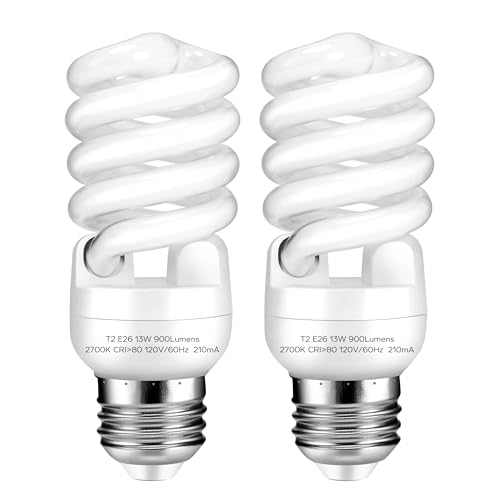
The socket is the first filter. E26 is the familiar medium screw base used by many household lamps and fixtures. The selected Arsmrau, UNITEDLUX 13W E26, and Xtricity bulbs use this format. They screw into compatible sockets, but an E26 bulb should not be used as a substitute for a pin-base lamp.
GU24 bulbs use two pins and a twist-lock installation. The selected UNITEDLUX GU24, JACKYLED, UGOODIS, and Winkcao products are designed for that format. Check the fixture before ordering, and pay attention to the UNITEDLUX GU24 listing’s warning that its base may be too wide for some traditional GU24 sockets. A GU24 bulb does not fit a standard E26 socket.
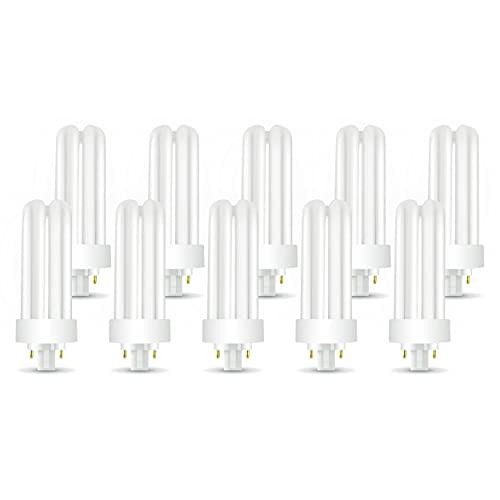
Plug-in CFLs require closer matching. KOR and Circle use GX24q-3 four-pin bases, while Sunlite FT24DL/830 uses a 2G11 four-pin base. These are fixture-specific lamps rather than general screw-in bulbs. KOR and Circle specify electronic-ballast use and exclude magnetic or dimmable ballast systems. Sunlite describes electronic-ballast reading lamps and tabletop fixtures. If the old lamp is available, match its base markings and wattage before purchasing.
Choose 2700K or 3000K
Color temperature describes the character of the light. The 2700K products in this selection are labeled warm white or soft white and are generally positioned for comfortable household spaces such as bedrooms, living rooms, dining areas, and lamps. The Sunlite FT24DL/830 uses 3000K warm white light, which is still warm but somewhat less amber than 2700K.
For a traditional incandescent-like appearance, begin with a 2700K option. For a work area where a slightly cleaner warm tone is acceptable, 3000K may be a better documented match. Do not infer color quality, flicker behavior, or visual comfort beyond the supplied listing claims.
Match lumens to the fixture
Lumens indicate listed light output, while watts indicate energy consumption. The 13W household models generally list about 900 to 1,040 lumens. Arsmrau and several GU24 options list 900 lumens, while UNITEDLUX E26 lists 1,040 lumens. These are appropriate starting points for ordinary lamps and general-purpose fixtures when the socket and enclosure are compatible.
For more light, the selected Xtricity, Winkcao, KOR, Circle, and Sunlite FT24DL/830 listings reach 1,600 or 1,800 lumens. Their higher wattages and specialized bases mean they should be matched to fixtures designed for them. A higher lumen figure is not automatically better if the fixture has a wattage limit or a smaller enclosure.
Consider rated life and efficiency claims
Listed service life ranges from 10,000 hours for many selections to 12,000 hours for KOR and Circle and 15,000 hours for UNITEDLUX E26. These are manufacturer or listing specifications, not independently verified results. They can still help compare replacement intervals on paper.
CFL wattage is lower than the incandescent-equivalent figure shown in several listings. For example, the Xtricity bulb uses 23 watts for a listed 100-watt equivalent, while many 13W products are presented as 60W equivalents. Treat equivalence as a brightness comparison supplied by the listing, not as a guarantee that every fixture will appear identical.
Check installation and operating details
Self-ballasted designs appear in several screw-base and GU24 listings, while plug-in lamps depend on the fixture’s ballast. Voltage details are especially useful for US applications: the selected products commonly specify 120V or 120V/60Hz. Some listings also describe instant-on or flicker-free starting, but those statements are product claims rather than test findings.
Confirm whether the fixture is enclosed, damp-rated, dimmable, or ballast-controlled. More generally, the supplied evidence does not establish universal outdoor or damp-location suitability for the selected products.
Compare pack size with the project
Pack counts range from two to ten bulbs in the selected group. A two-pack can suit a single-room replacement, while larger packs are practical for multiple compatible fixtures. Pack size should not override socket compatibility or the fixture’s electrical requirements. For a multi-fixture installation, matching the same base, color temperature, wattage, and lumen specification can produce a more consistent result.
Final Recommendation
Circle PLT-26W 827 GX24q-3 CFL, 10 Pack ranks first overall in this specification-based comparison under the published weighted criteria.
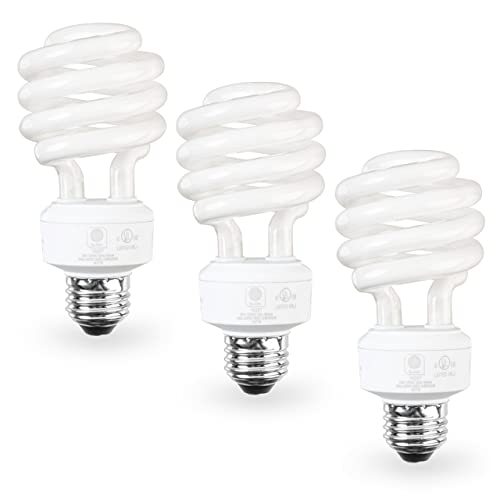
Xtricity 23W 2700K E26 CFL is the overall specification-based choice among the returned products for a compatible E26 fixture. It combines a standard E26 base with 1,600 listed lumens, 2700K soft white light, instant-on operation, and a 10,000-hour listed life. It is suited to an E26 fixture that can use its 23W format.
Circle PLT-26W 827 is a strong specialized choice for a GX24q-3 electronic-ballast fixture, while Winkcao 23W is a high-output GU24 alternative. For ordinary E26 lamps, UNITEDLUX 13W offers an extended listed life in this comparison, and Arsmrau provides a simple 900-lumen warm-white configuration. These are among the top warm compact fluorescent bulbs only when their bases and fixture requirements match.
The best warm compact fluorescent bulbs depend on the fixture as much as the lamp itself. Verify the base first, then compare 2700K versus 3000K, lumens, wattage, ballast requirements, and rated life. That sequence reduces the risk of choosing a bulb that is technically warm but physically or electrically incompatible.
Frequently Asked Questions
What are the best warm compact fluorescent bulbs for a standard lamp?
Choose an E26 model when the fixture has a medium screw socket. Xtricity provides a high listed E26 output in this selection, while UNITEDLUX 13W offers 1,040 lumens and a 15,000-hour listed life. Arsmrau is another 2700K E26 option with 900 listed lumens. Always confirm the fixture’s wattage limit and available space.
Is 2700K warmer than 3000K?
Yes. In the supplied listings, 2700K is labeled warm white or soft white and is positioned for cozy residential lighting. Sunlite FT24DL/830 uses 3000K warm white, which remains warm but is generally less amber in appearance. The choice is visual preference and fixture context rather than a performance ranking.
Can a GU24 CFL replace an E26 CFL?
No. GU24 bulbs use two pins and a twist-lock base, while E26 bulbs use a medium screw base. The selected UNITEDLUX GU24, JACKYLED, UGOODIS, and Winkcao products require GU24-compatible fixtures. Do not rely on wattage or lumen equivalence to overcome a physical socket mismatch.
Do plug-in CFLs need a ballast?
The selected plug-in products are described for ballast-controlled fixtures. KOR and Circle specify GX24q-3 four-pin bases and electronic-ballast compatibility, while Sunlite FT24DL/830 is described for electronic-ballast applications. Check the fixture’s ballast type and base before buying; a pin count alone is not enough to establish compatibility.
Are higher-lumen CFLs always better?
Not necessarily. Higher output can help in a large room or task area, but the fixture must support the bulb’s wattage, dimensions, base, and heat conditions. A 900-lumen 13W bulb may be a better fit for a smaller lamp than a 1,600- or 1,800-lumen model. Use the fixture requirements first, then select the light output that suits the space.