Buying Guide: best ceramic stockpots
A ceramic stockpot is usually a metal-bodied pot with a ceramic nonstick cooking surface, rather than a vessel made entirely from ceramic. In this comparison, the listings describe aluminum, hard-anodized aluminum, aluminized steel, or cast-aluminum bodies beneath the coating. That underlying construction affects heating, weight, and cooktop compatibility, so the coating alone should not determine your choice.
Start with capacity
Capacity should follow the food you normally prepare, not only the number printed in the product title. The selected range runs from 5 to 16 quarts. A 5- or 6-quart pot can suit pasta, soup, sauces, and ordinary family meals while taking up less storage space. An 8-quart model is a flexible middle choice for larger soups, stews, seafood boils, and meal prep. The 10- and 12-quart options provide more room for batches without reaching the scale of the 16-quart Bakken.
Remember that a pot should not be filled to the rim when boiling or simmering. A larger nominal capacity can provide useful headroom for bubbling liquids and bulky ingredients, but it also means more weight when full. For apartment kitchens or cooks who frequently lift and pour, the smaller pots may be easier to control. For gatherings, stock, sauces, or repeated meal preparation, the larger sizes are more practical.
Verify the coating description
The listings use several descriptions, including ceramic nonstick, diamond-infused ceramic, three-layer ceramic, and coatings stated to be free of substances such as PFAS, PFOA, PTFE, lead, or cadmium. These are product-description claims, not independent laboratory findings in this comparison. The useful distinction is how specifically each listing documents the coating and what handling information accompanies it.
Some selected products describe scratch resistance or metal-utensil safety, while others recommend gentler utensils or hand washing. Even when a listing describes a durable surface, following the maker’s care instructions is sensible. Ceramic nonstick performance is a feature of the cooking surface, not a reason to assume every model has identical long-term behavior.
Check your cooktop before buying
Induction compatibility is one of the clearest points of separation. GreenPan Valencia Pro, Bakken, GreenPan x Bobby Flay, ACTIV CUISINE, BEZIA 10QT, BEZIA 6 Quart, and SENSARTE document induction support. Blue Diamond documents compatibility with gas, electric, ceramic, and glass stovetops but specifically says it is not induction compatible. Gotham Steel’s supplied description mentions gas, electric, and other cooking uses but does not document induction compatibility.
If your kitchen uses induction, look for explicit induction language or a magnetic-base description. Do not infer compatibility solely from the word ceramic. The same check applies to glass and ceramic cooktops: the listings may include them, but the product’s base design remains important.
Compare body and heating construction
Body materials can help you narrow the field. Aluminum is repeatedly described as quick heating or even heating, and the selected products include standard aluminum, die-cast aluminum, cast aluminum, and aluminum alloy. GreenPan Valencia Pro adds a hard-anodized body, while Nordic Ware uses aluminized steel. SENSARTE documents a 4.8mm stainless steel pan bottom, and Bakken specifies a 0.1-inch base.
These details are useful specifications, but they are not a substitute for hands-on testing. Claims such as fast, uniform, or even heating should be read as supplied listing information. A thicker or reinforced base may appeal to shoppers concerned with stability, while a lighter body may be preferable when the pot must be moved often. Consider both empty weight and expected filled weight.
Review lid and handle design
A transparent lid is common across the selected products. It allows you to monitor a simmer without lifting the lid, which can help retain heat and moisture during cooking. Glass lids differ in their stated temperature limits, however. Blue Diamond lists oven and broiler safety up to 600°F, while GreenPan Valencia Pro lists its lid as oven safe up to 425°F. Other pots have lower or unspecified limits.
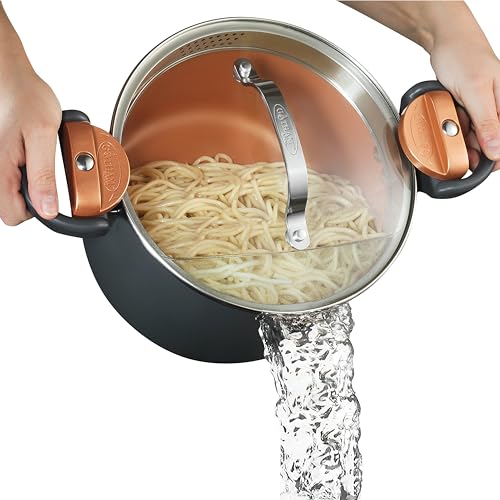
Straining features create a separate design category. ACTIV CUISINE provides a locking lid with two straining sizes, Gotham Steel uses a locking strainer lid, and BEZIA 6 Quart documents two strainer sizes plus a pour spout. These features can reduce the need for a separate colander, but they also add parts to inspect and clean.
Handle construction matters when the pot is full. Riveted stainless steel handles appear on several selected models. Silicone or Bakelite grips may improve comfort during stovetop handling, but heat limitations still apply. Bakken explicitly warns that its handles heat during cooking. Always follow the supplied handling instructions and use appropriate protection when moving a hot or heavy pot.
Match cleanup and oven use to your routine
Cleanup claims range from wipe-clean surfaces to dishwasher-safe designs and recommended hand washing. SENSARTE recommends hand washing. A dishwasher-safe label can be useful, but it does not mean every component has the same care requirements.
Oven limits vary substantially. Blue Diamond lists 600°F, Bakken 500°F, BEZIA 6 Quart 400°F with the lid excluded, GreenPan x Bobby Flay 392°F, Nordic Ware 350°F, and Gotham Steel 300°F. Some listings do not provide an oven temperature. If you plan to finish a stew or baked pasta in the oven, confirm whether the rating applies to the pot, the lid, or both.
How this comparison was scored
The editorial scores use six category-specific criteria: ceramic coating documentation, stovetop compatibility, capacity and cooking range, heat distribution and body construction, lid and handle utility, and cleanup and oven flexibility. Each product received a 0.0-to-10.0 score for every criterion, with weights totaling 100. The ranking is based on supplied public specifications and feature statements. It does not use customer sentiment, popularity, volatile marketplace labels, or hands-on test results.
Final Recommendation
GreenPan Valencia Pro 8QT Ceramic Stock Pot ranks first overall in this specification-based comparison under the published weighted criteria.
The final choice among the best ceramic stockpots depends on the documented features that match your intended use.
GreenPan Valencia Pro is the highest-scoring returned product and the first overall specification-based choice. It offers a balanced 8-quart capacity, documented induction compatibility, hard-anodized construction, diamond-infused ceramic nonstick, a glass lid, and dishwasher-safe cleanup. Those features make it a versatile starting point for many kitchens.
For large-volume cooking, Bakken 16 Quart is the stronger size-oriented alternative, while Nordic Ware Verde 12 Quart offers another large-capacity option with induction readiness and silicone-grip handles. Blue Diamond 8QT is the better fit when a high stated oven and broiler limit matters more than induction support. Among the top ceramic stockpots, ACTIV CUISINE, Gotham Steel, and BEZIA 6 Quart are especially useful for cooks who want built-in straining.
Capacity and cooktop should remain the deciding factors. Choose the 6- to 8-quart products for general household use, the 10- to 12-quart products for larger batches, and the 16-quart Bakken when volume is the priority. Before purchase, verify the latest listing details and confirm that the oven and care instructions match your routine.
Frequently Asked Questions
What are the best ceramic stockpots for induction cooking?
The supplied listings document induction compatibility for GreenPan Valencia Pro, Bakken 16 Quart, GreenPan x Bobby Flay 6QT, ACTIV CUISINE 8.5qt, BEZIA 10QT, BEZIA 6 Quart, and SENSARTE. Blue Diamond is specifically listed as not induction compatible. If induction is essential, select a model with explicit induction or magnetic-base language rather than relying on its ceramic coating description.
Is a ceramic stockpot the same as a ceramic pot?
Not necessarily. The selected products are generally metal-bodied stockpots with ceramic nonstick coatings. Their bodies include aluminum, hard-anodized aluminum, cast aluminum, aluminized steel, or aluminum alloy. The word ceramic usually describes the cooking surface or coating in these listings, so check the construction details if the body material matters to you.
Which selected pot is best for pasta draining?
ACTIV CUISINE 8.5qt has a locking strainer lid with two straining sizes. Gotham Steel 5 Quart also documents a locking strainer lid, while BEZIA 6 Quart includes two strainer sizes and a pour spout. These designs are suited to pasta and vegetables, but they may require more attention to lid alignment and cleaning than a conventional glass lid.
Can these stockpots go in the oven?
Several can, but the stated limits differ and may apply differently to the lid. Blue Diamond lists oven and broiler safety up to 600°F; Bakken lists up to 500°F; BEZIA 6 Quart lists up to 400°F with the lid excluded; and Gotham Steel lists up to 300°F. GreenPan Valencia Pro lists its glass lid as oven safe up to 425°F. Always follow the specific product instructions before transferring a pot or lid to the oven.
How should a ceramic nonstick stockpot be cleaned?
Follow the individual listing’s care guidance. GreenPan Valencia Pro, Blue Diamond, GreenPan x Bobby Flay, Gotham Steel, and ACTIV CUISINE document dishwasher-safe cleanup, while SENSARTE recommends hand washing. Even when a pot is dishwasher safe, gentle cleaning and suitable utensils may help preserve the ceramic surface. Do not assume that a lid, handle, or accessory has the same care rating as the pot body.