Buying Guide
Choosing the best cermet potentiometers starts with the circuit rather than the brand name. A cermet potentiometer is an adjustable resistive component, but the useful differences are substantial: resistance value, adjustment travel, power rating, installation method, and access direction all affect whether a part will fit the design. The listings in this comparison describe both small PCB trimmers and panel-style components, so these should not be treated as interchangeable.
Match the resistance value first
Resistance is the first filter. The selected products range from 500Ω and 1KΩ options through 2KΩ, 2.5KΩ, 5KΩ, 10KΩ, 20KΩ, 100KΩ, 500KΩ, and 5MΩ. That spread is useful, but it also means a physically similar part may be electrically wrong for the application.
The BI Technologies 64YR500 is the low-value choice at 500Ω, while the uxcell 3296W is listed at 1KΩ. The Bourns 3296W-1-502LF and BI Technologies 55PR2.5K cover the low-kilohm range, and the Bourns 3299W-1-103LF reaches 10KΩ. For higher-resistance circuits, the Vishay M43P203KB40 is 20KΩ, the uxcell 3296W-104 is 100KΩ, the Jameco Valuepro 3006P is 500KΩ, and the AVLIS-CO 3296Y-1-505LF is 5MΩ.
Do not assume that a stated resistance is exact in operation. Where supplied, tolerance matters: the uxcell 3296W-104 lists ±10%, while other entries may not provide tolerance in the listing evidence. Confirm the required tolerance and resistance curve against the circuit documentation before purchase.
Decide whether multi-turn adjustment is necessary
Turn count describes adjustment resolution, not automatically electrical accuracy. Multi-turn products provide more mechanical travel for making a setting, which can be helpful when a circuit needs a carefully tuned operating point. The Bourns 3296W-1-502LF, Bourns 3299W-1-103LF, Bourns 3299W-1-202LF, uxcell 3296W-104, uxcell 3296W, and AVLIS-CO 3296Y-1-505LF are listed with 25 turns. The BI Technologies 55PR2.5K provides 22 turns, and the Vishay M43P203KB40 provides 20 turns.
The Jameco Valuepro 3006P has 15 turns, and the BI Technologies 64YR500 has 12 turns. Those may be reasonable where some adjustment range is wanted without selecting the highest-turn design. By contrast, a single-turn component is faster to adjust but offers less mechanical travel; none of the selected products is ranked as the main single-turn choice because the documented multi-turn options provide a stronger comparison for calibration-oriented use.
Check power handling with margin
Power rating is a specification to compare directly with the circuit’s expected dissipation. The BI Technologies 55PR2.5K lists 1W, the Jameco Valuepro 3006P lists 3/4W, and the Bourns 3296W-1-502LF, Bourns 3299W-1-103LF, Bourns 3299W-1-202LF, Vishay M43P203KB40, and AVLIS-CO 3296Y-1-505LF list 500mW or 1/2W. The BI Technologies 64YR500 lists 1/4W.
The uxcell 3296W listing does not supply a power rating in the evidence used here, so it should not be treated as a high-power substitute merely because its body resembles other trimmers. Similarly, a larger physical package does not by itself establish greater power capability. Use the manufacturer’s current specification when operating near the rating or in a warm enclosure.
Choose the mounting and termination style
Most of the selected parts are intended for board installation. Through-hole mounting is explicitly stated for the Bourns 3296W-1-502LF, Bourns 3299W-1-103LF, Bourns 3299W-1-202LF, Vishay M43P203KB40, and the uxcell listings. The uxcell 1KΩ model also provides three pins and a 2.54mm pitch, which is useful information when checking PCB spacing. The BI Technologies 55PR2.5K is listed with through-hole termination.
The Jameco Valuepro 3006P has compact rectangular dimensions, but the supplied listing does not explicitly identify its termination or mounting method. Treat that missing detail as something to verify. Package quantity also varies: several products are listed as packs of five or 10, while the Bourns and Vishay parts are listed as individual components. A pack can be useful for repeated builds, but compare the quantity with the actual number of adjustments needed.
Plan adjustment access and physical clearance
Top adjustment and side adjustment are different mechanical choices. The Bourns 3296W-1-502LF, Bourns 3299W-1-103LF, Bourns 3299W-1-202LF, and uxcell 3296W-104 specify top adjustment. The Vishay M43P203KB40 specifies side adjustment, which may suit a board mounted behind a panel or beneath another assembly. Access direction should match the available tool path and enclosure opening.
Also check body dimensions, pin pitch, shaft requirements, and nearby components. The BI Technologies 64YR500 lists a 1/4-inch size, while the uxcell 1KΩ model lists a 10 x 9 x 4mm body and 2.54mm pitch. These details are more useful for fit decisions than a generic description such as compact. If the part will be manually adjusted from a front panel, verify whether the listing documents a shaft or panel-mount arrangement; the products ranked here are primarily board-level trimmers.
Verify the final specification before ordering
Public listing data can omit important information. Confirm tolerance, temperature coefficient, end resistance behavior, mechanical life, environmental limits, and exact package drawing from the manufacturer’s datasheet when the application is sensitive. The uxcell 3296W-104 is one of the more detailed listings because it supplies tolerance, temperature coefficient, withstand voltage, body size, and adjustment style. Even so, those details should be checked against the current manufacturer documentation.
Final Recommendation
AVLIS-CO 3296Y-1-505LF 5MΩ 25-Turn Pack ranks first overall in this specification-based comparison under the published weighted criteria.
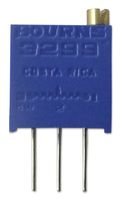
The Bourns 3296W-1-502LF is the first overall specification-based choice among these best cermet potentiometers because it combines a 5KΩ value, 25-turn adjustment, top access, through-hole mounting, and a stated 500mW rating. The Bourns 3299W-1-103LF is a close alternative when the circuit requires 10KΩ, while the Bourns 3299W-1-202LF serves the same general calibration role at 2KΩ.
For a side-adjust layout, choose the Vishay M43P203KB40. For higher resistance, the uxcell 3296W-104 is the most completely documented 100KΩ option, while the AVLIS-CO 3296Y-1-505LF reaches 5MΩ. The BI Technologies 55PR2.5K is notable for its 1W rating and 22 turns. Buyers looking for top cermet potentiometers should compare the actual resistance, turn count, access direction, and power rating rather than choosing by package appearance alone.
Frequently Asked Questions
What are cermet potentiometers used for?
They are adjustable resistive components commonly used to set or calibrate circuit parameters. The selected listings include board-mounted trimmers with one or more adjustment turns, as well as different resistance values and power ratings. The appropriate choice depends on the circuit’s required resistance, dissipation, mounting format, and access constraints.
Are 25-turn cermet potentiometers better than 12-turn models?
Not in every application. A 25-turn design offers more mechanical adjustment travel, which can help with fine setting, while a 12-turn product may be adequate when the adjustment does not need to be as gradual. The BI Technologies 64YR500 is listed at 12 turns, whereas several Bourns and uxcell models list 25 turns. Select by adjustment requirements, not turn count alone.
Which of these best cermet potentiometers is suitable for a 100KΩ circuit?
The uxcell 3296W-104 is the direct match in this comparison. Its listing specifies 100KΩ, 25 turns, ±10% tolerance, 1/2W power, top adjustment, and through-hole mounting. Verify the circuit’s tolerance and power requirements before substituting it for another component.
Does through-hole mounting mean every trimmer will fit the same PCB?
No. Through-hole parts can differ in body size, pin spacing, pin orientation, and adjustment direction. The uxcell 1KΩ listing provides a 2.54mm pitch, but that detail is not supplied for every selected product. Check the package drawing and board footprint before ordering.
When should I choose side adjustment?
Side adjustment can be useful when the top of the board is obstructed or when the adjustment tool must approach from the edge. The Vishay M43P203KB40 is the selected product that explicitly documents side adjustment. Make sure the enclosure and neighboring components leave enough clearance for the intended access path.