Buying Guide
Choosing the best crimp butt terminals starts with the wire, the environment, and the type of finish you need after crimping. A butt terminal joins two wire ends in a straight barrel. The connector must match the conductor size closely enough for the crimp tool to form a secure mechanical and electrical connection. A terminal that is too large may not grip correctly, while one that is too small may not accept both conductors.
Start with wire gauge
Read the AWG marking on the wire or confirm the conductor size before selecting a kit. Smaller AWG numbers indicate larger wire. The SVAAR, BAALA, and mankk assortments are useful when a project spans a wide range because their listings cover sizes reaching from the 20s into heavier 6- or 8-AWG groups. CHANZON is more focused on 22-10 AWG work, while the AIRIC, TICONN, and other color-coded heat-shrink kits target common automotive and marine sizes.
Do not assume that every red, blue, or yellow connector uses exactly the same gauge boundaries. Color conventions are common, but the supplied listings show that ranges can overlap or differ. Use the printed or listed gauge range for the specific product. Qibaok adds wire-gauge imprints to the tubing, and TICONN describes color-coded groups, both of which can make selection easier during a repair.
Choose insulated or non-insulated
Heat-shrink butt terminals combine the crimp barrel with an outer sleeve. AIRIC, TICONN, Qibaok, Kuject, and Oiojuct document adhesive-lined or hot-melt heat-shrink construction. After the wires are crimped, heat activates the sleeve and adhesive, creating a moisture-resistant covering according to the listings. This design is especially relevant to boat, trailer, outdoor, motorcycle, and under-vehicle wiring, although the connection still needs correct preparation and heating.
Non-insulated terminals leave the metal barrel exposed after crimping. SVAAR, Sopoby, BAALA, mankk, and CHANZON are examples in this comparison. Bare terminals can be useful for harness fabrication, enclosed panels, and repairs where the installer will add insulation separately. Sopoby explicitly recommends dual-wall adhesive-lined heat-shrink tubing. A non-insulated kit is not automatically unsuitable for a damp setting, but it places the insulation decision and installation step on you.
Compare barrel material and construction
Material affects how the terminal is intended to be used, but listing language should be read precisely. Several selected products specify copper or tinned copper. SVAAR identifies C11000 electrolytic copper, matte tin plating, annealing, and a seamless tubular barrel. BAALA also identifies C11000 pure copper and tinned construction. TICONN and AIRIC describe seamless copper barrels, while Sopoby specifies tinned red copper.
A seamless barrel is a useful design detail because the listing describes it as resisting splitting during crimping. Thick barrels are also documented by several products. These features support a more informed comparison than pack size alone. However, published specifications do not replace matching the connector to the wire and using a compatible crimping tool.
Look for insertion and alignment features
A center wire stop helps both conductors reach the intended position inside a butt splice. SVAAR, BAALA, AIRIC, and mankk document wire-stop or center-line features. Chamfered or flared openings can make wire insertion more straightforward; SVAAR and BAALA specifically mention chamfered ends, while AIRIC lists flared insulation. These are practical design details for repeat work, especially when making harnesses or working in a confined space.
For heat-shrink products, color coding is another selection aid rather than a substitute for measurement. Insert the stripped wire fully, crimp the appropriate side with the correct tool, repeat on the other side, and inspect the result before applying heat. The AIRIC listing specifically describes crimping followed by heating, and the other heat-shrink products likewise require a heat step to activate the sleeve.
Match kit size to the job
A large assortment is useful for technicians, restoration work, and projects with many branches. Qibaok lists 660 pieces, Oiojuct lists 600, and Sopoby lists 460. These kits may reduce the need to reorder, but the exact distribution among sizes matters more than the headline quantity when one gauge dominates your project.
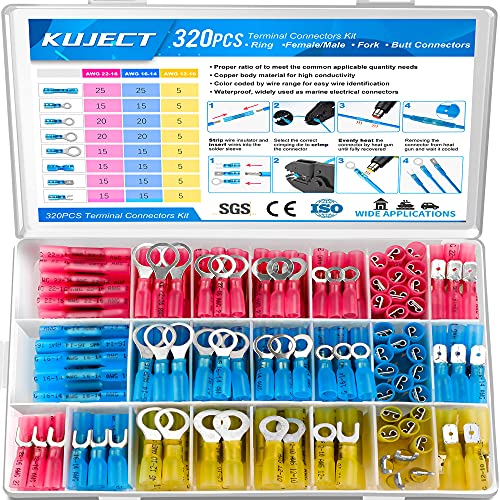
Smaller or more focused kits can be easier to manage. AIRIC and TICONN each list 100-piece assortments, while CHANZON lists 250 pieces concentrated in three gauge groups. Kuject and Oiojuct include other terminal styles, which is useful for mixed wiring tasks but less efficient if you need only butt splices.
Consider the working environment
Marine and outdoor projects generally call for closer attention to moisture protection and corrosion resistance. Heat-shrink products with adhesive-lined tubing provide an integrated sealing approach in the supplied evidence. Tinned copper is also repeatedly documented for corrosion resistance or marine use. For indoor panels or enclosed harnesses, non-insulated tinned-copper terminals may be appropriate when the installer supplies the required sleeve or heat-shrink covering.
The listing evidence supports intended applications such as automotive, marine, trailer, industrial, household, and DIY wiring. It does not establish a universal approval for every electrical system. Check the wire type, voltage, current requirements, enclosure conditions, and any applicable local or equipment requirements before installation. SVAAR and BAALA state a 600-volt rating, but that technical rating should not be generalized to products whose listings do not provide the same specification.
Installation checklist
Use a clean, correctly sized strip length and avoid nicking the conductor strands. Insert both wires to the stop where one is provided. Crimp each side with a tool intended for the terminal type and gauge, then inspect for movement or exposed conductor beyond the intended area. For heat-shrink designs, apply heat evenly enough to shrink the sleeve and activate its adhesive without damaging the wire insulation. For non-insulated designs, add suitable insulation after crimping. These steps are general installation guidance; the supplied listings document the connector features, not independent test results.
Final Recommendation
TICONN 100PCS Heat Shrink Butt Connectors ranks first overall in this specification-based comparison under the published weighted criteria.
The final choice among the best crimp butt terminals depends on the documented features that match your intended use.
SVAAR 380PCS Tinned Copper Butt Connectors is the highest-scoring returned product and the first overall specification-based choice. Its 26-6 AWG coverage, C11000 tinned copper, seamless barrel, wire stop, and chamfered openings give it the most specification-aligned documented combination for broad, heavy-duty repair work. It is non-insulated, so choose another product if integrated moisture sealing is your priority.
For sealed splices, TICONN 100PCS Heat Shrink Butt Connectors is the most complete documented option, with tinned copper, dual-wall adhesive-lined tubing, and a 3:1 shrink ratio. AIRIC is a balanced alternative for common 22-10 AWG sizes. BAALA is a compact non-insulated choice with broad coverage, while CHANZON keeps the assortment focused on common gauges.
The top crimp butt terminals depend on more than quantity. Select the smallest gauge range that fits your wire, then decide whether the finished splice needs integrated heat-shrink insulation. For mixed terminal needs, Kuject and Oiojuct add ring, fork, and spade styles. For repeated splice-only work, Qibaok or Sopoby provide larger dedicated assortments. In every case, treat the listed construction and gauge details as the basis for selection, not as a substitute for correct crimping practice.
Frequently Asked Questions
Among the best crimp butt terminals, are heat-shrink butt terminals better for marine wiring?
They can be a practical fit for marine wiring because the selected heat-shrink products document adhesive-lined or hot-melt adhesive tubing intended to seal the splice after heating. TICONN, AIRIC, and several other listed products also describe marine applications. The result still depends on matching the gauge, making a proper crimp, and applying heat correctly. A non-insulated terminal can also be used when an appropriate external insulation method is added.
What does the color coding on a butt terminal mean?
Color coding generally helps identify a connector’s intended wire-gauge group, but the exact range varies by product. TICONN documents red, blue, yellow, black, and white options with different AWG groupings, while AIRIC lists red, blue, and yellow for 22-10 AWG. Always follow the range printed or specified for the kit you purchased rather than relying on color alone.
Should I choose tinned copper or plain copper?
Tinned copper adds a plated surface, and several selected listings describe it as helping resist corrosion or oxidation. SVAAR, BAALA, Sopoby, and TICONN document tinned construction. Plain copper may still be suitable for an enclosed application, but the supplied evidence does not support treating one material as universally correct. Consider the environment, the terminal’s insulation, and the wire specification together.
Do non-insulated butt connectors need heat-shrink tubing?
Non-insulated connectors do not include an insulating sleeve, so they need a suitable covering when the finished splice must be protected from contact, moisture, or abrasion. Sopoby explicitly recommends dual-wall adhesive-lined heat-shrink tubing, and BAALA similarly recommends heat-shrink tubing for best results. In an enclosed application, the required protection may differ, so follow the equipment and wiring requirements.
Is a larger connector kit always the better choice?
No. A large kit such as Qibaok, Oiojuct, or Sopoby may be useful for repeated work, but the distribution of sizes and terminal styles matters. A focused 100-piece AIRIC or TICONN kit may be more convenient when your project uses only a few common gauges. Choose based on the wire sizes you actually need, whether you want integrated insulation, and whether mixed terminal types are useful.