Buying Guide
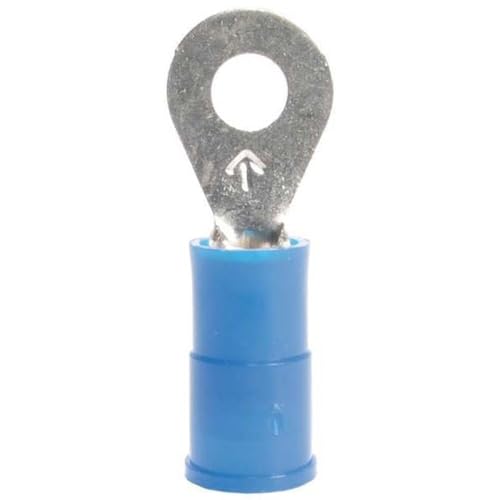
Choosing the best non-insulated ring terminals starts with the connection, not the piece count. A ring terminal must match the conductor size and the stud or bolt it will sit on. Because these terminals have no built-in sleeve, the installer must also consider how the finished connection will be protected from accidental contact, moisture, and nearby metal.
Match the wire gauge first
The most important specification is the wire range accepted by the terminal barrel. The broad kits in this comparison document coverage from AWG 22 through AWG 10. ELECALL, ROCKDIG, Teansic, and Twidec all identify multiple groups within that span. This is useful for a mixed wiring project, but it does not mean every terminal in a kit fits every wire. Sort the pieces by their printed or listed gauge group before crimping.
Focused packs can be preferable when the wire is already known. HKS is listed for AWG 16-14 wire, while DQLIOWUO is also specified for AWG 16-14. Crimp Supply targets the smaller AWG 22-18 range. A narrowly matched terminal can reduce sorting and make replenishment easier, provided the stud opening is also correct.
Confirm the stud or bolt size
A ring terminal is secured by passing the stud through its closed opening. The opening must be large enough for the fastener but not so oversized that the terminal is poorly supported. Twidec documents ring openings from #10 through 3/8 inch, while DQLIOWUO is a #8 pack and HKS is sized for an M5 bolt. Sherco-Auto specifies a 3/8-inch stud, and Crimp Supply specifies a #6 stud.
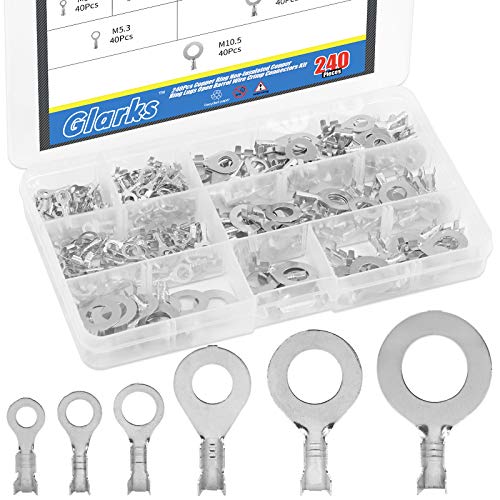
Some assortment kits list metric-style opening dimensions rather than a single bolt standard. Rustark and Glarks both document six sizes, including M3.2, M4.2, M5.3, M6.3, M8.4, and M10.5. These sets are useful when a project includes different fasteners, but compare the listed opening with the actual hardware instead of assuming that a similar-sounding metric and imperial size are interchangeable.
Compare copper and steel construction
Copper is common in the general-purpose kits here. ROCKDIG identifies 99.9% pure copper, ELECALL identifies T2 copper at 99.9% purity, and several other listings specify copper or red copper with tin plating. Tin plating is described as helping resist corrosion or oxidation and is documented for ROCKDIG, Teansic, Twidec, HKS, and DQLIOWUO.
Sherco-Auto and Crimp Supply take a different approach with nickel-plated steel high-temperature terminals. Their listings emphasize a 900°F maximum temperature, while Sherco-Auto also gives a 600 V rating. These products may make more sense for a heat-exposed connection where the documented temperature specification matters more than having several gauge options. The supplied evidence does not establish that one material is universally better, so choose according to the application and the manufacturer’s stated limits.
Decide whether you need rings only or a mixed kit
Several high-count products include both ring and fork terminals. ELECALL, Teansic, Twidec, and ROCKDIG are examples. A mixed kit can be useful for general wiring because a fork terminal can be placed around a fastener without fully removing it, but it means the headline piece count is not a ring-only count.
Glarks, Rustark, and the focused HKS, DQLIOWUO, Sherco-Auto, and Crimp Supply listings are more directly centered on ring terminals. Read the package composition carefully if the project requires a known number of closed-ring connectors rather than a mixture of terminal styles.
Consider installation and protection
The listings commonly describe crimp installation with standard or suitable crimping tools. ROCKDIG and Twidec also state that the terminals can be soldered, while HKS says its terminals can be installed without soldering. Follow the tool and wire-size match specified for the terminal; a loose crimp is not corrected by choosing a larger assortment.
Non-insulated construction leaves the metal barrel and ring exposed. ROCKDIG and Twidec specifically mention using heat-shrink tubing to insulate and protect the connection. If the connection will be near a conductive surface, exposed terminals deserve particular attention. Heat-shrink tubing is not included in the evidence for every product, so treat it as a separate planning item unless the selected listing states otherwise.
Think about storage and project scale
For a workshop or vehicle with several wire sizes, organization can be as important as quantity. Teansic lists 18 grids and a transparent case. A divided case helps keep gauge groups and stud sizes separate.
For a one-off repair, a 50- or 100-piece focused pack may be more appropriate. Sherco-Auto, Crimp Supply, HKS, and DQLIOWUO are easier to evaluate against a single known connection. Larger assortments offer flexibility, but unused terminal styles and sizes can add sorting work.
Methodology
This is a specification-based comparison using the supplied public listing titles, features, and technical fields. The editorial criteria emphasize gauge coverage, stud-size information, material and coating, organization, and installation or application fit. No hands-on testing, customer sentiment, volatile marketplace metrics, or undocumented performance claims were used. Products were selected only when their listings independently described non-insulated ring terminals or a kit that included them, and duplicate parent groups were treated as one product.
Final Recommendation
ELECALL 420-Piece Ring and Fork Terminal Kit ranks first overall in this specification-based comparison under the published weighted criteria.
ELECALL is the first overall specification-based choice among these best non-insulated ring terminals because its listing combines 22-10 AWG coverage, multiple ring openings, T2 copper, corrosion resistance, and a substantial mixed assortment. It is the most specification-aligned general-purpose option when the wiring job includes several common sizes.
For the widest documented stud-size selection, Rustark and Glarks are compelling alternatives, with six listed openings each. Twidec is a useful middle ground for buyers who want named #10 through 3/8-inch ring sizes, tinned red copper, and a divided case. Teansic is better suited to maintaining a larger terminal inventory, while ROCKDIG is notable for publishing thickness and current figures by AWG group.
When the connection is already defined, a focused pack can be more efficient. HKS targets M5 and AWG 16-14; DQLIOWUO targets #8 and AWG 16-14; Crimp Supply targets #6 and AWG 22-18. For elevated temperatures, Sherco-Auto has the clearest documented high-heat specification. Together, these are the top non-insulated ring terminals for different specification needs rather than a single universal design.
Frequently Asked Questions
Among the best non-insulated ring terminals, what are non-insulated ring terminals used for?
They connect a stripped wire to a stud, bolt, or post through a closed ring opening. The selected listings describe uses including automotive circuits, marine equipment, household appliances, machinery, solar systems, power distribution, and industrial wiring. The terminal must still be matched to the conductor and fastener.
How do I choose the correct ring-terminal size?
Match two specifications: the wire gauge accepted by the barrel and the stud or bolt size accepted by the ring. For example, HKS is listed for AWG 16-14 wire and an M5 bolt, while DQLIOWUO is listed for AWG 16-14 wire and a #8 stud. Do not select by wire gauge alone.
Are copper terminals better than nickel-plated steel terminals?
The supplied listings document different strengths rather than a universal winner. Copper and tinned copper are common in general-purpose assortments, while Sherco-Auto and Crimp Supply specify nickel-plated steel and 900°F maximum temperature ratings. Choose based on the application’s documented temperature, corrosion, and compatibility requirements.
Do non-insulated terminals need heat-shrink tubing?
They may need a separate insulation or protection method because the metal connection is exposed. ROCKDIG and Twidec specifically mention heat-shrink tubing for insulating and protecting connections. Plan that protection separately unless the product listing explicitly includes it.
Should I buy a large assortment or a focused pack?
Choose an assortment when the project includes several gauges or stud sizes. ELECALL, Rustark, Teansic, and Twidec provide broad documented selections. Choose a focused pack when the connection is known, such as the HKS M5 AWG 16-14 pack or the Crimp Supply #6 AWG 22-18 pack. This can simplify matching and storage.