Buying Guide
Choosing the best crimp ring terminals starts with the connection rather than the package count. Identify the wire gauge, the stud or bolt diameter, and the environment around the joint. A terminal that fits the wire but not the fastener is not a suitable match, and an unsealed terminal may need additional protection in a damp or exposed location.
Match the wire gauge
The selected products cover several useful ranges. The small-gauge group includes 22-16 AWG, while medium options commonly list 16-14 AWG and 12-10 AWG. The TKDMR set extends in the other direction, documenting AWG 2 through 12 for battery-cable applications. Do not treat a broad package range as permission to use any terminal with any wire: match the conductor to the terminal’s color or printed size information.
The color-coded products make that selection easier. smseace, Tanbupu, LIDUOLE, and haisstronica list red, blue, and yellow insulation associated with different wire ranges. That organization can be helpful when several circuits are being assembled or repaired. For larger cables, TKDMR’s explicit AWG 2, 4, 6, 8, 10, and 12 coverage is more relevant than a small-wire assortment.
Check the stud or fastener size
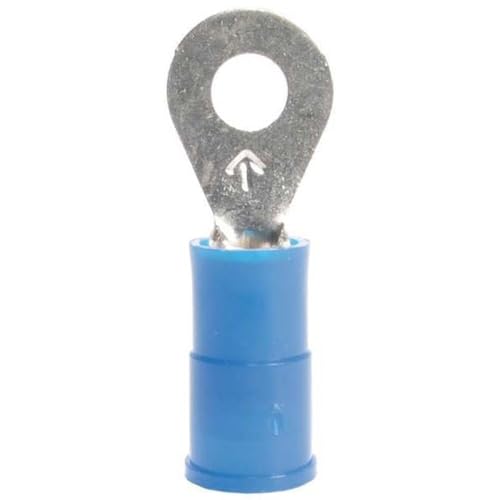
Ring terminals are defined by the opening as well as the wire barrel. The selected insulated assortments list openings such as #4, #8, #10, 1/4 inch, 5/16 inch, and 3/8 inch. Haisstronica provides the broadest documented insulated spread in this comparison, while LIDUOLE emphasizes smaller and medium openings. TICONN also lists #10 through 3/8 inch, making it appropriate when several common fastener sizes may appear in one wiring job.
For metric equipment, Rustark and QOOSIKICC document M3 through M10-style openings. Rustark lists six specific sizes from M3.2 through M10.5, and QOOSIKICC lists M3, M4, M5, M6, M8, and M10. Confirm the actual opening dimensions before ordering, especially when a listing uses nominal metric descriptions rather than a single exact diameter.
Decide between insulated and non-insulated designs
Insulated terminals provide a built-in sleeve around the crimp area. This makes insulated formats convenient for general wiring where exposed metal should be covered.
Non-insulated products such as Rustark, RockDIG, QOOSIKICC, and KOXXIAMOQ leave the barrel exposed. That can be useful in equipment layouts where space is limited or where the installer plans to add separate heat shrink. It also means the terminal alone should not be treated as an environmental barrier. Rustark and QOOSIKICC specifically document open-barrel or open-housing designs, which may help with solid or stranded wire insertion but do not replace insulation.
Consider moisture and outdoor exposure
Heat-shrink designs are the logical starting point for marine, vehicle, outdoor, and damp-area wiring when the listing documents a sealed construction. TICONN describes dual-wall insulation, a 3:1 shrink ratio, and heat-activated adhesive. The selected haisstronica product describes one-third heat-shrink tubing with waterproof and dustproof properties. TKDMR also includes 3:1 dual-wall adhesive tubing for its battery-cable lugs.
These descriptions identify design intent, not a guarantee for every installation condition. Proper wire stripping, crimping, heating, and sizing still matter. Standard insulated terminals can be appropriate for protected indoor or enclosed wiring, but the selected smseace, Tanbupu, and LIDUOLE listings do not document the same adhesive-lined seal as the heat-shrink products.
Review the conductor material
Copper and brass are common conductor materials in this selection. Several listings specify pure or high-purity copper, while others describe brass or copper construction. Tin plating appears repeatedly and is described as helping resist corrosion or oxidation. RockDIG adds listed thickness and current figures for its three gauge groups, giving it more technical detail than many assortment listings.
Material language should be read alongside the terminal design. A tinned copper barrel can support corrosion resistance, but the evidence does not establish a universal performance level across brands. Avoid assuming that a material claim alone determines suitability for a particular current or temperature. Use the manufacturer’s documented gauge and electrical specifications when those are supplied.
Think about assortment composition
A high piece count is useful when it matches the work. Haisstronica’s 260-piece ring-terminal assortment is suited to varied common wiring, while KOXXIAMOQ offers 250 bare terminals across four wire ranges. Rustark provides 240 pieces divided among six ring sizes. In contrast, TICONN’s 120-piece package includes ring, fork, spade, butt, and quick-disconnect styles, so it is a broader connector kit rather than a ring-only stock box.
Mixed kits can reduce the number of ring terminals available but may prevent a second purchase when a project needs several connector forms. Dedicated assortments are more efficient when the job is specifically ring-terminal replacement or repeated panel work. Storage boxes and color coding, documented for several selected products, also help separate sizes during installation.
Installation and verification checklist
Use a crimping tool suited to the wire and terminal range. Strip only the necessary insulation, insert the conductor fully into the barrel, and verify that no loose strands extend beyond the terminal. Where the design includes an inspection window, use it to check insertion before crimping. After crimping, inspect the joint and perform a careful pull check appropriate to the application; do not rely on the insulation sleeve alone to indicate a sound mechanical connection.
For heat-shrink terminals, position the ring over the correct stud before finalizing the circuit, then apply controlled heat as directed by the product instructions. The supplied evidence supports the presence of adhesive-lined or dual-wall designs for selected products, but it does not provide a universal heating temperature or installation time. Always verify the wire range and opening against the actual hardware.
Final Recommendation
haisstronica 260PCS Heat Shrink Ring Terminals ranks first overall in this specification-based comparison under the published weighted criteria.
haisstronica 260PCS Heat Shrink Ring Terminals is the highest-scoring returned product and the first overall specification-based choice. It combines 22-10 AWG coverage, four documented stud sizes, pure-copper terminals, color coding, and heat-shrink insulation in one broad assortment.
For metric bare-terminal work, Rustark 240 Pcs Non-Insulated Ring Crimp Terminals is the most specification-aligned alternative because its six documented sizes run from M3.2 to M10.5. Choose TICONN 120 Pcs Marine Crimp Ring Terminal Kit when a project needs heat-shrink sealing plus several other connector types. For larger battery cables, TKDMR 160Pcs Battery Cable Lug and Heat Shrink Set is the more targeted selection. These are among the top crimp ring terminals here because each addresses a different combination of gauge, opening, protection, and assortment needs.
The best crimp ring terminals are therefore application-specific: select a sealed heat-shrink design for documented moisture protection, a bare assortment where separate insulation is planned, or a broad insulated kit for general repairs. Before installation, confirm both the wire range and stud opening from the product information.
Frequently Asked Questions
Which of the best crimp ring terminals is suited to marine wiring?
TICONN, haisstronica, and the selected Tanbupu heat-shrink assortment document heat-shrink insulation and moisture-related protection. TICONN specifically describes dual-wall insulation with heat-activated adhesive and marine applications. The correct choice still depends on the wire gauge, ring opening, and installation conditions.
Are non-insulated ring terminals a good choice?
They can be useful when the terminal will be covered separately or when a compact bare connection is required. Rustark, RockDIG, QOOSIKICC, and KOXXIAMOQ are selected non-insulated examples. Their listings describe copper or brass construction and, in some cases, tin plating, but they do not provide an integrated insulating sleeve. Add suitable protection when the connection could contact conductive surfaces or moisture.
How do I choose between metric and inch ring sizes?
Use the fastener system used by the equipment. Rustark and QOOSIKICC list metric openings, while haisstronica, TICONN, smseace, and LIDUOLE list inch or numbered openings. Do not choose based only on the wire gauge: the ring must fit the stud without excessive looseness and should not interfere with adjacent hardware.
What wire gauges are covered by the selected kits?
Many selected general-purpose kits cover 22-16, 16-14, and 12-10 AWG. Haisstronica and TICONN document that broad small-to-medium range. TKDMR instead reaches larger battery-cable sizes, including AWG 2, 4, 6, and 8. Check the individual terminal marking or product size table before crimping, because package-level coverage does not mean every ring size accepts every gauge.
Do heat-shrink ring terminals eliminate the need for proper crimping?
No. Heat-shrink tubing helps insulate or seal a connection, but it does not replace correct wire insertion and crimping. The selected products describe adhesive-lined or dual-wall designs, including 3:1 shrink ratios, but the supplied evidence does not establish a universal installation procedure. Use the correct tool, verify the wire is fully inserted, and inspect the finished connection.