Buying Guide
The best glass wine decanters are easier to compare when you separate the vessel itself from the accessories and mechanisms attached to it. The products selected here are all independently listed as wine decanters or wine carafes, but they take different approaches to aeration, pouring, storage, and cleaning. A wide open bowl prioritizes surface exposure, while an integrated aerator or filter adds another way to distribute wine during serving.
Start with the intended bottle size
A standard 750ml bottle is the most useful reference point. Several selected models explicitly document that capacity: Le Chateau is listed at 750ml, Plaisir de la Cave is designed to fit a full 750ml bottle at its widest point, and Cork & Mill says its wide-base design is intended for a full 750ml bottle. Godinger Dublin also lists a 750ml capacity.
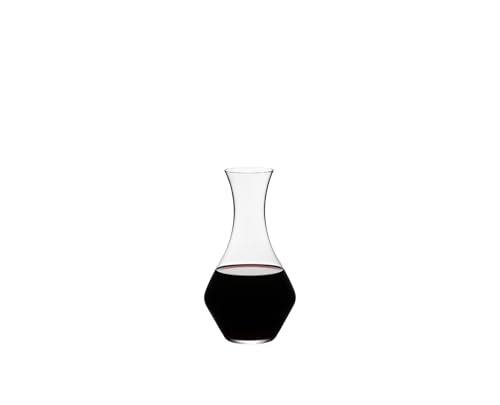
Larger vessels can offer more room around the wine, but they may also occupy more cabinet or countertop space. JoyJolt Lancia lists 1200ml or 40oz, Wlasss lists 1300ml, and Plaisir de la Cave lists 1800ml or 60oz total capacity. Those formats are useful when you want generous headroom around a standard bottle or plan to serve a group. Riedel Cabernet, at 25oz, is a more compact single-bottle choice with less spare capacity.
Be careful when comparing capacity labels. Bormioli Rocco Loto is listed at 1.25 liters to the brim but 1 liter with the stopper in, while some other listings use ounces or describe capacity by bottle fit. The practical question is not simply the largest number; it is whether the usable interior fits your normal bottle and leaves room for pouring without filling the vessel to its edge.
Choose an aeration style
Open, wide-base designs create a broad area for the wine to spread. Le Chateau documents a wide diameter, JoyJolt Lancia specifies a large base area, and Cork & Mill describes a wide base for aerating a full bottle. Plaisir de la Cave also provides a large 1800ml form around a 750ml bottle. These shapes are relatively simple and have fewer added components.
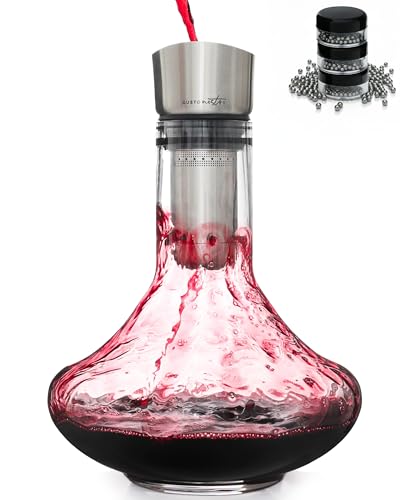
Integrated systems take a different approach. VnoPerito documents a built-in aerator and double-layer filter that combines decanting, filtering, and pouring. Wlasss lists a double-layer filtration system and a stainless steel pour lid. Gusto Nostro includes a stainless steel pourer, lid, and filter. These designs may appeal when you want aeration and serving functions in one top assembly, but the added parts can require more attention during cleaning.
Riedel Cabernet offers a simpler angular crystal form and is documented for both young and old wines, as well as white or red. Godinger Dublin documents a traditional crystal carafe without an aerator or filter. That simpler approach can be appropriate when your priority is transferring and presenting wine rather than using a specialized top.
Examine pouring control
A tilted or slanted opening can help direct the stream. Le Chateau documents both a slanted top and spout. JoyJolt Lancia has an easy-pour slanted spout, while Wlasss uses a tilted bottle spout and a narrow neck. Plaisir de la Cave also lists a slanted top for drip-less pouring. These features are useful specification clues for handling, although the listing evidence does not establish a measured pour performance.
Le Chateau specifically lists a wide mouth, and Cork & Mill describes a wide neck suitable for a long-handled brush. If easy access matters, compare the opening and neck design rather than relying on the word crystal alone.
Consider material and construction
Riedel identifies clear crystal glass, while Bormioli Rocco Loto is identified as made in Italy and uses a glass stopper. Hand-blown construction is specifically stated for Le Chateau, JoyJolt Lancia, VnoPerito, Gusto Nostro, Wlasss, and Plaisir de la Cave.
Clear glass or crystal also keeps the wine visible, which is part of the presentation appeal of this category. However, construction language should not be treated as proof of impact resistance, thermal performance, or long-term durability beyond what the listing states. The supplied evidence supports material and manufacturing comparisons, not laboratory conclusions.
Plan for cleaning and storage
Cleaning information varies considerably. Le Chateau lists a wide mouth, and Cork & Mill describes a wide neck and contours intended for a long-handled brush. Gusto Nostro includes reusable stainless steel cleaning beads, and Plaisir de la Cave includes stainless steel beads as well. Those accessories address the narrow or curved interiors common to wine carafes, but they do not replace following the manufacturer’s care instructions.
Covered designs can help with storage. Bormioli Rocco Loto includes a glass stopper, Cork & Mill includes a matching stopper, and Plaisir de la Cave includes a cork stopper. By contrast, several open designs do not document a lid or stopper. A stopper can be useful between pours, but it also adds another component to wash and store.
Before choosing, check the vessel’s height and footprint. Le Chateau is listed at about 3.94 inches in one dimensional field, while other selected models list heights from roughly 8.7 to 12.1 inches. The supplied dimensional fields are not equally complete across listings, so use the available height and width information as a planning aid rather than assuming every measurement describes the same point on the product.
Match the design to your serving routine
For a classic open carafe, Le Chateau, Godinger Dublin, and Riedel Cabernet provide clear material and capacity information without relying on a built-in filter. For a larger base, JoyJolt Lancia, Wlasss, and Plaisir de la Cave provide more room around a standard bottle. For integrated serving functions, VnoPerito and Gusto Nostro document aerators, filters, or pourers. For display-oriented storage, Cork & Mill adds an acacia stand and stopper, while Bormioli Rocco Loto includes a glass stopper.
This comparison is specification-based. It does not claim that one shape changes a wine’s flavor by a measured amount, pours without exception, or cleans faster in practice. Instead, the ranking reflects how completely each listing documents category-relevant design features and how directly those features address aeration, capacity, pouring, material, and maintenance.
Final recommendation
Plaisir de la Cave Decanter with Stopper and Beads ranks first overall in this specification-based comparison under the published weighted criteria.
Le Chateau Large Elegant Crystal Wine Decanter is the first overall specification-based choice among these best glass wine decanters. Its documented combination of hand-blown lead-free crystal, 750ml capacity, wide diameter, slanted top, spout, and wide mouth gives it a balanced feature set for standard-bottle red-wine service.
The top glass wine decanters otherwise divide into clear use cases. Choose JoyJolt Lancia for a larger base and 1200ml capacity, VnoPerito or Wlasss for built-in aeration and filtration features, and Gusto Nostro for an aerator paired with cleaning beads. Plaisir de la Cave is the most accessory-rich large format, while Cork & Mill is the display-ready set with an acacia stand and stopper.
For simpler crystal presentation, Riedel Cabernet and Godinger Dublin keep the design focused. Bormioli Rocco Loto adds a glass stopper and documented use with spirits as well as wine. The best glass wine decanters for your table will depend on whether you prioritize an open bowl, an integrated pourer, a stopper, a cleaning aid, or a more compact footprint.
Frequently Asked Questions
What capacity should a glass wine decanter have for one bottle?
A 750ml capacity matches a standard bottle, as documented by Le Chateau and Godinger Dublin. Some larger models, such as JoyJolt Lancia at 1200ml and Wlasss at 1300ml, leave more room around that bottle. Plaisir de la Cave lists 1800ml total capacity and is designed to fit a full 750ml bottle at its widest point. Compare usable capacity and the vessel’s footprint together.
Are built-in aerators different from wide-base decanters?
Yes. A wide-base decanter spreads wine across a larger interior area; Le Chateau, JoyJolt Lancia, and Cork & Mill document this type of design. VnoPerito, Gusto Nostro, and Wlasss add built-in aeration or pourer components, with VnoPerito and Wlasss also documenting filtration. The supplied listings describe these designs, but they do not provide independent performance testing.
Which of the best glass wine decanters include cleaning accessories?
Gusto Nostro includes reusable stainless steel cleaning beads, and Plaisir de la Cave includes stainless steel beads as well. Cork & Mill documents a wide neck intended for use with a long-handled brush. Le Chateau lists a wide mouth. These details can help with maintenance planning, although the evidence does not establish a universal cleaning time or result.
Do any selected decanters include a stopper?
Yes. Bormioli Rocco Loto includes a glass stopper, Cork & Mill includes a matching stopper, and Plaisir de la Cave includes a cork stopper. The other selected models do not document a stopper in the supplied listing information. A covered design may suit storage between pours, while an open design may have fewer parts to manage.
What material details are documented for these decanters?
Several selections specify lead-free crystal, including Le Chateau, VnoPerito, Gusto Nostro, Wlasss, Plaisir de la Cave, and Godinger Dublin. Riedel identifies clear crystal glass, and Bormioli Rocco Loto is listed as made in Italy with a glass stopper. These are material and construction descriptions from public listings, not independent assessments of durability or safety beyond the claims supplied.