Buying Guide
Choosing among the best portable air conditioners with dehumidifiers starts with matching the documented capacity to the room rather than relying only on the headline BTU number. Listings may provide both ASHRAE and SACC figures; when both appear, SACC is useful for comparing portable units under a stated seasonal rating. The selected products range from compact-room models rated around 300 to 350 square feet to larger units listing coverage up to 700 or 800 square feet.
Match capacity to the room
The DREO 318S and IDEALHOUSE 8,000 BTU models are positioned for smaller rooms, with IDEALHOUSE listing coverage up to 350 square feet and DREO listing 5,000 BTU SACC. Midea specifies coverage up to 300 square feet, making it a focused option for a bedroom, office, or similarly sized area. Air Future lists up to 450 square feet, while DOMANKI lists up to 500 square feet.
For larger spaces, TECXERLLON, Humhold, Garvee, and KAMLAM provide higher stated capacities. TECXERLLON lists 15,000 BTU and coverage up to 800 square feet. Humhold lists 14,000 BTU ASHRAE, 10,000 BTU SACC, and 550-to-700-square-foot coverage. Garvee and KAMLAM also list 14,000 BTU capacity, with coverage up to 750 and 700 square feet respectively. These figures are listing claims, not independent room-performance measurements, so room layout, insulation, sun exposure, and ceiling height still matter.
Evaluate dehumidification and drainage
A cooling unit can remove moisture while operating, but the drainage design determines how much attention it may need. Some selected models provide numerical moisture-removal claims. TECXERLLON lists up to 100 pints per day, Humhold lists 80 to 96 pints per day, Air Future lists up to 50 pints per day, and IDEALHOUSE lists up to 45 pints per day.
Self-evaporating systems can reduce routine emptying during cooling, but they do not mean every operating condition is drainage-free. DREO states drainage-free operation below 90% humidity for its selected units, while TECXERLLON describes up to 72 hours under 90% humidity. KAMLAM states no manual drainage at humidity of 85% or below. Humhold says normal use may not require draining but calls for continuous drainage in its dry mode or at higher humidity. Air Future likewise warns that its internal tank can fill in extremely humid conditions.
If humidity control is the main reason for buying, prioritize a listing with a pints-per-day figure and read the drainage notes. A unit with a hose option may be more suitable for sustained dry-mode use than one designed mainly to evaporate condensate during cooling.
Consider controls and modes
The core modes in this category are cooling, fan, and dehumidification or dry operation. Several selected models add sleep mode, timers, auto swing, or temperature sensing. DREO’s two models are the most connected choices because they support an app plus Siri, Alexa, and Google Home control. Midea offers SmartHome app control and voice-assistant compatibility. Garvee provides Follow Me sensing through the remote, while KAMLAM lists a smart mode that switches between cooling and fan operation based on room conditions.
A 24-hour timer appears across many selections, including Garvee, Humhold, Midea, DOMANKI, and IDEALHOUSE. A timer can help schedule operation, but the supplied evidence does not establish energy savings or real-world running cost. Treat it as a convenience feature rather than a performance guarantee.
Check noise claims carefully
Noise information is uneven across the listings. DREO states 45dB, DOMANKI states as low as 48dB in sleep mode, TECXERLLON states 48dB, and Humhold states less than 48dB in sleep mode.
The absence of a number does not prove that a unit is loud; it simply means the supplied evidence does not quantify sound. Midea, Garvee, KAMLAM, Air Future, and IDEALHOUSE provide useful operating features but no numerical noise figure in the supplied listing data. For a bedroom, use documented noise claims as one input and also consider whether sleep mode can adjust the fan or turn off the display.
Plan installation and movement
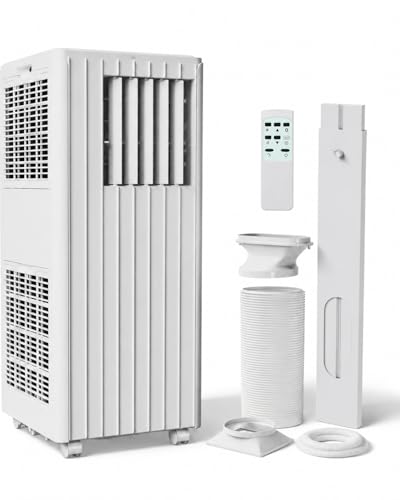
Every selected model is a floor-standing portable AC intended to exhaust through a window. Included window kits and hoses are documented for the products, with Midea giving a 26.5-to-48-inch bracket range and Garvee describing a no-drill kit for sliding and double-hung windows. IDEALHOUSE similarly describes tool-free setup for those window types.
Portability is more than having casters. TECXERLLON lists a 70.4-pound weight, Humhold lists the current price, and KAMLAM lists the current price. These units may roll between rooms but may be difficult to carry. Smaller models such as Air Future and IDEALHOUSE have more compact listed footprints, and the selected products generally include wheels or casters. Measure the storage area, window opening, and route between rooms before purchase.
Final recommendation
TECXERLLON 15,000 BTU Portable AC ranks first overall in this specification-based comparison under the published weighted criteria.
TECXERLLON 15,000 BTU Portable AC is the first overall specification-based choice in this comparison.
The final choice among the best portable air conditioners with dehumidifiers depends on the documented features that match your intended use. TECXERLLON combines a 15,000 BTU rating, stated coverage up to 800 square feet, up to 100 pints per day of dehumidification, a 48dB claim, sleep mode, and self-evaporation. For connected-home controls and a 45dB claim, DREO Portable Air Conditioner 515S is a strong alternative. For smaller rooms, DREO 318S and Midea provide clearly documented smart-control options.
Among the top portable air conditioners with dehumidifiers, the practical choice depends on the evidence that matters most to your room. Choose a model with a clear SACC figure for capacity comparison, a numerical moisture-removal claim when humidity is the priority, and a stated drainage plan if you expect extended dry-mode use. Treat room-coverage figures as product-listing guidance, and confirm the window kit will fit before ordering.
Frequently Asked Questions
Do portable air conditioners also work as dehumidifiers?
Yes. Every selected product lists a dehumidification or dry function alongside cooling and fan operation. Some, including TECXERLLON, Humhold, Air Future, and IDEALHOUSE, also provide numerical moisture-removal claims. Cooling-mode condensate handling and dedicated dry-mode drainage can differ, so review the model’s drainage instructions.
Which best portable air conditioners with dehumidifiers are aimed at larger rooms?
TECXERLLON lists coverage up to 800 square feet, Garvee up to 750 square feet, KAMLAM up to 700 square feet, and Humhold 550 to 700 square feet. These are stated listing capacities, not independent test results. Actual suitability can vary with insulation, sunlight, room shape, and other heat sources.
Can these units operate without manual draining?
Some can reduce routine drainage during cooling through self-evaporating systems. DREO specifies drainage-free operation below 90% humidity, TECXERLLON describes up to 72 hours below 90% humidity, and KAMLAM states no manual drainage at or below 85% humidity. Humid conditions or dedicated dehumidifier mode may still require a hose or tank drainage.
Are portable air conditioners suitable for bedrooms?
Several selected units document sleep modes or quiet-operation claims. DREO lists 45dB, while DOMANKI and TECXERLLON list 48dB-related sleep or operating claims. The other products may still be used in bedrooms, but the supplied evidence does not provide a comparable numerical noise rating for every model. Window exhaust installation is still required.
What should I measure before buying?
Measure the room, the window opening, and the path used to move or store the unit. Confirm that the included window kit is suitable for the window style. Also check the unit’s listed dimensions and weight, especially for larger models such as TECXERLLON, Humhold, KAMLAM, and DREO 515S.