Buying Guide
This guide compares the best portable floor air conditioners using documented cooling capacity and coverage, airflow and hose design, moisture management, controls and operating modes, portability and installation support, and noise and sleep features.
Portable floor air conditioners cool indoor air while sending hot air outdoors through an exhaust hose. The practical question is not simply which model has the largest BTU label. Consider the room area stated by the listing, the cooling-capacity measurement used, hose arrangement, humidity conditions, window compatibility, controls, and whether you will move the appliance regularly.
Match capacity to the room
Start with the manufacturer’s stated coverage rather than assuming that every 12,000 or 14,000 BTU model serves the same area. The Midea 10,000 BTU unit is listed for up to 300 square feet, while the Shinco 12,000 BTU model is listed for up to 450 square feet. Frigidaire’s 12,000 BTU model is listed for up to 550 square feet, and larger entries such as the NYpeak and BLACK+DECKER models list coverage reaching 850 and 700 square feet respectively.
Those figures are comparison points, not guarantees for every home. Sun exposure, ceiling height, insulation, open doorways, and cooking heat can change the cooling load. A unit intended for a small bedroom may be less suitable in an open living area, while selecting a large unit for a compact room can consume more floor space than necessary. Where available, pay attention to both ASHRAE and SACC figures. Comparing like measurements is preferable.
Choose the hose design deliberately
A single-hose portable AC uses one exhaust path, while a dual-hose design has separate intake and exhaust hoses. The Midea 13,000 BTU and Whynter ARC-14S specifically document dual-hose systems. ZAFRO also lists a dual-hose system. Their separate intake and exhaust arrangements are intended to reduce the pressure imbalance associated with drawing room air through the appliance and exhausting it outside.
Dual-hose equipment can be attractive for larger rooms or users prioritizing airflow design, but it requires managing two hoses and a larger window setup. A single-hose unit can be simpler to place. Before buying, check the included window kit and the type of window in your room. Listings may mention sliding, vertical, horizontal, or double-hung compatibility, but the supplied panel dimensions still need to suit the opening.
Consider humidity and drainage
Cooling and dehumidification are related but different functions. Many selected models offer a Dry or Dehumidify mode, including Frigidaire, Shinco, HUMHOLD, and TECXERLLON. Several also describe self-evaporating operation. This can reduce routine draining under stated conditions, but it does not mean water management is irrelevant in every environment.
The HUMHOLD listing says daily draining is generally unnecessary but calls for continuous drainage in high humidity or Dry mode. TECXERLLON describes up to 72 hours of drainage-free cooling below 90% humidity. Whynter documents an auto-drain function and a 71-pint-per-day dehumidification capacity, while TECXERLLON lists 100 pints per day. These specifications are useful for humid climates, basements, or rooms where moisture control matters. Follow each model’s operating and drainage instructions.
Decide which controls you will use
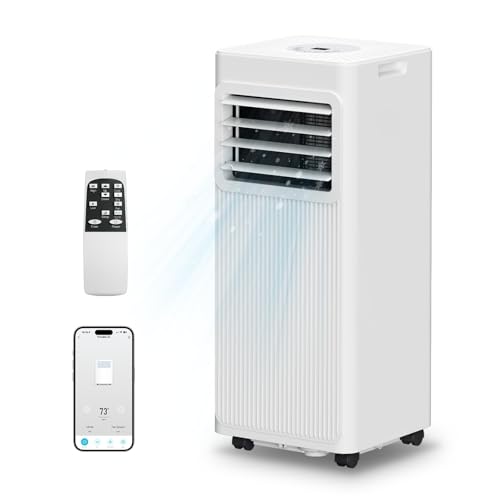
Basic remote control and a digital panel are enough for many rooms. A timer is helpful when you want the unit to operate only during selected hours. Frigidaire, Midea, Shinco, HUMHOLD, and other selected models list 24-hour timers. Sleep modes can adjust operation overnight or reduce display and airflow disturbances, but the exact behavior differs by model.
Smart control is useful when you want to pre-cool a room or adjust settings from another location. Midea’s two selected models list SmartHome app control, and the Frigidaire, BLACK+DECKER, ZAFRO, and NYpeak models document app or voice-control features. These capabilities depend on compatible networks and devices, so buyers who prefer simple operation should not prioritize smart functions they will not use.
Check noise claims carefully
Noise information is not supplied consistently, so do not treat an absent figure as evidence of quiet operation. Where a numeric claim is provided, ZAFRO lists operation as low as 42 dB, NYpeak states below 40 dB, and HUMHOLD and TECXERLLON list 48 dB sleep-related operation.
Compressor appliances produce changing sounds as they cycle. Hose placement, window sealing, floor vibration, and fan speed can also affect the experience. If the appliance will sit beside a bed or desk, favor a selected model with a documented sleep or low-noise specification, while remembering that listing figures may describe a particular mode rather than every operating condition.
Portability means more than caster wheels. The selected products range from relatively compact small-room designs to heavier large-capacity appliances. Midea’s 10,000 BTU model lists a 50.04-pound weight, while the Whynter and TECXERLLON units list 73 and the current price. Wheels and handles help with movement across one level, but stairs and thresholds remain practical limitations.
Measure the intended floor area and the route to the window. Check height, width, hose length, and panel range before ordering. Included kits are common across this category: Midea, Shinco, BLACK+DECKER, and NYpeak all document installation hardware or window kits. Tool-free or no-drill language can be useful for renters, but the kit still needs a suitable window and a stable seal.
Look for maintenance and seasonal flexibility
Washable filters reduce the need to buy a replacement filter immediately, but they still require regular cleaning. Midea’s 10,000 BTU model recommends weekly filter cleaning, while Frigidaire documents clean-filter alerts. These details matter in homes with dust or pets. Also consider whether you need heat. BLACK+DECKER is the selected model that explicitly adds 10,000 BTU heating, making it more versatile for shoulder seasons than cooling-only models.
Final Recommendation
ZAFRO 16,000 BTU Smart Inverter Portable AC ranks first overall in this specification-based comparison under the published weighted criteria.
ZAFRO 16,000 BTU Smart Inverter Portable AC is the first overall specification-based choice among these best portable floor air conditioners. Its dual-hose inverter design, smart controls, six modes, self-evaporating system, and stated 42 dB low-noise operation give it a broad documented feature balance.
Midea’s 13,000 BTU Dual Hose Inverter AC is an alternative for buyers who value neutral-pressure airflow and broad smart-home compatibility. Whynter ARC-14S is suited to shoppers prioritizing documented dehumidification, while BLACK+DECKER is the clearest choice when supplemental heat is important. For small rooms, Midea’s 10,000 BTU Smart Portable AC keeps the footprint and feature set more focused. The top portable floor air conditioners are not interchangeable, so room size and window setup should decide the final match.
Frequently Asked Questions
Among the best portable floor air conditioners, are portable floor air conditioners suitable for bedrooms?
Yes, several selected models document sleep modes or low-noise operation. ZAFRO lists operation as low as 42 dB, while HUMHOLD and TECXERLLON describe 48 dB sleep-related operation. Placement also matters: leave the required clearance around the appliance, install the exhaust hose correctly, and consider whether the controls and display are convenient from the bed.
Is a dual-hose portable AC better than a single-hose model?
Neither design is automatically best for every room. Dual-hose models such as Midea’s 13,000 BTU unit, Whynter ARC-14S, and ZAFRO document separate intake and exhaust paths intended to support more balanced airflow. A single-hose model may be simpler to install and manage. Compare the window kit, hose arrangement, room coverage, and available floor space before deciding.
Do these portable AC units need a drain hose?
Drainage needs vary with humidity and operating mode. Self-evaporating systems can reduce routine draining, but the HUMHOLD listing notes that continuous drainage may be needed in high humidity or Dry mode. TECXERLLON and Whynter also document moisture-management features, but users should follow each model’s instructions rather than assuming every environment will remain drain-free.
What does SACC mean on a portable air conditioner?
SACC is a portable-air-conditioner cooling-capacity measurement intended to account for conditions that can affect operation. Some listings provide both an ASHRAE figure and a SACC figure, such as BLACK+DECKER, Shinco, and Midea. When comparing models, use the same type of capacity figure whenever possible and also consider the stated room-size guidance.
What should renters check before installation?
Renters should confirm that the included window panel fits the window opening and that the exhaust hose can reach the window without sharp bends. Several selected products document no-drill or tool-free installation approaches, but the exact kit still differs. Also measure the appliance’s height, width, and weight, and verify that casters can roll across the room’s flooring.