Buying Guide
Choosing among the best voice-controlled portable air conditioners starts with the room, not the smart-home feature. A unit that responds to voice commands is useful only if its stated cooling capacity, window fit, and moisture handling suit the space. The products above are ranked from supplied listing evidence rather than hands-on testing, customer sentiment, or volatile marketplace information.
Match the unit to the room
Portable air-conditioner listings use more than one capacity convention. Several products provide both ASHRAE and DOE or SACC figures, and those numbers are not interchangeable. Use the listing’s stated room target as the starting point. The DREO 740S gives a relatively conservative 200- to 300-square-foot target despite its 14,000 BTU ASHRAE figure. By contrast, the GrowthWing and KoolSiln listings state coverage up to 700 square feet, while the BLACK+DECKER model lists up to 550 square feet.
For medium rooms, the GE, Midea, and Hisense products each document coverage around 350 square feet. The LG 6,000 BTU model is specifically aimed at spaces up to 250 square feet, while the LG 7,300 BTU model lists up to 300 square feet. Do not treat a larger BTU number as permission to ignore the manufacturer’s room guidance. Room height, sunlight, insulation, window exposure, and heat from electronics can all affect real-world suitability, but those conditions are not quantified in the supplied evidence.
Check voice-assistant compatibility
Voice control is not identical across products. The DREO 740S lists Alexa, while the DREO 543S names Siri, Amazon Alexa, and Google Home. GE identifies Alexa and Google Assistant, and both LG models identify Amazon Alexa and Hey Google. Midea lists Alexa and Google Assistant pairing. Hisense lists Google and Alexa connectivity through ConnectLife. These explicit platform names make compatibility easier to verify before purchase.
GrowthWing and KoolSiln describe voice control but do not identify supported platforms in the supplied evidence. They may still suit a smart home, but buyers should confirm compatibility with the devices already installed. App control is also useful when voice commands are unavailable, and most selected models retain a physical panel or remote. The BLACK+DECKER Follow Me remote is notable because the listing says it can act as a thermostat, while GE includes app, remote, and panel controls.
Compare single-hose and dual-hose designs
A dual-hose portable AC uses separate airflow paths for intake and exhaust. The DREO 740S and Hisense listings explicitly document dual-hose designs. DREO says the arrangement helps reduce hot-air backflow, while Hisense describes faster, more efficient cooling and more consistent room temperatures. Dual-hose systems can require more careful window-kit planning, so inspect the installation instructions and available window space.
The other selected units document portable exhaust-hose installation but do not all identify their hose configuration. That does not automatically make them unsuitable; it means the supplied evidence supports a narrower comparison. Window-kit dimensions are particularly important in rentals. GrowthWing and KoolSiln list ranges extending from about 20 to 67 inches, GE lists 19 to 48 inches, and the DREO 740S lists 20 to 53 inches. Measure both the opening and the clearance around the unit.
Consider drainage and humidity
Self-evaporation can reduce routine water handling, but it is not always the same as permanent drainage-free operation. GrowthWing states up to 72 hours of drainage-free cooling in most environments. KoolSiln gives a similar 72-hour claim, and GE says automatic evaporation usually avoids draining under normal room conditions while warning that very humid or extended use may require manual draining.
DREO’s two selected models provide more specific conditions. The 740S describes automatic evaporation under environments below 90% humidity, while the 543S says a hose is needed above that threshold. Hisense lists drain-free operation in cooling mode. Midea, LG, and BLACK+DECKER provide useful cooling and dehumidification functions but do not document the same drainage detail in the supplied listing. If you plan to use Dry or dehumidifier mode frequently, confirm whether a hose or container is required.
Weigh noise claims carefully
Noise figures are useful when supplied, but they are usually tied to a particular mode. GrowthWing lists Sleep Mode as low as 42dB, DREO 740S lists 42dB, DREO 543S lists 45dB, KoolSiln lists 48dB, and Hisense lists 42dB. These are listing claims, not independent measurements, and they should not be interpreted as a guarantee for every setting.
Several models offer sleep modes, dimmed displays, timers, or gradual overnight adjustment. Place any portable AC on a stable surface with adequate clearance, and follow the supplied installation guidance rather than assuming a quieter mode eliminates all operating sound.
Look beyond voice commands
The best voice-controlled portable air conditioners still need useful non-voice controls. App scheduling helps pre-cool a room, while a remote is practical when a phone or smart speaker is unavailable. Cooling, fan, and dry modes also extend the unit’s usefulness across changing weather. GE, Midea, LG, DREO, and BLACK+DECKER all document combinations of these functions.
Portability is another trade-off. The selected units are freestanding appliances with casters or portable designs, but listed weights vary substantially and some models are more than the current price. A wide cooling range can come with a larger cabinet. Check height, width, depth, outlet requirements, and storage space before ordering. Included window kits simplify setup, but the correct fit still depends on the window type and dimensions.
Final Recommendation
GrowthWing 14,000 BTU Smart Wi-Fi Portable AC ranks first overall in this specification-based comparison under the published weighted criteria.
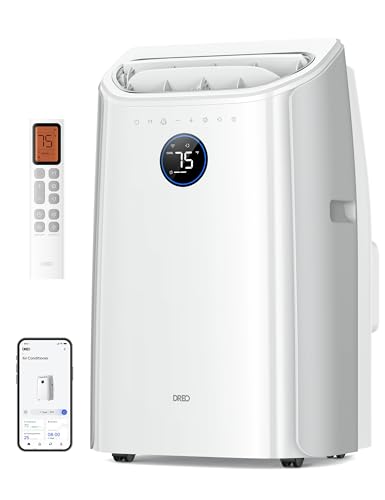
DREO 740S is the highest-scoring returned product and the first overall specification-based choice among the best voice-controlled portable air conditioners. Its combination of inverter technology, dual-hose airflow, automatic water handling, 42dB listing, and Alexa control gives it the most specification-aligned overall evidence package. The DREO 543S is a better fit when Siri support and a 45dB claim are more important. For broad stated coverage, GrowthWing and KoolSiln are worth comparing, while GE, Midea, Hisense, LG, and BLACK+DECKER cover more specific room and control preferences. Together, these are the top voice-controlled portable air conditioners to investigate, but window fit and room size should determine the final choice.
Frequently Asked Questions
What should I check before buying the best voice-controlled portable air conditioners?
Confirm the stated room coverage, capacity convention, window-kit range, power requirements, and supported voice platform. Also check whether the unit requires manual drainage in Dry mode or during humid conditions. Voice control is only one part of a good fit.
Do all smart portable air conditioners work with Alexa and Google Assistant?
No. The selected listings identify different combinations. GE, Midea, and both LG models explicitly name Alexa and Google-related compatibility, while DREO 543S also lists Siri and Google Home. GrowthWing and KoolSiln mention voice control without naming platforms in the supplied evidence. Verify the exact ecosystem before purchase.
Is a dual-hose portable AC always the better choice?
Not automatically. Dual-hose models such as DREO 740S and Hisense document separate intake and exhaust airflow, which may help reduce hot-air backflow. They can also require more involved window placement. Compare the room target, installation space, and drainage needs rather than choosing by hose count alone.
Can a portable AC run without draining?
Some selected models document automatic evaporation or drain-free cooling under stated conditions. DREO gives humidity limits, GE notes that very humid or extended use may require manual draining, and GrowthWing and KoolSiln provide time-based claims for most environments. Dehumidifier mode may have different drainage requirements, so read the product instructions.
Which option is aimed at a smaller room?
The LG 6,000 BTU model lists coverage up to 250 square feet, making it the clearest small-room option in this comparison. The LG 7,300 BTU model lists up to 300 square feet. Larger models should not be selected solely because their capacity number is higher; use the published room target and your window configuration as the primary checks.