Buying Guide
Choosing the best din rail solid-state relays starts with the load, not the headline current number. The selected listings cover DC-to-AC, AC-to-AC, and DC-to-DC switching, along with slim low-current modules for pneumatic valves. A relay that fits one role may be unsuitable for another, even when both products use DIN rail mounting.
Match the control and load voltages
First identify the signal that will command the relay and the voltage supplied to the load. The LCLCTC 40A, AURTRR 40A, ReleyWell 40A, and LCLCTC 25A models document 3–32V DC inputs with 24–480V AC outputs. These are the appropriate comparisons when a low-voltage controller must switch an AC circuit.
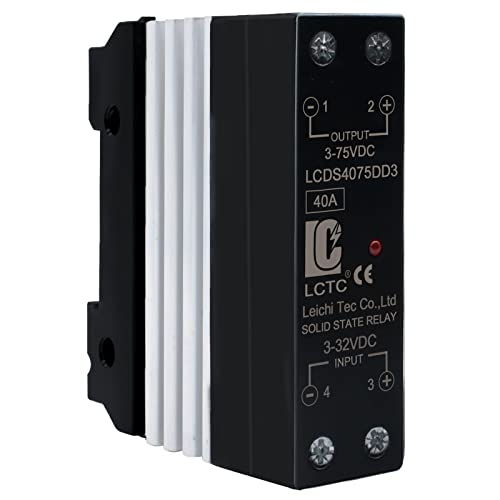
The LCLCTC 120A model is listed as AC-to-AC, but its supplied evidence does not give a detailed control-voltage range. Treat that missing information as a selection checkpoint and verify compatibility before ordering. For a DC load, the LCLCTC 40A DC-to-DC unit lists 3–32V DC input and 3–75V DC output. OONO covers 3–32V DC input and 5–30V DC output, while Badafaci and Joyzan list 4–32V DC input and 5–60V DC output.
Size current by load type
A headline current rating is not enough for every application. The LCLCTC 120A listing specifically gives lower guidance for inductive and capacitive loads than for resistive loads: up to 20A inductive and 12A capacitive, compared with up to 60A resistive. Identify the load category before comparing models.
The two 40A LCLCTC products, AURTRR, and ReleyWell are aimed at larger switching duties according to their listed sizes. OONO documents a 10A maximum on-state average current and separates that figure from its 20A short-duration maximum and 160A non-repetitive surge specification. For the slim valve-oriented modules, Badafaci and Joyzan list 2A output, so they belong in a smaller-control category rather than beside larger power SSRs.
Check heat-sink and spacing requirements
Heat management is a major difference among the selected products. The LCLCTC AC and DC models, AURTRR, and ReleyWell list a heat sink, radiator, or heat-sink-equipped construction. Those features reduce the need to source a separate thermal component, but they do not remove the need to follow installation guidance.
The narrow LCLCTC listing warns that installing multiple units together can compromise heat dissipation because of its dual-sided narrow radiator design. It recommends corresponding fans for optimal performance. That warning matters in dense distribution boxes. Badafaci, YWBL-WH, and Joyzan emphasize slim module construction instead; do not assume that a compact control relay has the same thermal role as a 40A SSR with a listed heat sink.
Prioritize cabinet fit and rail hardware
Rail compatibility and body width can determine whether a relay fits the intended enclosure. LCLCTC’s narrow models list a 0.964-inch width and rail clips. AURTRR provides a 50mm DIN rail dimension. OONO’s nylon carrier is documented as supporting 35mm, 32mm, and 15mm rail widths. Joyzan identifies TS-35 installation.
For high-density control wiring, YWBL-WH and Badafaci both list a 6.2mm format. Their bridgeable adjacent terminals are useful when several modules must be wired in sequence. OONO also documents screw terminals and a carrier designed for DIN rail mounting.
Use indicators and protection features where needed
An LED can make commissioning and troubleshooting easier by showing the input state. OONO, Badafaci, YWBL-WH, and Joyzan document LED indication. Badafaci and Joyzan also list reverse-connection protection, while their modules specify 4kV isolation. OONO documents photocoupler isolation up to 5000V and gives input turn-on and turn-off thresholds.
IP20 appears in the Badafaci and Joyzan evidence. This is a technical enclosure rating, not a claim that the relay is sealed against water or suitable for outdoor exposure. For other products in this comparison, the supplied listings do not provide an IP rating, so enclosure protection should be evaluated at the panel level.
Read the evidence gaps before buying
A specification-aligned match is the one whose published details answer your installation questions. OONO provides especially detailed electrical and timing information. The larger AC SSRs make their input, output, current class, and heat-sink arrangements clear. The slim modules provide useful rail, indicator, protection, and wiring details but may omit output-current information or target only small valve circuits.
Before finalizing a purchase, confirm the load type, operating voltage, continuous current, inrush or surge conditions, rail standard, terminal arrangement, and required heat dissipation. This comparison is based on public listing data, not hands-on testing, so any missing specification should be verified from current manufacturer or seller documentation.
Final Recommendation
OONO DC-DC 10A Isolated DIN Rail SSR ranks first overall in this specification-based comparison under the published weighted criteria.
OONO DC-DC 10A Isolated DIN Rail SSR is the highest-scoring returned product under the published weighted criteria.
The final choice among the best din rail solid-state relays depends on the documented features that match your intended use.
OONO is the first overall specification-based choice because its listing covers electrical ranges, current limits, timing, isolation, indication, rail-carrier compatibility, and construction certifications. It is a well-supported pick when the application is a DC load within its documented output range.
For broad AC switching, LCLCTC 40A DC-to-AC SSR with Heat Sink is a strong alternative because it combines 3–32V DC control, 24–480V AC output, rail clips, a heat sink, and a narrow body. Buyers comparing the top din rail solid-state relays should also consider the LCLCTC 120A AC-to-AC model when load-type derating is the key concern, or AURTRR when a stated rail dimension is helpful.
For compact low-current valve control, Badafaci and Joyzan provide clear protection and indicator details, while YWBL-WH emphasizes a 6.2mm cabinet-friendly profile. Match the selected relay to the documented load and verify any omitted electrical detail before installation.
Frequently Asked Questions
What should I check before choosing the best din rail solid-state relays?
Check the control input, load voltage, load type, continuous current, rail standard, terminal arrangement, and heat-dissipation plan. The selected products span DC-to-AC, AC-to-AC, and DC-to-DC designs, so the switching direction must match the circuit.
Are the 40A relays interchangeable with the 2A modules?
No. The larger AC and DC SSRs list 40A-class applications, while Badafaci and Joyzan list 2A output for slim DC valve-oriented modules. Their intended electrical roles and thermal requirements differ.
Do all of these relays include a heat sink?
No. Heat sinks or radiators are documented for the LCLCTC AC and DC models, AURTRR, and ReleyWell. Badafaci and Joyzan describe slim low-current modules without a heat sink in the supplied evidence. Do not infer thermal hardware where the listing does not state it.
Which models document an LED indicator?
OONO, Badafaci, YWBL-WH, and Joyzan list LED indication. The other selected products do not provide an LED specification in the supplied evidence, so indicator availability should be confirmed if it is important for commissioning or maintenance.