Buying Guide
Choosing among the best easy-read wall clocks starts with the distance and conditions in which the clock will be viewed. A compact analog clock can work in a small bathroom, but a shared classroom, garage, or large living room may need a substantially larger display. The listings in this comparison cover traditional analog faces, atomic analog models, and digital clocks with additional information.
Start with viewing distance and face layout
For a basic indoor clock, a 12-inch face is a common middle ground. OSTAR, Bernhard Products, Lumuasky, Crosstime, Foxtop, GLVSAE, and jomparis all use approximately 12-inch formats, but their faces are not identical. Black numerals on a white face, as documented for Bernhard Products and Lumuasky, create a straightforward high-contrast arrangement. Crosstime and GLVSAE add dimensional numerals, while jomparis uses white 3D numerals on gray.
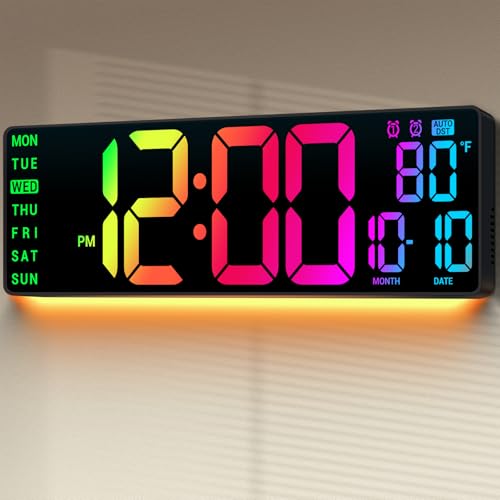
A 14-inch or larger display can be more suitable when people will read the clock from across a room. TIMESS has a 14-inch analog face and LCD panel, while both WallarGe digital models use a 14.5-inch format. ANSOPER goes further with a 16.5-inch screen and ultra-large numbers. Larger does not automatically mean better for every wall: check the available wall area and whether additional information makes the display feel busy.
Analog clocks show the relationship between the hour and minute hands at a glance. The simpler models here are useful when the primary need is time, not a calendar or environmental reading. OSTAR, Bernhard Products, Lumuasky, Crosstime, GLVSAE, and jomparis follow that approach.
Digital models can make numerals especially prominent and can add information. WallarGe’s 14.5-inch digital clock includes time, date, day, and indoor temperature, while its atomic version also adds outdoor temperature and seconds. ANSOPER lists time, date, day, and temperature, along with alarms and timer functions. TIMESS offers a hybrid arrangement: an analog face plus an LCD panel for month, date, and Fahrenheit temperature.
Consider whether those extras will be used. A digital calendar and temperature display can be useful in an office, kitchen, or classroom, but a simple analog face may be easier to scan when all you want is the time.
Prioritize quiet movement where sound matters
Bedroom, nursery, library, and home-office placement makes movement noise an important specification. OSTAR, Bernhard Products, Lumuasky, Crosstime, GLVSAE, and jomparis explicitly describe silent or non-ticking movement. TIMESS and Foxtop list quiet or smooth sweep movement as well. These descriptions support choosing a sweep-style clock when a conventional ticking sound would be distracting.
The digital ANSOPER and WallarGe models do not depend on an analog ticking mechanism, but their listings focus on electronic displays and do not use the same sweep-movement wording. If silence is a deciding factor, compare the movement description rather than assuming that every wall clock operates identically.
Compare power and time-setting requirements
Most of the analog models use one AA battery, generally not included. That makes mounting relatively flexible because there is no power cord, but it also means periodic battery replacement. GLVSAE’s package description says batteries are included, although the supplied specifications do not identify the type.
Digital options can require more power. WallarGe’s standard digital clock uses four AA batteries. The atomic WallarGe clock uses four AA batteries for the clock and two more for the outdoor sensor. TIMESS requires two AA batteries. ANSOPER is different: it uses a 9.84-foot USB cable for normal display power, while its built-in memory battery is described as being for memory storage. Plan outlet access before choosing it.
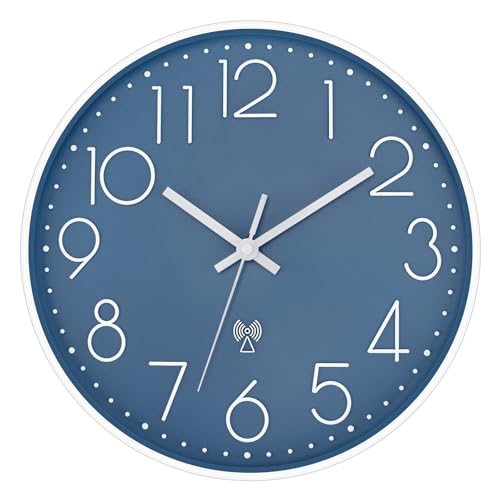
Automatic setting is another distinction. Foxtop and WallarGe’s atomic model use WWVB radio synchronization, and Foxtop also lists an Auto DST switch. These features can reduce manual time adjustments, but radio-controlled operation depends on receiving the relevant signal. Basic quartz models avoid that complexity and require manual setting when first installed or after battery changes.
Look at protection and mounting details
A wall clock in a kitchen, classroom, or busy office benefits from a protected face and a case that is easy to maintain. Crosstime lists a dustproof and waterproof glass lens with an ABS frame. Bernhard Products and Lumuasky specify glass lenses, while GLVSAE lists high-strength tempered glass. TIMESS includes an HD glass panel and a piano lacquer frame.
Mounting is generally simple across this group. OSTAR has an integrated hook, Foxtop lists a rear hanging slot, and the analog basic clocks describe hooks or easy hanging. WallarGe’s digital models add a mounting ruler, and the atomic version includes a fold-out stand for desk use. ANSOPER can also be wall-mounted or placed on a desktop stand. These details matter when you are replacing a clock, avoiding new measurements, or deciding between wall and desk placement.
Match the design to the room
A high-contrast white-and-black face is a practical choice for visibility. Blue-and-white faces, such as Foxtop’s blue model, can also create strong contrast. TIMESS uses a blue background with white numbers, while jomparis and Crosstime offer more decorative neutral styling. The colorful Bernhard Products kids model was not selected for this comparison, but the selected range still includes modern and understated options.
It was not selected in this top 10 because the ranking emphasizes the most specification-aligned overall evidence for easy indoor reading and varied display utility. If outdoor use is your priority, verify that the intended location and weather exposure match the product’s documented protection claims.
How this comparison was scored
The editorial scores use six category-specific criteria: display readability, quiet timekeeping, power and setup practicality, useful display features, construction and protection, and placement and design flexibility. The weights emphasize readability first, followed by quiet operation. Scores reflect the supplied listing descriptions and specifications only. This is not a hands-on test, and it does not summarize customer opinions or volatile marketplace information.
Final Recommendation
ANSOPER 16.5-Inch RGB LED Digital Wall Clock ranks first overall in this specification-based comparison under the published weighted criteria.
ANSOPER 16.5-Inch RGB LED Digital Wall Clock is the highest-scoring returned product and the first overall specification-based choice. Its very large high-contrast screen, remote control, multiple information displays, Auto DST, alarms, timer, and auto-dimming give it the broadest documented feature set in this comparison. Choose it when outlet access is available and maximum digital visibility matters.
For automatic time setting in a more traditional format, Foxtop is a strong alternative because it combines a 12-inch analog face with WWVB synchronization and Auto DST. WallarGe’s atomic digital model is better when you want indoor and outdoor temperature alongside a large time display. TIMESS is a useful middle ground for shoppers who prefer analog hands but want a calendar and Fahrenheit temperature panel.
Among straightforward quiet analog options, OSTAR, Bernhard Products, Lumuasky, Crosstime, GLVSAE, and jomparis cover different priorities. Bernhard Products and Lumuasky emphasize black-on-white contrast, GLVSAE adds a three-dimensional dial and tempered glass, and Crosstime offers a modern cement-style face with a dustproof and waterproof lens description. jomparis is the most understated neutral design in the selected group. Together, these are top easy-read wall clocks for shoppers who do not need digital extras.
The best easy-read wall clocks are not necessarily the most feature-heavy. Select the display type first, then confirm the face size, battery or outlet requirements, movement description, and mounting method. That approach keeps the choice tied to the room and the way the clock will actually be used.
Frequently Asked Questions
What makes the best easy-read wall clocks easy to see?
Large numerals, strong contrast, and a face sized for the viewing distance are the main documented factors in this comparison. Bernhard Products and Lumuasky use black numerals on white faces, while ANSOPER lists ultra-large high-contrast digital numbers. GLVSAE and Crosstime use dimensional numerals, which may add visual definition. A 12-inch clock can be sufficient for many rooms, but 14-inch and larger models are more suitable when the clock must be read across a larger space.
Are silent wall clocks actually non-ticking?
Several selected models explicitly list silent, non-ticking, or quiet sweep movement. OSTAR, Bernhard Products, Lumuasky, Crosstime, GLVSAE, jomparis, TIMESS, and Foxtop all provide such wording in their supplied listing evidence. The digital models use electronic displays rather than the analog movement descriptions used by those clocks. Because this comparison is specification-based, it reports the listed movement type rather than making an independent noise measurement.
Which selected clock automatically adjusts the time?
Foxtop and WallarGe’s atomic digital clock list WWVB radio synchronization. Foxtop also includes an Auto DST switch, while the WallarGe atomic model is described as automatically synchronizing with the WWVB broadcast and showing a low-battery indicator. ANSOPER and WallarGe’s standard digital model list Auto DST, but their supplied evidence does not describe them as WWVB atomic clocks. Basic quartz models require manual setting.
Which clock is best for a classroom or large shared room?
ANSOPER is the most specification-aligned specification-based choice when an outlet is available because its 16.5-inch screen uses ultra-large numbers and includes a remote. WallarGe’s 14.5-inch atomic model is another option for a large room, especially when date, day, and temperature information are useful. For a simpler battery analog design, OSTAR or Bernhard Products provide large numerals and quiet movement, with Bernhard Products specifically listing classrooms among suitable locations.
What should I check before mounting a wall clock?
Confirm the clock’s overall size, mounting hardware, and power source. Analog models such as OSTAR, Foxtop, and jomparis list hooks or rear hanging slots, while WallarGe includes a mounting ruler and a fold-out stand. ANSOPER uses a USB cable for normal operation, so outlet distance matters. Battery-powered models avoid cord placement, but check the required battery count and whether batteries are included. Also consider whether the listed glass, plastic, or tempered-glass construction fits the room’s maintenance needs.