Buying Guide
The best night light wall clocks differ mainly in how they produce light, how much control they provide, and how they are powered. This comparison uses listed specifications rather than hands-on testing or customer opinions. The selected products include active LED illumination, sound activation, glow-in-the-dark materials, and digital backlighting.
Choose the lighting type
Active LED lighting is a controllable design in this group. The Koosome provides a low-light sensor and three brightness settings, while the WallarGe 12-inch model offers off, low, and high states through its sensor. HITO also uses automatic sensing and adjustable brightness, with the added distinction that both hands and numbers illuminate. These designs are suitable when the clock should respond to changing room light without being manually switched on.
Sound-activated lighting is another approach. The white Lafocuse clock turns on for about 28 seconds when sound is detected in darkness, and the OCEST Blue Moon model operates for about 45 seconds after a specified sound threshold is reached. This can provide a short time check without leaving a light on continuously. Activation depends on the room and the sound reaching the sensor, so it is not the same as a continuously visible display.
Glow-in-the-dark clocks use a different system. Sharp and Warminn use luminous hands or numbers that absorb light and release it in darkness. This avoids a separate lighting circuit, but the result depends on how much light the face receives beforehand. The Sharp listing recommends bright or sunlight exposure for the glow function, while Warminn lists an approximate three-to-six-hour glow period.
Match size to viewing distance
A 12- or 13-inch analog face is generally easier to view from across a bedroom or living room than an 8-inch face. The Koosome, Sharp, HITO, WallarGe, and Warminn clocks all use approximately 12- or 13-inch formats. Large numbers further improve legibility, as shown by the WallarGe clock’s one-inch bold numerals and Warminn’s four large 3D numbers.
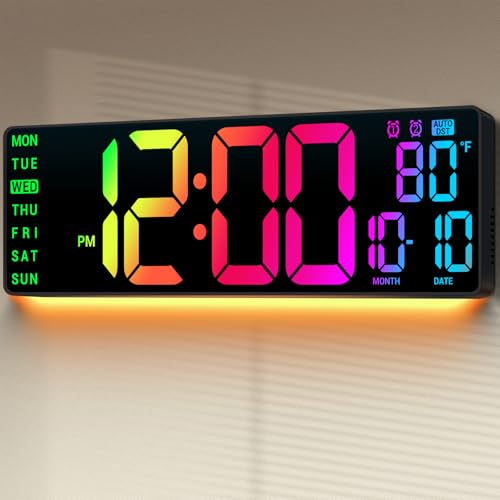
The JoFomp JF08 is 8 inches, but its bold white numbers on a blue face can work well on a smaller wall or in a compact room. The JALL digital clock takes a different route: its 3.5-inch digits are designed for viewing from a distance even though its overall width is about 12 inches. Digital numerals may be preferable when reading hands on an analog face is inconvenient.
Consider brightness at night
A bedroom clock should provide enough light to read without becoming an unwanted source of glare. Adjustable modes are useful because a living room, hallway, nursery, and bedroom may need different levels. The Koosome and HITO offer detailed control, while the OCEST 13-inch clock lists low and high settings. JALL adds auto brightness for its display and a back night light.
Glow-in-the-dark models offer less direct control. Their light gradually fades, and the supplied evidence does not document an adjustable brightness system for Sharp or Warminn. They may be a better fit when a soft, passive glow is preferred over active illumination.
Check the power arrangement
Battery requirements vary substantially. The Sharp and Warminn clocks use one AA battery. Sensor-based analog clocks can need more batteries: WallarGe separates one AA battery for the movement from three for the sensor, while the white Lafocuse clock lists five AA batteries in total.
The JoFomp JF08 gives the LED two power choices: USB-C or three AA batteries, with a USB-C cable included. JALL is a plug-in digital clock and includes a 10.5-foot cable, but it must remain connected to a 5V power adapter. Confirm outlet access before choosing a plug-in design.
Review quiet movement and installation
For bedrooms, nurseries, offices, and study areas, a non-ticking movement can be more appropriate than a traditional ticking mechanism. Every selected analog model specifies a quiet quartz or sweep movement, and the digital JALL clock has no ticking movement.
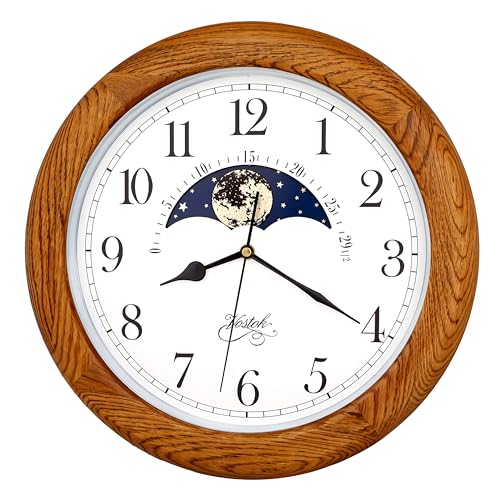
Most selected clocks use a hook, slot, or included hanging hardware. WallarGe includes one hook, Warminn uses a back slot and hook, and JoFomp lists hook-based installation. Face construction differs: HITO lists a glass cover, OCEST lists a crackle-effect glass dial, and Koosome uses a white acrylic face.
Final recommendation
Koosome 13-Inch Lighted Wall Clock ranks first overall in this specification-based comparison under the published weighted criteria.
Koosome 13-Inch Lighted Wall Clock is the first overall specification-based choice among these best night light wall clocks. Its 13-inch face, automatic sensor, three brightness settings, quiet movement, and bold white display create a balanced feature set for a bedroom or general living space.
Choose HITO if illuminated hands and numbers are more important than minimizing battery use. Select WallarGe when you want a simpler automatic sensor design. The white Lafocuse and OCEST Blue Moon are sound-activated alternatives, with different decorative directions and activation periods.
For digital readability, JALL is a strong specification-aligned fit because of its large digits, auto brightness, color choices, and back night light, provided a nearby outlet is available. JoFomp JF08 is a flexible compact option because its LED can use USB-C or batteries. Sharp and Warminn are better for passive glow and simple one-battery operation, while the decorative OCEST 13-inch clock adds a Tiffany-style face and two brightness settings. Together, these are practical examples of the top night light wall clocks for different room layouts and nighttime preferences.
Frequently Asked Questions
Are the best night light wall clocks usually battery operated?
Many analog models in this comparison are battery operated, including Koosome, WallarGe, HITO, Lafocuse, Sharp, and Warminn. Requirements differ: some use one AA battery for the movement, while sensor lighting can require several additional batteries. JALL must be plugged in, and JoFomp JF08 supports either USB-C or batteries for its LED.
What is the difference between sensor lighting and glow-in-the-dark numbers?
Sensor lighting uses an active light system that responds to darkness, and some models also respond to sound. Glow-in-the-dark numbers and hands absorb light during the day and release it in darkness. Sensor models generally provide more direct control, while passive glow models use fewer electronics and may use fewer batteries.
Which selected clock is easiest to read from a distance?
JALL has listed 3.5-inch digital digits, making it a strong choice for long-distance viewing. Among analog clocks, the 12- and 13-inch models with bold numerals, including Koosome, WallarGe, and Warminn, are more suitable for across-room reading than the compact 8-inch JoFomp JF08.
Are these clocks suitable for a bedroom?
The selected analog clocks specify quiet quartz or sweep movements, and JALL has no ticking mechanism. For nighttime comfort, compare the lighting behavior as well: adjustable sensor models can be dimmed or switched off, while sound-activated clocks illuminate for a listed period and glow-in-the-dark clocks gradually fade.
What should I verify before installation?
Check the required battery count or outlet location, the clock’s diameter, and whether the listed hanging hook or slot suits your wall. For glow-in-the-dark models, also confirm that the face can receive enough bright light before nighttime use.