Buying Guide
The best eco-friendly reusable grocery bags are not all built for the same kind of shopping. A rigid box tote can make loading and unloading easier, while a soft nylon bag may be preferable when storage space is limited. Cotton canvas offers a different feel and organization options, but it can take more room when stored. Start by deciding whether your priority is heavy grocery hauling, compact backup storage, or a large household supply.
Match capacity to your usual grocery run
Check the stated load limit rather than relying only on words such as “heavy duty.” VeraMia lists an 80-pound capacity, while LALABAG and Green Bulldog each state support up to the current price. WISELIFE’s ten-pack lists up to the current price, FENELY lists the current price, and NERUB lists the current price. These figures are supplied listing specifications, not independent test results, so they should be treated as reference points rather than guarantees for every carrying situation.
Those limits may be adequate for everyday items, but dense canned goods, bottles, and large household supplies can quickly add weight. If your routine includes bulk purchases, select a design with a clearly documented higher limit and distribute heavy items across multiple bags.
Choose structure for easier packing
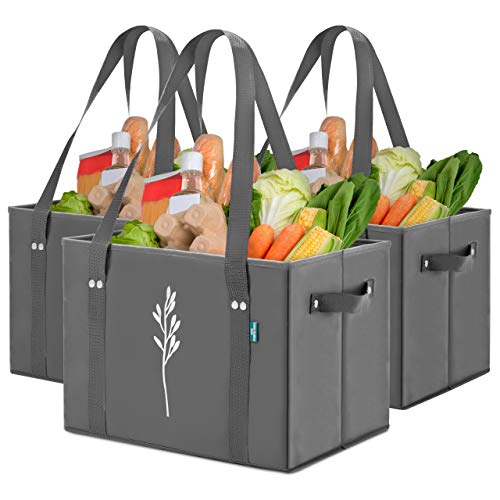
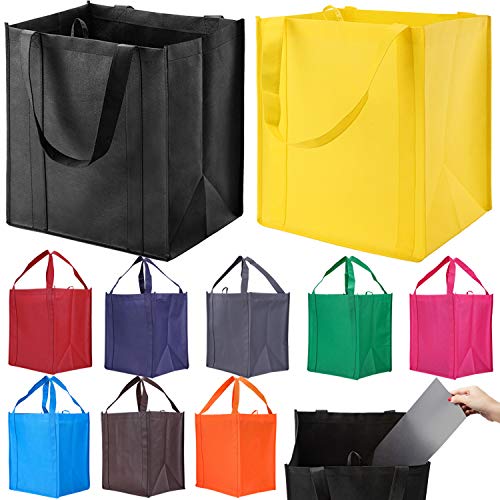
Box-shaped totes can stand upright while being loaded. LALABAG, BALEINE, Green Bulldog, and the three-pack WISELIFE design all document features intended to keep the bags open or upright. This format can help when moving groceries from a checkout area to a car or from a trunk into the kitchen. It also creates a more defined container for cartons, produce, and other items that might shift in a soft bag.
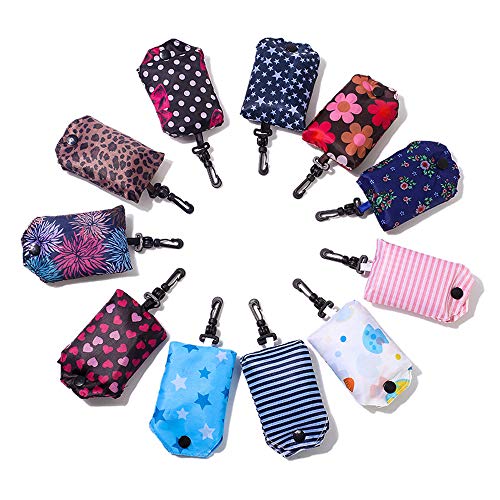
Soft folding totes have a different advantage. Noilk, Kaxich, and the FENELY set emphasize foldability, while WISELIFE’s ten-pack folds flat. These designs are easier to keep in a purse, glove box, drawer, backpack, or luggage. The trade-off is that the supplied evidence does not establish that they will remain open on their own during packing.
Consider handles and organization
Handle design affects how a full bag can be carried. VeraMia documents both a 25-inch shoulder strap and a 13-inch short handle, giving shoppers two carrying positions. BALEINE lists 12-inch reinforced handles, and several other totes describe long or wide handles suitable for hand or shoulder carrying. When a listing does not provide handle length, avoid assuming the fit will be the same as another model.
Organization may matter as much as capacity. VeraMia includes six sewn bottle pockets, which is the clearest dedicated organization feature in this comparison. FENELY includes food-grade mesh produce bags, while the WISELIFE structured design uses a bottom and side inserts to help preserve shape. These features can be useful, but they do not replace careful packing of fragile items.
Review storage and cleaning requirements
A reusable grocery bag is easier to keep in rotation when it has a realistic storage and cleaning routine. Pocket-folding models such as Noilk and Kaxich are designed to collapse into very small formats. Box totes such as LALABAG and BALEINE fold flat, though their structured bodies may still occupy more space than a thin polyester pouch.
Cleaning instructions vary. Noilk and NERUB specifically list machine washing, while LALABAG and BALEINE describe wiping with a damp cloth. FENELY and WISELIFE describe wipe-clean or rinse-clean surfaces. VeraMia lists machine-washable cotton canvas but notes that the fabric may wrinkle.
Water resistance is useful for wet produce or an accidental spill, but it should not be interpreted as complete leakproof protection. BALEINE, Green Bulldog, FENELY, Kaxich, and the structured WISELIFE design document water-resistant or waterproof features. For liquids, use sensible packing and do not assume that seams, inserts, or fabric will contain a leak indefinitely.
Compare material and pack size
The selected bags use several documented materials. VeraMia uses natural cotton canvas; Kaxich uses 190T polyester; Noilk uses ripstop nylon; and multiple structured totes use non-woven polypropylene. NERUB specifically identifies recycled polypropylene. Each material involves practical trade-offs in texture, structure, cleaning, and storage. Reusable construction alone does not establish a particular environmental life-cycle result, so the most supportable comparison is how often and conveniently the listed design can be reused.
Pack size should reflect your shopping pattern. Three-packs work well for a regular grocery trip, while six- and ten-packs allow more separation or leave spares in different locations. A larger pack is not automatically better if you have limited storage.
Final recommendation
LALABAG 3-Pack Heavy-Duty Eco Totes ranks first overall in this specification-based comparison under the published weighted criteria.
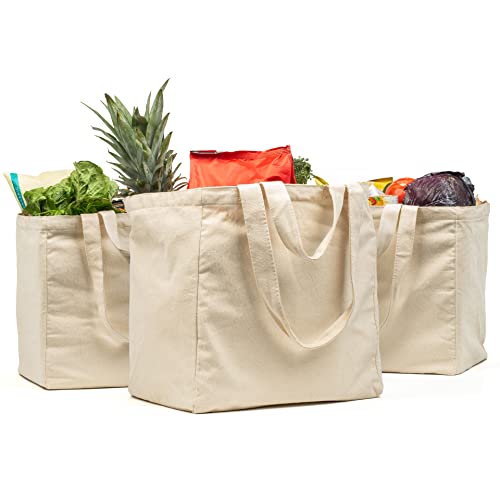
VeraMia 3pc Canvas Grocery Bags is the first overall specification-based choice among the best eco-friendly reusable grocery bags in this comparison. Its documented 80-pound capacity, natural cotton canvas, six bottle pockets, and dual handle options give it the broadest combination of hauling and organization features. LALABAG is the better fit for shoppers who want upright box totes with a stated 65-pound capacity and fold-flat storage. BALEINE is a sensible everyday alternative with water resistance and quick folding.
For compact backups, Noilk and Kaxich are the most storage-focused options, with attached or pocket-size folding formats. NERUB and WISELIFE’s ten-pack are practical for households that want many bags available, while FENELY adds mesh produce bags to a large waterproof set. The top eco-friendly reusable grocery bags therefore depend on whether your priority is capacity, upright packing, cleaning, or portability.
Frequently Asked Questions
VeraMia lists the highest stated capacity in this comparison at the current price per bag. LALABAG and Green Bulldog each list up to the current price, while WISELIFE’s ten-pack lists up to the current price. These are public listing specifications, not independent load tests, so distribute heavy items carefully and inspect handles and seams before use.
Noilk says its bags fold into attached pocket-size pouches, and Kaxich says its bags fold to approximately 4.9 by 2.95 inches. Both are designed for storage in a purse, car, or other small space. The trade-off is that these soft bags do not document the upright structure offered by the box-style totes.
Are reusable grocery bags machine washable?
Some are. Noilk and NERUB specifically list machine washing, and VeraMia describes its cotton canvas bags as machine washable. Other products recommend wiping, rinsing, or hand washing. Follow the individual listing’s care guidance, especially for bags containing cardboard or plastic inserts.
Which grocery totes offer bottle organization?
VeraMia documents six sewn pockets for 2-liter bottles. FENELY includes separate food-grade mesh produce bags, but its main totes are not described as having bottle pockets. If dedicated bottle separation is important, VeraMia provides the clearest evidence in this selection.
How should I choose between a three-pack and a larger pack?
Choose a three-pack when you typically complete one regular grocery run and have limited storage. Six- or ten-packs provide spares for the car, pantry, or laundry use.