Buying Guide
The best polyester reusable grocery bags are not all designed for the same shopping pattern. Some emphasize a high listed load, while others are built around small folded dimensions or a large household pack. Because this comparison uses public listing data, the scores reflect documented specifications rather than hands-on durability testing. Treat stated capacities as manufacturer or seller claims and choose with a sensible margin for the way you normally pack groceries.
Start with the load you actually carry
Capacity is the first practical distinction. Paterr lists a 55-pound capacity, while BeeGreen’s 12-pack, BeeGreen’s six-pack, CiCiGo, and Aricsen each list a 50-pound-class capacity. Ksheria also lists a 50-pound capacity, making it a useful choice when one oversized tote is more convenient than several smaller bags. GAUENEEN lists the current price, which covers many regular trips but leaves less headroom than the largest claims.
The 190T polyester options from PENGJINYU and Kaxich list a 22-pound capacity per bag. That is not necessarily a weakness: a lower-load bag can be a sensible spare for produce, packaged goods, or an unplanned store visit. It serves a different role from a bag intended for a heavy, consolidated load. Avoid interpreting any stated number as a recommendation to exceed the handles, seams, or comfortable carrying limit.
Compare fabric and reinforcement details
A plain polyester description tells you the base material, but additional construction details make comparisons more useful. CiCiGo and BeeGreen describe rip-stop polyester, and both mention reinforced seams or bias tape. Paterr also describes reinforced seams. Those details are relevant when a bag will be loaded repeatedly, although the listings do not establish how the products perform over time.
Ksheria identifies washable Oxford fabric and reinforced stitching, while PENGJINYU and Kaxich specify 190T polyester and tear-resistant or reinforced edge and bottom construction. These descriptions help separate a lightweight packable style from a more substantial heavy-duty style. The evidence supports comparing documented construction details, not predicting long-term performance.
Decide between a soft foldable bag and a structured tote
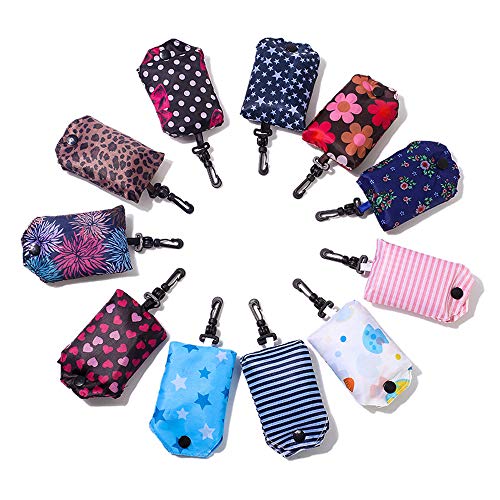
Most of the best polyester reusable grocery bags here fold, roll, or fit into an attached pouch. PENGJINYU and Kaxich provide especially specific folded dimensions, making them easy to evaluate for a purse, wallet, pocket, or glove box. Masirs uses an external pocket, and GAUENEEN includes a hook for storage in a handbag, bag, or car. BeeGreen and Aricsen describe compact rolling, while CiCiGo folds into an attached pocket-size pouch.
A soft foldable design is generally easier to keep in several locations, while a larger single tote can be convenient for organized loading. Ksheria includes a small pocket and wide reinforced handles, but its listing does not describe a rigid frame. Choose based on whether compact backup storage or one larger carry is more important to your routine.
Check cleaning and moisture claims
Washability matters for grocery bags because the interior may encounter produce residue or packaging spills. BeeGreen, CiCiGo, Paterr, GAUENEEN, PENGJINYU, and Kaxich explicitly mention machine washing or washable material. Follow the care directions supplied with the specific product; a listing’s machine-wash statement does not provide a drying temperature or establish a particular lifespan.
Weather-related wording also varies. CiCiGo, Paterr, Ksheria, PENGJINYU, and Kaxich document waterproof or comparable moisture-related construction in their listing evidence. For the remaining options, do not assume that polyester alone makes a bag waterproof. If rain protection is important, prioritize a product with an explicit waterproof description and still protect items that must remain dry.
Match pack size to your routine
Pack size is a utility decision, not simply a quantity contest. Aricsen’s 20-pack and BeeGreen’s 12-pack suit large households, shared car storage, events, or shoppers who want enough bags for rotation. Paterr’s 10-pack and Masirs’ 10-pack offer broad coverage without reaching the largest quantity. Six-packs from CiCiGo, BeeGreen, PENGJINYU, and Kaxich are easier to distribute among household members or keep in several locations. GAUENEEN’s four-pack is a smaller starting set, while Ksheria is a single-tote choice.
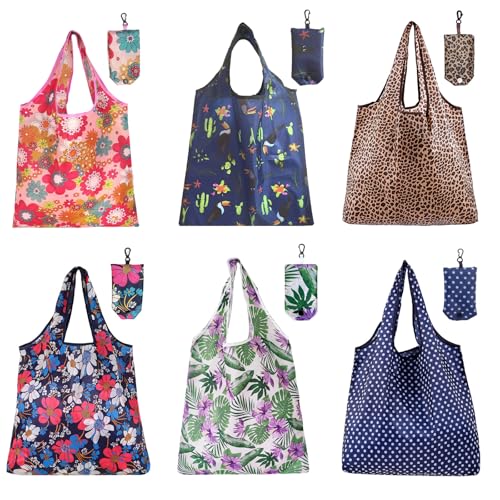
Pattern variety can also have a practical role. Multiple colors or designs can help separate pantry items, produce, errands, or household members, but they do not indicate stronger construction. The evidence supports comparing documented material, capacity, storage, care, and pack details rather than predicting appearance quality or long-term performance.
Final recommendation
Paterr 10-Pack 17x22-Inch Reusable Grocery Bags ranks first overall in this specification-based comparison under the published weighted criteria.
BeeGreen 12-Pack Flower Reusable Grocery Bags is the first overall specification-based choice among these best polyester reusable grocery bags. It combines a 50-pound-plus listed capacity, polyester construction, machine washing, compact rolling, and a useful 12-bag assortment. Paterr is the alternative if the stated 55-pound capacity matters most, while CiCiGo is a balanced six-pack with rip-stop fabric, reinforced seams, waterproof wording, and pocket storage.
Choose Ksheria when one large bag with wide handles and a small pocket fits your routine. Choose PENGJINYU or Kaxich when folded size and low weight matter more than maximum capacity. For household quantity, Aricsen supplies 20 bags, and Masirs offers a compact 10-pack with an explicit 100% polyester description. These are the top polyester reusable grocery bags for different documented priorities, not a substitute for checking current care instructions or inspecting the bag before carrying a heavy load.
Frequently Asked Questions
What should I look for in the best polyester reusable grocery bags?
Start with a clearly identified polyester material, a stated capacity that fits your normal load, and a storage method you will actually use. Reinforced seams, rip-stop fabric, waterproof wording, machine-wash guidance, and comfortable or widened handles are useful documented features. Also check whether you need one soft foldable tote or a rotating multipack.
Are all polyester reusable grocery bags waterproof?
No. Polyester appears in the material descriptions, but waterproofing is separately documented only for some products. CiCiGo, Paterr, Ksheria, PENGJINYU, and Kaxich include waterproof or comparable moisture-related wording in the supplied evidence. Do not infer waterproof performance from polyester alone.
Which bag type is easiest to keep in a car or purse?
Pocket or pouch-folding styles are well suited to compact storage. PENGJINYU and Kaxich provide particularly small folded dimensions, while CiCiGo, Masirs, and GAUENEEN describe attached pockets or hooks. A larger tote such as Ksheria is better suited to a car or regular shopping routine than a small purse.
Not necessarily. A 20-pack or 12-pack can help a large household rotate clean bags, but a four-pack, six-pack, or single tote may be easier to store and manage. Consider how many bags you use per trip, where you will keep them, and whether the stated capacity matches your typical load. Quantity should complement the bag’s design rather than replace it.
Can these bags replace every disposable grocery bag?
The listings describe these products as reusable shopping or grocery bags, and several provide large stated capacities. However, the supplied evidence does not establish universal suitability for every load, store, or use. Check the seams, handles, and bottom before carrying heavy items, follow the product’s care instructions, and use a capacity margin for fragile or unusually dense groceries.
Methodology
This is a specification-based comparison, not a hands-on product test. Editorial scores use a published weighted formula: material and seam durability (25.0%), carrying capacity (25.0%), portability and storage (20.0%), cleaning and weather utility (15.0%), and set practicality (15.0%). A limited non-published marketplace adjustment is applied internally after the editorial formula; its underlying values are not reproduced. The combined result determines rank. Potential limitations are editorial inferences based on documented category-relevant attributes; they are not observations from hands-on testing.