Buying Guide
The best 120v car power inverters are not interchangeable. A compact accessory-socket model may be ideal for phones and a laptop, while a battery-connected unit is better suited to higher continuous loads. The product listings in this comparison use both 110V and 120V descriptions; in practice, shoppers should focus on the stated output type, wattage, connection method, and device requirements rather than treating the voltage label alone as a complete compatibility guarantee.
Match continuous wattage to the load
Continuous wattage is the most important starting point. The BMK and FOVAL models are rated around 200 watts, which fits smaller electronics such as phones, tablets, cameras, and laptops when the total load remains within the stated limit. The BESTEK 300W and ALLWEI 300W models provide more headroom for several moderate devices. The FSATBTNE and Vansoet 400W models add capacity while retaining a plug-in form factor.
Among the selected products, the Ampeak reaches 750 watts continuous, while the Green Fuel and StrenrmGO models document 1000 watts. Cantonape goes substantially higher at 3000 watts. Higher output does not automatically make an inverter a better everyday choice: it can require battery connections, more careful installation, and closer attention to the vehicle battery and wiring.
Peak or surge figures are not a substitute for continuous output. A product may briefly support a higher startup demand, but the device’s normal operating requirement still needs to fit the continuous rating. Also add the power draw of devices that will run simultaneously, including USB equipment.
Check the connection method
Accessory-socket operation is convenient because the inverter can be plugged in without a permanent installation. The compact BESTEK, ALLWEI, FSATBTNE, Vansoet, BMK, and FOVAL designs are aimed at this kind of use.
Battery clips provide a more suitable documented path for larger loads. Ampeak includes both clips and a cigarette-lighter plug, and StrenrmGO also lists both connection options. Cantonape, Green Fuel, and other high-output designs should be matched to the connection and installation instructions supplied with the chosen product. Do not assume a high wattage can be delivered through every vehicle accessory socket.
Input voltage also matters. Several selected models specify 12V vehicle operation, while BESTEK’s 300W model and ALLWEI list an 11-17V range.
Compare outlets and USB charging
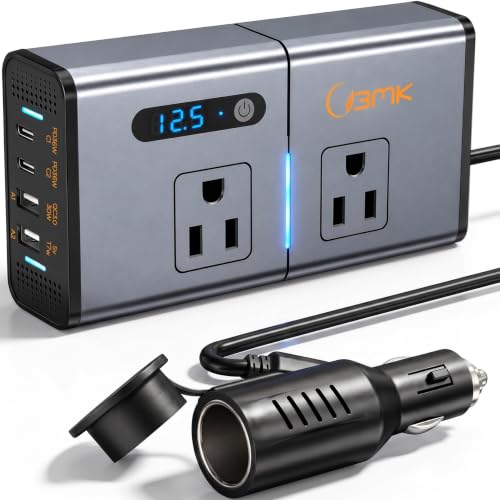
Outlet count is useful when multiple AC devices must run together, but USB output can be more important for modern travel. Vansoet supplies two AC outlets plus USB-C and USB-A ports, and FSATBTNE highlights a 65W USB-C PD port for compatible devices. BMK offers two AC outlets, two USB-C ports, two USB-A ports, and a pass-through 12V socket. These layouts reduce the need for separate chargers, but the total output still applies across connected devices.
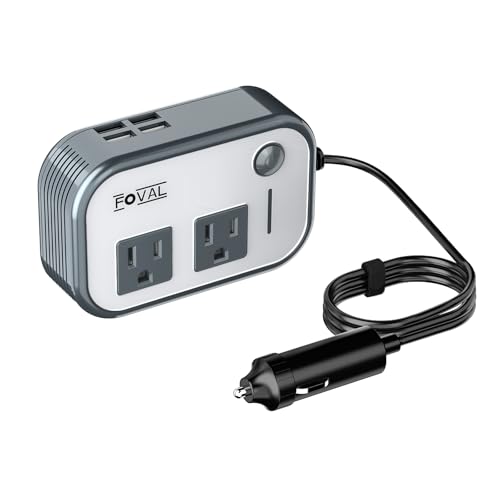
Cantonape and Green Fuel emphasize multiple AC outlets for broader equipment access. The compact FOVAL model instead prioritizes four USB ports alongside two AC sockets. Choose based on the devices you actually carry, and confirm whether a laptop or other USB-C device requires a particular charging protocol or wattage.
Review protection, cooling, and monitoring
Protection features commonly listed across the selected products include overload, over-temperature, short-circuit, and under- or over-voltage safeguards. Cantonape additionally lists reverse-polarity protection, while Ampeak uses replaceable external fuses. These features are useful design indicators, but they do not remove the need to follow the manual, keep ventilation clear, and stay within the rated load.
Cooling also varies. The selected products generally describe smart or temperature-controlled fans; Cantonape and Green Fuel use larger installation-oriented housings, while compact models use smaller shells and automatic fan control. A fan may be audible under load, and a metal housing may improve heat dissipation while adding weight or changing portability.
Displays can make troubleshooting easier. Cantonape provides an LCD with input, output, battery, load, and frequency information. StrenrmGO lists an LCD with operating and protection codes, and BMK displays vehicle input voltage. Models without a display may still list protective functions, but they offer less direct information about the operating state.
Consider installation and portability
A short, compact inverter is easier to store and move between vehicles. FOVAL, BMK, BESTEK, ALLWEI, FSATBTNE, and Vansoet all emphasize compact or travel-friendly designs. Longer cords, such as the documented cables on Ampeak, BESTEK, ALLWEI, and FSATBTNE models, can make rear-seat use easier. Permanent mounting brackets, supplied with Green Fuel and Cantonape’s installation-oriented design, make more sense when the inverter will stay in an RV, vehicle, garage, or work area.
Final Recommendation
Cantonape 3000W 12V Power Inverter ranks first overall in this specification-based comparison under the published weighted criteria.
The final choice among the best 120v car power inverters depends on the documented features that match your intended use.
Cantonape 3000W 12V Power Inverter is the first overall specification-based choice among the selected products. It has the highest documented continuous output, four AC outlets, four USB ports, an LCD, remote control, and multiple protections. For a more flexible 12V setup with both battery clips and an accessory plug, the Ampeak 750W Dual-Connection Inverter is a strong alternative. StrenrmGO is another practical choice when 1000 watts and varied charging ports are priorities.
For sensitive electronics, BESTEK 300W Pure Sine Wave Inverter is the clearest fit because its listing specifically identifies pure sine wave output. Vansoet and FSATBTNE are better suited to users who prioritize modern USB-C charging, while BMK and FOVAL make sense for compact, lower-power travel setups. These are the top 120v car power inverters in this comparison by documented specifications, not by hands-on test results or customer sentiment.
Before choosing, confirm the vehicle’s system voltage, the accessory socket’s limit, the combined device load, and whether the equipment requires pure sine wave output. Use battery clips or permanent installation only as directed by the product documentation.
Frequently Asked Questions
How do I choose among the best 120v car power inverters?
Start with the continuous wattage required by all devices running at once. Then check whether the model uses an accessory plug, battery clips, or both. Compare outlet and USB-port layouts, input-voltage range, protection features, cooling, and monitoring. A 200W model can be appropriate for small electronics, while higher-output products may need a direct battery connection and a more deliberate installation.
Can a 1000W inverter run through a car cigarette-lighter socket?
Do not assume it can deliver its full rating through the socket. Check the chosen model’s instructions and the vehicle socket specification before connecting a high-power load.
Is modified sine wave output suitable for every device?
No universal compatibility claim is supported by these listings. Cantonape, StrenrmGO, BMK, and FOVAL identify modified sine wave output or a related 110V design, while BESTEK specifically identifies pure sine wave output. Users with sensitive or specialized equipment should check the equipment documentation and select an inverter whose output type is appropriate.
Why do car inverters include cooling fans?
Fans help manage heat as load and internal temperature rise. The selected listings describe smart or temperature-controlled fans on models such as Ampeak, Vansoet, FSATBTNE, BMK, and FOVAL. Fan behavior can vary with operating conditions, so keep vents unobstructed and use the inverter within its stated limits. A fan-equipped design may be preferable for sustained loads, but it can produce some operating noise.
What does an inverter’s display add?
A display can show useful operating information or protection codes. Cantonape lists input and output voltage, battery capacity, load capacity, and frequency; StrenrmGO lists voltage and fault-code information; BMK shows vehicle input voltage. A display does not increase the inverter’s capacity, but it can make it easier to identify voltage or overload conditions before troubleshooting.