Buying Guide
Choosing among the best electricity and electronics books for teens and young adults starts with the reader’s intended first step. Some titles introduce electricity as a physical phenomenon, while others move directly into components, circuits, programming, or renewable energy. The supplied listings support a useful comparison, but they do not provide complete tables of contents or document every activity. Treat the rankings as a specification-based guide rather than a substitute for checking the edition and format before ordering.
Match the book to the starting point
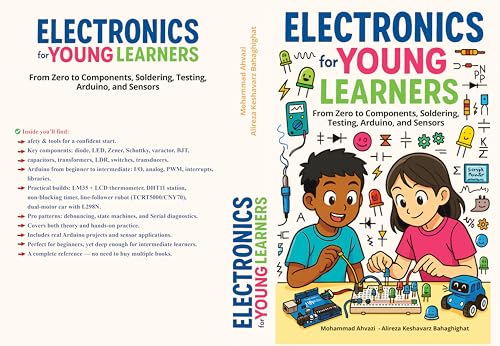
For a broad beginning, Electronics for Young Learners has the clearest documented sequence: its title moves from zero to components, soldering, testing, Arduino, and sensors. The range makes it a logical starting point when the reader has not yet chosen a specialty. The Basics of Electronics takes a more concept-centered route, with its title identifying it as a core-concepts book and its publisher identified as Rosen Young Adult.
Readers more interested in electricity than electronic components can begin with Lightning and Static Charge. It is identified as Book 1 in a self-study series on electricity with experiments, and the title names lightning and static charge as the central subjects. Energy for Keeps takes electricity into renewable resources, so it fits a reader whose curiosity is connected to energy production and environmental applications.
Choose project intensity
A project-based learner should look first at titles with explicit activity language. The Crafty Kids Guide to DIY Electronics states that it includes 20 fun projects, making it the clearest choice when a known project count matters. Design Electronic Breadboard Circuits names both breadboard circuits and project templates, while Scrappy Circuits provides a direct circuit-building identity in a large paperback format.
These books represent different kinds of practical learning. A craft-oriented project book may be more inviting for a younger maker, while breadboard templates suggest a more specific circuit-building path. The supplied evidence does not establish the difficulty of each individual activity, so readers should confirm that the projects match their existing tools and supervision arrangements.
Consider Arduino, software, and robotics connections
Arduino is the most clearly documented programmable-electronics route in this group. Getting Started With Arduino is dedicated to the open-source electronics prototyping platform, while Electronics for Young Learners includes Arduino among several stages in its broader progression. The former is more focused; the latter covers more introductory territory in the title.
Tinkercad | Step by Step takes a software-centered approach. Its title combines electronic-circuit design and programming with Tinkercad, while also including 3D-object creation and CAD. That combination may appeal to a learner who wants electronics alongside digital design. It is not as narrowly focused on physical components as the breadboard titles, so the reader’s preferred workspace is important.
Weigh theory against building
A strong beginner collection usually benefits from both explanation and application. The Basics of Electronics and Electronics in easy steps are the most plainly introductory by title, but their supplied listings do not document project counts. Getting Started With Arduino, Design Electronic Breadboard Circuits, and The Crafty Kids Guide to DIY Electronics provide clearer practical signals. Lightning and Static Charge supplies an electricity-focused experiment route, while Energy for Keeps adds a generation and energy-systems perspective.
The top electricity and electronics books for teens and young adults therefore differ more by learning route than by a single universal feature. A reader preparing for circuit construction may need components and breadboard material first. A reader exploring the science of charge may prefer the electricity series. A student interested in digital tools may get more from Arduino or Tinkercad.
The pool includes paperbacks and Kindle editions. Paperbacks such as Getting Started With Arduino, Scrappy Circuits, Design Electronic Breadboard Circuits, The Basics of Electronics, and Energy for Keeps may suit readers who want a physical book beside a work area. The Kindle titles are portable, including Electronics for Young Learners, The Crafty Kids Guide to DIY Electronics, Lightning and Static Charge, and Electronics in easy steps.
The listings provide some physical dimensions but do not describe illustration quality, page count, diagrams, or accessibility features. Do not infer those details from the title alone. A reader who needs visual circuit layouts should verify the current edition’s sample pages or publisher information.
Build a sensible learning sequence
A practical sequence can begin with a fundamentals title, continue with a project book, and then move into a defined platform. For example, a reader could start with The Basics of Electronics, use Design Electronic Breadboard Circuits for circuit practice, and then explore Getting Started With Arduino. Another route could pair Lightning and Static Charge with Energy for Keeps to connect basic electricity with renewable-resource applications.
The best electricity and electronics books for teens and young adults are not interchangeable. Compare the documented subject, project language, audience framing, and format with the reader’s current goal. Also remember that the listings do not confirm included kits, tools, component packs, or experiment supervision requirements. Those details should be checked separately before beginning a hands-on activity.
Final Recommendation
Electronics for Young Learners ranks first overall in this specification-based comparison under the published weighted criteria.
Electronics for Young Learners is the first overall specification-based choice among the best electricity and electronics books for teens and young adults because its title documents the broadest beginner progression, from components and soldering through testing, Arduino, and sensors. It is followed by Getting Started With Arduino for a focused prototyping path and The Crafty Kids Guide to DIY Electronics for its explicitly stated 20 projects.
For physical circuit practice, Scrappy Circuits and Design Electronic Breadboard Circuits are the more targeted selections. For a science-first electricity introduction, Lightning and Static Charge is the clearest fit, while Energy for Keeps provides renewable-electricity context. The top electricity and electronics books for teens and young adults ultimately depend on whether the reader wants foundational concepts, tactile circuits, programmable electronics, or energy applications.
Frequently Asked Questions
Among the best electricity and electronics books for teens and young adults, what should a complete beginner read first?
Electronics for Young Learners is the broadest documented starting point because its title covers components, soldering, testing, Arduino, and sensors. The Basics of Electronics is another suitable starting point when the reader prefers core concepts before projects. Lightning and Static Charge is more focused on electricity, static charge, and experiments.
Which selected book is most clearly project-based?
The Crafty Kids Guide to DIY Electronics states that it contains 20 fun projects. Design Electronic Breadboard Circuits also has a practical emphasis because it names breadboard circuits and project templates. Scrappy Circuits is another circuit-building option, although the supplied listing does not state its project count.
Which book is best for learning Arduino?
Getting Started With Arduino is the most focused choice because its title is dedicated to the Arduino open-source electronics prototyping platform. Electronics for Young Learners also names Arduino, but as one part of a wider progression that includes components, soldering, testing, and sensors.
Are these books about electronics or electricity?
The list includes both. Electronics-focused titles cover components, circuits, breadboards, Arduino, and Tinkercad. Lightning and Static Charge centers on electricity and static charge, while Energy for Keeps focuses on creating clean electricity from renewable resources. Choose according to whether the reader wants circuit construction, electrical science, or energy context.