Buying Guide
Choosing among the best fire bowl fire pits starts with the fuel system, because propane and wood create different setup and maintenance requirements. The selected propane models from Flame King and Outland Living use adjustable controls and documented hoses, while the wood-burning options require logs, ash handling, and attention to sparks. The right format depends on where the bowl will sit, how often it will move, and whether you want a natural wood fire or a more controlled gas flame.
Propane versus wood burning
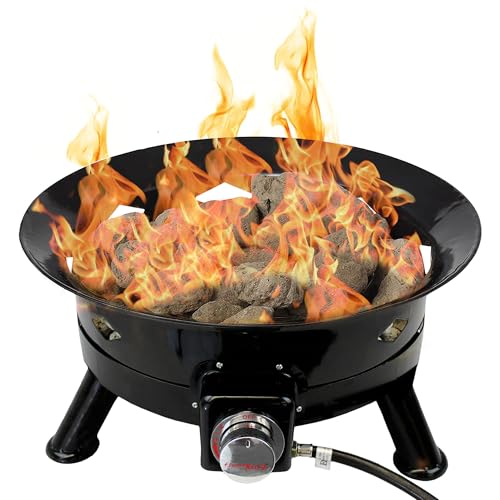
Propane bowls are generally the more direct choice when you want a fire without collecting or storing firewood. Flame King lists a 58,000 BTU output, piezo ignition, adjustable flame control, and compatibility with several standard propane tank sizes. Its tank is sold separately, so allow room for the cylinder and hose connection. The Outland Living 21-inch and 19-inch models also list 58,000 BTU output, adjustable regulation, and pre-attached 10-foot hoses. Both include lava rock for the burner area, and both are positioned for camping, patios, RV travel, or tailgating.
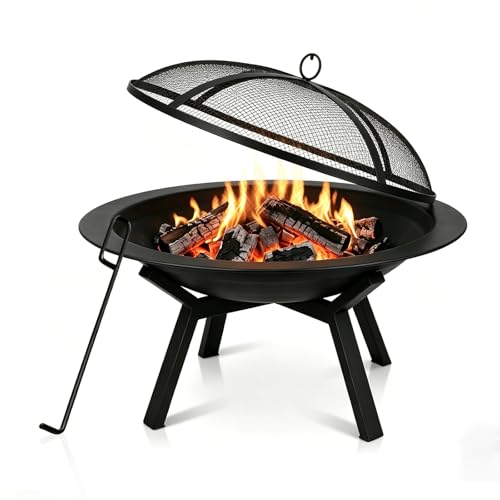
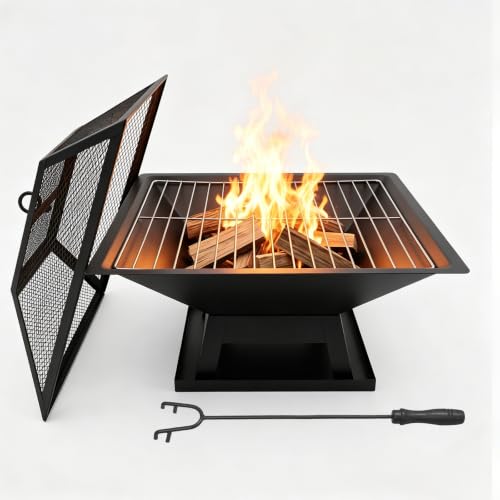
Wood-burning bowls offer a different experience and can accommodate logs directly in the fire area. The KOL bowl documents 360-degree airflow and a 35.5-inch diameter, while EcoNook provides a grill, lid, log grate, poker, and rain cover. IBGUC includes a spark screen and poker with its 28-inch bowl. Those features are useful, but wood-burning models still need a suitable fuel supply and a plan for cooled ash disposal. Check local fire rules before use; the Outland listing specifically says restrictions should be checked even when a model is described for use during most campfire bans.
Match bowl size to your space
Measure the intended location before choosing a diameter. The compact Outland 19-inch, AmazStove 19-inch, and Fire Beauty 22-inch models are easier to place in smaller outdoor areas. AmazStove specifically describes its square model for two to four people. Larger options such as KOL at 35.5 inches, EcoNook at 36 inches, and Patina at 30 inches create a broader visual and fire area but need more clearance and storage space.
Height also affects placement. The Outland 21-inch model is listed at 9.25 inches high, while the 19-inch model is 11 inches high. Taller pedestal-style designs may present a different seating relationship, but the selected products here should be evaluated on a firm, noncombustible surface appropriate to the installation. Do not infer safe clearances from dimensions alone; follow the product instructions and local requirements.
Consider portability and setup
For camping, RV travel, or tailgating, weight and included carrying equipment matter. The Outland models include carry kits, and Flame King includes a fabric carry strap plus a stabilizer ring. Fire Beauty lists a weight of about the current price, making it one of the easier wood-burning bowls to move. KOL lists a 30-pound weight, while Ash & Ember lists the current price, so those models are better suited to a more permanent backyard position.
Setup details also vary. Flame King and Outland describe no-tool assembly or quick setup. Patina arrives fully assembled, and AmazStove describes tool-free assembly with two adults in 10 to 15 minutes. EcoNook documents approximately 10-minute assembly but includes more components because it also functions as a grill and covered table. A larger accessory package can add utility, but it can also require more storage between uses.
Review construction and weather features
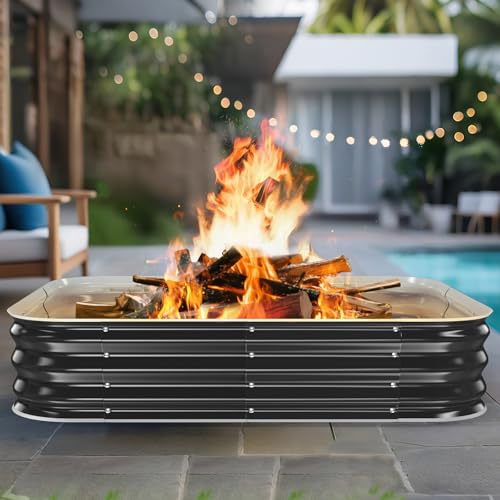
Look for the material and finish that are actually documented rather than assuming all metal bowls perform alike. Outland uses steel with a protective enamel finish and identifies a stainless steel burner. Ash & Ember uses hand-welded cast iron with high-temperature black paint and an integrated drain. KOL uses Corten steel that develops a rust-colored patina, while EcoNook describes a high-temperature powder coating. These details speak to construction and outdoor exposure, but they do not replace routine care or a cover where one is supplied.
Spark management is especially relevant for wood-burning models. IBGUC, Fire Beauty, AmazStove, and Patina document mesh screens or interior mesh. A screen can help contain embers, but it is not a substitute for supervision, correct placement, or local fire-safety practices. The KOL and Ash & Ember listings do not document included screens, so buyers should not assume one is supplied.
Check included accessories and maintenance
A bare bowl may be appropriate if you already own a stand or tools, but included accessories can simplify the initial setup. Flame King includes a cover, carry strap, stabilizer ring, and lava rocks. Outland includes a cover-and-carry kit and lava rocks. EcoNook is particularly accessory-rich among the selected wood models, with a grill, lid, log grate, poker, and rain cover. IBGUC and Fire Beauty include spark screens and pokers.
Maintenance depends on fuel and material. Gas models avoid ash and firewood handling, but the propane tank remains a separate requirement. Wood models need cooled ash removed and metal surfaces protected according to their instructions. A drain, such as the one documented on Ash & Ember, may help prevent water buildup. Always let the fire fully extinguish and cool before cleaning, covering, or moving the bowl.
Final Recommendation
Flame King 24-Inch Portable Propane Firebowl ranks first overall in this specification-based comparison under the published weighted criteria.
Flame King 24-Inch Portable Propane Firebowl is the highest-scoring first overall specification-based choice among these best fire bowl fire pits. Its combination of 58,000 BTU output, self-ignition, adjustable control, tank compatibility, cover, carry strap, stabilizer ring, and lava rock is unusually complete. Choose Outland’s 21-inch model when a lower profile and portability are more important, or the 19-inch model when storage space is limited.
For wood burning, KOL is the practical large-bowl pick, while EcoNook is better when grilling and covered-table use matter. Ash & Ember favors a heavy, permanent cast-iron centerpiece, and Fire Beauty is easier to move. These top fire bowl fire pits are not interchangeable: compare fuel, dimensions, screen coverage, accessories, and placement requirements before deciding. The specifications support different use cases rather than one universal design.
Frequently Asked Questions
Are propane or wood-burning fire bowls easier to maintain?
Propane models generally avoid ash and firewood handling, while wood-burning bowls require logs, ash cleanup, and spark management. Propane still requires a compatible tank and proper hose setup. Flame King and the Outland models document propane connections and controls; wood models such as IBGUC and Fire Beauty document screens and pokers.
What size fire bowl is suitable for a small patio?
The 19-inch AmazStove and Outland models, along with the 22-inch Fire Beauty bowl, are the more compact choices in this selection. AmazStove specifically describes its model for two to four people. Confirm the required clearances and surface requirements in the manual before installation.
Do the best fire bowl fire pits include a spark screen?
Some do, but not all. IBGUC, Fire Beauty, and AmazStove document spark screens, and Patina documents interior wire mesh. Flame King and Outland are propane models and instead focus on controlled gas flames. The KOL and Ash & Ember listings do not document an included spark screen, so verify the package contents before purchase.
Can a fire bowl also be used for cooking?
EcoNook explicitly includes a cooking grill and log grate, so it is the selected model with documented cooking functionality. The Fire Beauty listing mentions BBQ use, but its supplied features do not clearly identify an included cooking grate. Follow the manufacturer’s instructions for any food-contact use.
What should I verify before using a fire bowl outdoors?
Check local fire restrictions, required clearances, placement surfaces, fuel connections, and the manufacturer’s operating instructions. Keep the bowl attended, use only the specified fuel, and allow the fire and components to cool fully before cleaning or moving them.