Buying Guide
The best freestanding outdoor heaters differ most in fuel source, heat distribution, control method, and how easily they can be secured or moved. The products here fall into two main groups: propane tower heaters for higher heat output and electric infrared heaters for cleaner, plug-in operation. Start by deciding whether your patio can support propane-tank storage and ventilation, or whether an outdoor electrical connection is more convenient.
Choose propane or electric first
Propane models generally dominate the high-output end of this comparison. The VEVOR heater lists 50,000 BTUs and an 18-foot-diameter heating area, while the Ignovate lists 50,000 BTUs and a 10-foot radius. Amazon Basics lists 46,000 BTUs and a 9-foot radius. These figures are useful for comparing the listings, but they are not guarantees of comfort in every outdoor condition. Wind, seating arrangement, clearance, and heater placement can change the practical result.
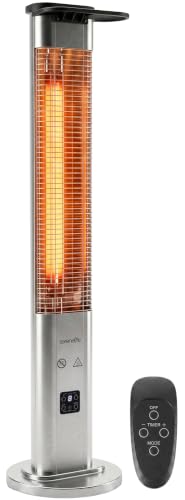
Electric infrared models use wattage rather than BTUs. ThermoMate, BLACK+DECKER, EnerG+, and DR. INFRARED HEATER all list a maximum of 1,500 watts, while SereneLife lists 900 watts. Infrared heating is described as directly warming people and objects rather than relying only on heated air. That can suit open patios, but the available coverage is more focused in the supplied evidence: SereneLife states up to 15 square feet, and ThermoMate states up to 100 square feet.
Match output and coverage to the space
For a large seating area, compare both output and the shape of the claimed coverage. The VEVOR model documents an 18-foot diameter, which describes a broad circular area and complements its round-table design. Amazon Basics and Ignovate use radius figures, while the pyramid models from Pamapic and OLIXIS provide high BTU figures without a specific coverage measurement. Avoid treating BTU alone as a complete room-size rating; the listing evidence does not establish a universal conversion between BTUs and comfortable outdoor coverage.
For a smaller seating group, a compact electric design may be easier to position. SereneLife supplies the clearest small-area specification, with a stated 15-square-foot range. EnerG+ documents oscillation, which may help distribute warmth around nearby users, and ThermoMate lists eight heat levels for more gradual adjustment. The right choice depends on whether you want broad group heating or a focused personal comfort zone.
Compare controls and adjustment
Adjustable output is important because outdoor conditions and personal comfort change during an evening. Propane options including VEVOR, Amazon Basics, Ignovate, Pamapic, and OLIXIS document adjustable heat controls. Their ignition systems differ: VEVOR and Ignovate use push-button ignition, Amazon Basics uses one-touch ignition, and Pamapic and OLIXIS document pulse ignition.
Electric controls range from basic to highly adjustable. BLACK+DECKER provides three wattage settings and a pull-chain control. EnerG+ combines three settings with a remote and oscillation. DR. INFRARED HEATER lists three power settings and a remote, while ThermoMate adds eight heat levels, an eight-hour timer, an LED display, and remote control. More controls can improve flexibility, but they also add more settings to manage. If you want simple operation, a three-level heater may be sufficient.
Review stability and safety features
A freestanding heater needs a stable setup and a way to respond if it tips. The propane models selected here document tilt or anti-tip shutoffs. Amazon Basics also lists a water box for weighing down its base and a chain for securing the tank. Ignovate documents a ground-anchored base with included ground screws, which may suit a location where the heater will remain in one place. VEVOR, Pamapic, and OLIXIS document tilt or anti-tipping protection.
Electric models also vary in protection details. ThermoMate lists a 360-degree tip-over switch and overheat protection. SereneLife lists a 360-degree tip-over switch, overheat protection, and a mesh guard. EnerG+ lists tip-over and overheating protection, while DR. INFRARED HEATER specifies tip-over protection and requires a GFCI outlet outdoors. These features do not replace safe placement, appropriate clearances, or following the manufacturer’s instructions.
Consider weather exposure and storage
Weather-related specifications are especially useful when a heater will remain on a patio. SereneLife and ThermoMate list IP65 protection, DR. INFRARED HEATER lists IP55, and EnerG+ lists IP44. These are technical protection ratings, not promises that a unit can be left in every condition indefinitely. The propane pyramid heater from Pamapic includes a cover and specifically advises moving the heater indoors in windy weather.
A cover can help with storage, but it does not eliminate the need to follow outdoor-use instructions. Wheels are common on the propane towers: VEVOR, Amazon Basics, Ignovate, Pamapic, and OLIXIS all document wheels or removable wheels. Electric choices may be easier to carry because several are lighter or use tripods, but cord routing and outlet location become part of the setup.
Propane heaters require a fuel tank. Amazon Basics, Ignovate, and the pyramid models identify compatibility with a 20-pound propane tank, generally not included in the supplied listing evidence. Check where the tank will sit, how the access door or base works, and whether the heater can be moved safely after connection.
Electric heaters avoid propane handling but need a suitable outdoor outlet. DR. INFRARED HEATER explicitly calls for a GFCI outlet outdoors. Measure the intended area before buying: tall propane towers can occupy a substantial base, while electric towers, tripods, or wall-mount designs offer different placement options. Also account for the heater’s tilt, controls, cord, and any wall hardware.
Final Recommendation
VEVOR 50,000 BTU Round Table Patio Heater ranks first overall in this specification-based comparison under the published weighted criteria.
VEVOR 50,000 BTU Round Table Patio Heater is the highest-scoring returned product and the first overall specification-based choice among these best freestanding outdoor heaters. Its documented 18-foot-diameter coverage, 50,000 BTU output, adjustable heat, wheels, tilt shutoff, and stainless steel construction give it the most complete large-area specification profile in this comparison.
Choose Amazon Basics when you want a conventional wheeled propane tower with a water-weighted base and clear 9-foot-radius documentation. Ignovate is a better fit when ground anchoring is useful. Pamapic and OLIXIS suit shoppers who prefer pyramid styling and flame-tube presentation.
For electric heating, ThermoMate offers the most extensive documented control package, including eight levels and an eight-hour timer. BLACK+DECKER is useful when freestanding and wall-mounted installation both matter. EnerG+ adds oscillation and a remote, while DR. INFRARED HEATER combines tripod portability with wall hardware. SereneLife is the compact, higher-weather-resistance option, but its stated coverage is limited.
These top freestanding outdoor heaters should be compared against your actual patio dimensions, outlet access, fuel plans, wind exposure, and storage arrangements rather than by output figures alone.
Frequently Asked Questions
How should I choose among the best freestanding outdoor heaters for a small patio?
Start with documented coverage and footprint. SereneLife states coverage up to 15 square feet, making its intended heating zone clearer than models without a stated area. EnerG+ may suit nearby seating because it documents oscillation, while a propane tower such as Amazon Basics is better considered when higher output and a larger outdoor arrangement are needed. Leave appropriate space around any heater and follow its instructions.
Are propane or electric outdoor heaters better?
Neither fuel type is universally better. Propane models in this comparison provide the highest documented outputs, including 46,000 to 50,000 BTUs, but require a compatible tank and suitable outdoor placement. Electric models avoid propane and provide infrared heat through an outlet, but their wattage and documented coverage are generally more focused. Choose based on available power, desired coverage, ventilation, storage, and control preferences.
What safety features should a freestanding patio heater have?
Look for documented tip-over or tilt shutoff protection. The selected propane models include such features, and some add a water-weighted base, tank chain, or ground screws. Electric models may add overheat protection, mesh guards, or 360-degree tip-over switches. DR. INFRARED HEATER specifies a GFCI outlet for outdoor use. These features supplement, rather than replace, stable placement and the manufacturer’s safety directions.
Can these heaters stay outside in rain?
Check the specific listing rather than assuming. EnerG+, DR. INFRARED HEATER, SereneLife, and ThermoMate provide IP ratings, but those ratings are technical specifications and do not establish unrestricted exposure in every condition. Pamapic includes a cover and advises moving the heater indoors during windy weather. Storage, covers, weather conditions, and the product manual should guide your decision.
Do freestanding outdoor heaters need to be moved often?
Propane towers from VEVOR, Amazon Basics, Ignovate, Pamapic, and OLIXIS document wheels, which can help reposition them on suitable surfaces. Tripod-based electric designs offer another portable approach, while wall-mounted configurations are more fixed. A ground-anchored design such as Ignovate may be less convenient for frequent relocation, so consider your intended layout before installation.