Buying Guide
The best freestanding single-bowl kitchen sinks are defined by more than a basin and four legs. Compare the washing space, steel specification, storage, plumbing, drainage, and leveling hardware before choosing. This is a specification-based comparison using public listing data, not hands-on testing or customer opinions.
Measure the installation area
Check floor width, depth, height, wall clearance, door swings, and the path used to bring the sink into the room. Compact options such as GarveeTech and KINGBO are easier to consider for smaller utility areas, while LUCKWIND, Lafati, VEVOR, and Toemics require more room. A listed width does not necessarily describe every assembled component, so verify the complete dimensions before ordering.
Also check faucet and drain clearance. A station may fit between walls but still interfere with a shelf, appliance, or walkway. Kraus lists a 24-by-24-inch footprint, while several other models are approximately 39, 47, or 55 inches wide. Those larger workstations can provide useful counter space, but they need a suitable floor plan.
Match the basin to the task
A single bowl can accommodate soaking, rinsing, produce washing, laundry, tools, or bulky cookware without a center divider. Deeper or larger bowls generally provide more room for oversized items, but the basin must still leave comfortable faucet clearance.
Kraus documents a 12-inch-deep basin and 16.5-gallon capacity. Lafati lists a 7.7-inch depth, and KINGBO lists an 8-inch bowl depth. DuyviSteil documents a 14-by-13-by-7-inch basin, making it a more compact choice. These figures help compare listed utility, but they do not replace checking the exact internal dimensions for your own containers.
Compare material claims
Stainless steel is common in this category, but the listed grades differ. Kraus documents 18-gauge stainless steel. Toemics and LUCKWIND identify 304 stainless steel, while VEVOR identifies SUS201. Garvee and MilleLoom document 304 bowls with 201 frames. That distinction matters when comparing construction specifications.
Look at whether a grade applies to the basin, frame, or complete station. Rounded corners and polished surfaces may make routine wiping easier, but the supplied evidence does not establish long-term performance in a particular environment. Avoid treating a material label as a guarantee of service life.
Decide whether storage is important
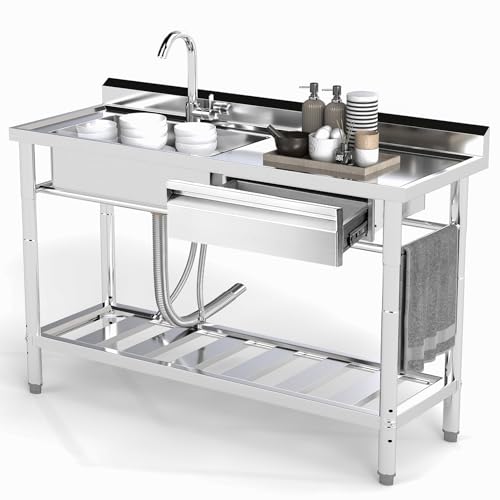
A sink with a workbench or shelf can reduce trips to another counter. Lafati documents a countertop and undershelf. MilleLoom adds a workbench, pull-out drawer, hooks, and basket. Toemics has a drawer and lower rack, while LUCKWIND combines two shelves, hooks, and a foldable countertop.
Open shelves keep supplies visible, while drawers can conceal smaller items. Choose according to the tools, bottles, towels, and cleaning products you expect to keep near the basin. A foldable extension may help when additional work area is useful only occasionally.
Check plumbing and drainage components
Many selected products list a 360-degree faucet and hot-and-cold inlet pipes. That feature can be useful for food preparation, laundry, or garage cleanup, but it does not confirm compatibility with existing connections. Check inlet sizes, hose lengths, drain placement, and local installation requirements.
Drain filters and strainers can catch larger debris. VEVOR lists a removable strainer basket and multiple drain-pipe options. Kraus lists a drain assembly with removable strainer and a sloped bottom with channel grooves. GarveeTech and KINGBO also document detachable or removable filters. These parts still require routine cleaning and correct drain installation.
Consider leveling and stability
Adjustable feet are useful on uneven garage, patio, basement, or laundry floors. Kraus, Lafati, VEVOR, Garvee, and MilleLoom document adjustable feet or legs. Garvee and MilleLoom also list anti-slip feet. Kraus documents a wall-mount option for added stability.
Freestanding does not mean the sink can be placed without checking stability. Follow the supplied instructions, level the base, and make sure water and drain connections are not pulling against the unit. If the sink will be used outdoors, confirm that the proposed location and plumbing arrangement are appropriate for the installation.
Final Recommendation
Kraus Standart Pro 24-inch Utility Sink ranks first overall in this specification-based comparison under the published weighted criteria.
Kraus Standart Pro 24-inch Utility Sink is the first overall specification-based choice in this comparison.
Among the best freestanding single-bowl kitchen sinks, Kraus has an extensive documented package for high-use utility work: 18-gauge steel, a 16.5-gallon capacity, soundproofing, a shelf, adjustable feet, backsplash, and drainage features. It is a strong fit for a laundry room or compact work area when the faucet and connection requirements are handled separately.
Choose Lafati when a wide prep surface is more important than a compact footprint. Garvee is a practical option for organized storage and flexible placement. Toemics and MilleLoom are useful drawer-storage alternatives, while LUCKWIND suits a broad station with an expandable work surface. GarveeTech, KINGBO, and DuyviSteil are more appropriate when floor space is limited.
These are also among the top freestanding single-bowl kitchen sinks for different documented use cases, but the right selection depends on available space, basin clearance, plumbing, and storage. Review the current listing dimensions and included components before purchase.
Frequently Asked Questions
What are the best freestanding single-bowl kitchen sinks for a small room?
GarveeTech and KINGBO are the most space-conscious selected options based on their listed formats. DuyviSteil is another compact choice with a listed 30-by-16-by-30-inch size and a 14-by-13-by-7-inch basin. Check the complete assembled dimensions, faucet clearance, and drain position before ordering.
Is 304 stainless steel important for a freestanding sink?
It is a useful specification to compare, but confirm which component uses it. Toemics and LUCKWIND identify 304 stainless steel for the sink, while Garvee and MilleLoom identify 304 bowls with 201 frames. Other products identify 201 stainless steel or do not provide a grade. The listing evidence supports comparison, not a guarantee of service life.
Do these sinks include faucets and plumbing parts?
Many selected models list faucets and hot-and-cold inlet pipes. VEVOR, Garvee, Toemics, Lafati, LUCKWIND, GarveeTech, KINGBO, and DuyviSteil document faucet or plumbing features. DuyviSteil specifically lists drain pipes and angle valves. Confirm connector compatibility, drain requirements, and package contents before installation.
Are adjustable legs useful on a freestanding kitchen sink?
They can help level a station on an uneven floor. Kraus, Lafati, VEVOR, Garvee, and MilleLoom document adjustable feet or legs. This is especially relevant in garages, patios, basements, and laundry rooms. Adjustable hardware does not replace checking stability or ensuring that plumbing connections remain aligned after leveling.
Which selected sink is best for storage?
LUCKWIND offers two storage tiers, five hooks, and a foldable countertop. MilleLoom documents a drawer, workbench, hooks, and basket, while Toemics combines a drawer with a lower rack. These designs suit users who want supplies near the basin. Open shelves are easier to access, while drawers can keep smaller items less visible.