Buying Guide
Choosing among the best garage wastebaskets starts with the kind of material your garage produces. A workbench used for packaging scraps has different needs from a space handling renovation debris, recycling, or frequent vehicle-maintenance cleanup. The supplied listings show several useful formats: large commercial round cans, lidded rectangular wastebaskets, mobile electronic bins, multi-packs, and compact containers for localized scraps. Because this comparison uses public specifications rather than hands-on testing, the guidance below focuses on documented capacity, construction, access, liner handling, and placement features.
Match capacity to the waste stream
Capacity is the first practical distinction. The Rubbermaid Commercial BRUTE 32-Gallon Round Can is the largest single-container option selected here and is positioned for demanding cleanup loads. Its size makes sense when the garage generates bulky packaging, yard-related waste, or frequent debris. The Zedfire 23-Gallon Waste Bin 3-Pack offers slightly smaller individual containers but adds multiple stations, which can be more useful when waste and recycling need to be separated or when several work areas are spread across the garage.
Mid-size cans are more adaptable for ordinary household and garage use. The Zedfire 18-Gallon Step-On Trash Can provides a balance between capacity and a contained design. The 13-gallon Sterilite and iTouchless models use a familiar liner size, while the Rubbermaid 20-Gallon BRUTE six-pack supplies more room at each station. A 2.5-gallon STORi Luup is not a substitute for a main can, but it can collect small scraps close to a workbench and reduce trips across the garage.
Consider open access versus a lid
Open containers are fast for repeated disposal. Both BRUTE models and the Zedfire 23-gallon bins document open access, making them convenient when users are dropping material frequently. That format also makes the contents visible and does not add a lid mechanism to maintain. The trade-off is that the supplied evidence does not document odor containment or concealment for these open designs, and the 20-gallon BRUTE listing explicitly says its lids are not included.
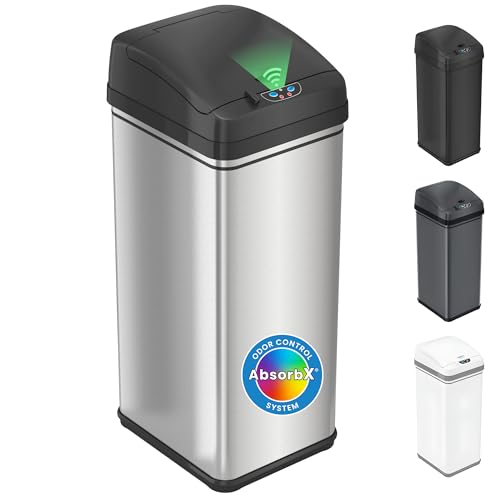
Lidded wastebaskets are better suited to garages attached to living areas or locations where waste should remain concealed between uses. The Zedfire 18-gallon model uses a secure-fit lid and foot pedal. Sterilite’s Swing Top, D-Shape Lift Top, and TouchTop models provide different one-handed or touch-operated approaches. The iTouchless Glide adds a motion sensor and odor filter, but it also introduces battery or optional adapter requirements. Select the simplest closure that fits your routine; a mechanism is useful only if its access style matches how the garage is used.
Evaluate construction for the setting
Garage floors can expose a container to dust, rough movement, temperature changes, and contact with tools or materials. The BRUTE listings provide detailed commercial-oriented construction information, including UV-inhibited material, reinforced rims or bases, rounded handles, and resistance claims. The 32-gallon version also documents a base designed for dragging over rough surfaces. These features make it a logical choice when the container will be moved while loaded, although the listing does not establish a particular real-world service life.
The Zedfire 18-gallon can uses heavy-duty commercial-grade plastic, while the Zedfire 23-gallon bins are described as heavy-duty plastic with built-in handles and anti-jamming reinforcements. The Rubbermaid Untouchable pair is injection molded and described as resistant to dents, cracks, punctures, and ultraviolet rays. Plastic options are generally easier to wipe, but the supplied evidence should be read as product specifications rather than a guarantee of performance in every garage.
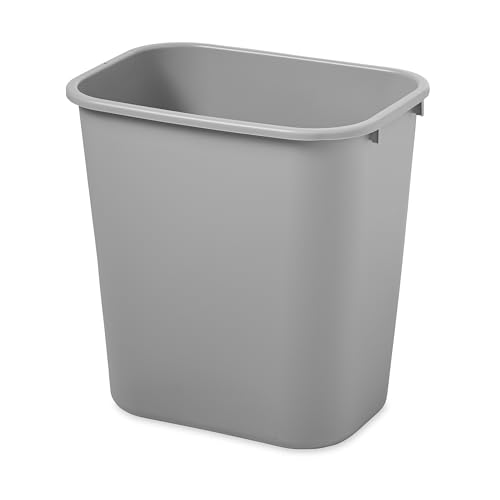
Measure the available floor area, wall clearance, and overhead clearance. The iTouchless Glide is 11.4 inches wide and 16 inches long according to the listed dimensions, and its four removable locking wheels support relocation. The STORi Luup is substantially smaller and is intended for tight spaces, including a garage or workshop. By contrast, round BRUTE containers need their diameter available around the full circumference, even when placed near a wall.
Flat-sided or rectangular options can be easier to align with walls and cabinets. The Sterilite D-Shape model specifically documents a flat side for wall or cabinet placement. The Zedfire 18-gallon can is rectangular, and the Sterilite TouchTop listing provides dimensions of 16.25 inches long, 12.63 inches wide, and 24.75 inches high. The Sterilite Swing Top is also described as space efficient, but individual dimensions are not supplied. When exact clearance matters, favor a listing with usable measurements or confirm the dimensions before ordering.
Look at liner control and replacement
A bag that slips into the container can make cleanup harder than the capacity suggests. The Rubbermaid 32-gallon BRUTE and 20-gallon BRUTE listings document integrated cinches for securing liners. The larger BRUTE also lists venting channels intended to reduce the force needed to remove a filled liner. The STORi Luup takes a different approach, using side hooks to hold grocery or other small bags. These are meaningful design distinctions because they address how bags stay in place rather than merely stating that a container accepts a liner.
Several Sterilite models document compatibility with standard or 13-gallon liners, which can simplify replacement if that size is already used elsewhere in the home. The iTouchless Glide is described as accommodating common 13-gallon bags. Always distinguish liner compatibility from an included bag-retention system: the former identifies a usable bag size, while the latter describes how the bag is held during use.
Decide whether a multipack is practical
Multipacks can support recycling, shared work areas, or different floors, but they also require storage and repeated liner purchases. The Zedfire 23-gallon three-pack, Rubbermaid Untouchable two-pack, Sterilite Swing Top four-pack, Sterilite D-Shape six-pack, Sterilite TouchTop eight-pack, and Rubbermaid 20-gallon BRUTE six-pack all solve coverage problems in different ways. A set is most useful when each container has a planned location. If only one garage station needs a wastebasket, a single large or medium can avoids unused units occupying space.
Final Recommendation
Rubbermaid Commercial BRUTE 32-Gallon Round Can ranks first overall in this specification-based comparison under the published weighted criteria.
Rubbermaid Commercial BRUTE 32-Gallon Round Can ranks first in this specification-based comparison under the published weighted criteria.
Rubbermaid Commercial Products BRUTE Heavy-Duty Round Trash/Garbage Can, 32-Gallon, Gray is the highest-scoring returned product and the first overall specification-based choice among the best garage wastebaskets. Its 32-gallon capacity, reinforced construction, venting channels, liner cinches, and handles give it broad documented utility for demanding garage cleanup. It is an open can, however, so shoppers wanting concealed waste should consider the Zedfire 18-Gallon Step-On Trash Can or a Sterilite lidded model instead.
For mobility, the iTouchless Glide stands out because its four locking wheels and sensor lid address relocation and touch-free access. For several work areas, the Zedfire 23-Gallon three-pack or Rubbermaid 20-Gallon BRUTE six-pack provides broader station coverage. The STORi Luup is the focused choice for a bench or small workshop scraps. These top garage wastebaskets are not interchangeable: capacity, lid style, bag handling, and available floor space should determine the final pick.
Frequently Asked Questions
What size wastebasket works best for a garage?
It depends on the waste stream and emptying schedule. The selected range includes the 2.5-gallon STORi Luup for small scraps, 13-gallon bins for general household-style waste, 18- to 23-gallon choices for larger loads, and the 32-gallon BRUTE for demanding cleanup. A multipack can be more useful than one large can when waste is generated in separate areas.
Should a garage wastebasket have a lid?
A lid is useful when concealing waste or reducing exposure to odors is important. The Zedfire 18-gallon, Sterilite Swing Top, Sterilite D-Shape, Sterilite TouchTop, and iTouchless Glide all document enclosed designs. Open BRUTE and Zedfire bins are better suited to fast, repeated disposal when concealment is not a priority.
Which of the best garage wastebaskets is easiest to move?
The iTouchless Glide documents four removable wheels with locking capability. The BRUTE models document rounded handles, and the Zedfire 23-gallon bins list built-in handles. A container’s loaded weight, floor surface, and doorway clearance still matter, so mobility features should be matched to the actual route through the garage.
Are multipacks useful for garage organization?
They can be useful when the garage has separate work areas, recycling points, or several rooms needing matching containers. The Rubbermaid 20-gallon BRUTE six-pack emphasizes commercial handling features, while the Sterilite and Zedfire sets offer lidded or slim alternatives. For one disposal point, a single container may be easier to place and maintain.
What should I check before ordering?
Confirm capacity, external dimensions, lid clearance, liner size, and whether a lid or bag-retention feature is included. Pay special attention to listings without individual measurements, such as some multipacks. Also check whether wheels require locks, whether electronic models need batteries or an adapter, and whether an open design suits the intended garage location.