Buying Guide
Choosing the best garage floor comfort mats starts with identifying what kind of standing or movement the garage requires. A mechanic working at one bench needs a different surface from someone building a home gym, and a damp utility area may benefit from drainage rather than a sealed foam tile. The products above are ranked from documented specifications, not hands-on testing or customer sentiment.
Match the mat to the task
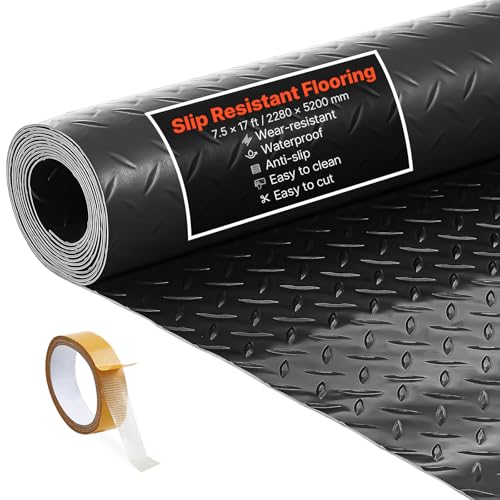
For a single standing station, compact anti-fatigue mats are usually easier to position than a full floor system. The FEATOL mat measures 39 by 20 inches and documents 0.9-inch memory foam, while the Durable 442S measures 24 by 36 inches and lists 7/8-inch thickness with sponge backing. The Guardian Air Step provides a larger 3-by-5-foot vinyl surface and can be cut to fit. These formats are useful when comfort is needed only where a person stands, such as beside a workbench, tool chest, or vehicle service position.
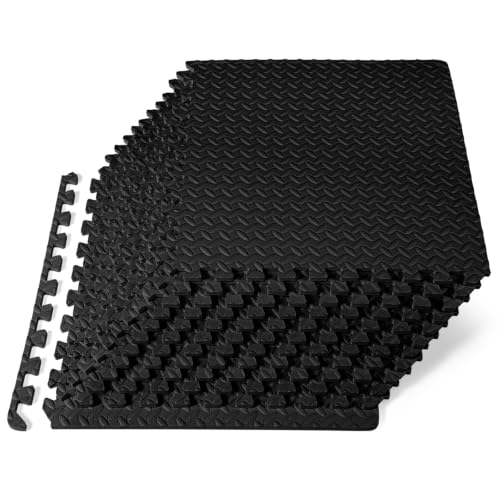
Interlocking tiles make more sense when the comfort area needs to surround exercise equipment or extend across a larger section of concrete. BalanceFrom provides 24 square feet from six tiles, Performance Tool covers the same stated area with six 2-by-2-foot tiles, and ProSourceFit expands to 48 square feet with 12 tiles. SUPERJARE’s rubber-top system is the broadest selected option at 96 square feet. The modular formats can be assembled, repositioned, or extended, but they require more planning at seams and borders.
Compare thickness and cushioning
Thickness is a useful first specification, but it does not describe every aspect of comfort. BalanceFrom lists 1-inch high-density EVA foam, the greatest stated thickness here. FEATOL lists 0.9-inch high-density memory foam, and Durable lists 7/8-inch construction with sponge backing. Performance Tool specifies 3/8-inch, while the ProSourceFit and Art3d options are approximately 1/2 inch. Thicker foam can be attractive for prolonged standing, stretching, or floor exercises, but the right choice also depends on whether equipment will sit on the mat and how much floor height the garage can accommodate.
Rubber-topped designs offer a different balance. VEVOR combines a rubber top with EVA foam in a 0.56-inch tile, and SUPERJARE uses an EPDM rubber top over high-density EVA foam. Their listings emphasize grip, shock absorption, wear resistance, or equipment use. That construction may be preferable where traction and equipment support are priorities, while a softer all-EVA tile may be more appealing for kneeling, stretching, or play areas.
Check traction and edge details
A garage mat should stay predictable underfoot, especially on smooth concrete. Performance Tool, BalanceFrom, VEVOR, and SUPERJARE describe interlocking designs or non-slip surfaces. FEATOL specifies a textured surface, non-slip bottom, beveled edges, and a yellow border. Durable also lists beveled edges and a yellow border, while Guardian can be cut to fit but provides less detailed traction information in the supplied listing.
Borders matter because they create a transition between the mat and exposed concrete. Performance Tool, BalanceFrom, ProSourceFit, and VEVOR include edge pieces or borders. A finished perimeter can help the layout look more deliberate, but it does not remove the need to place tiles on a clean, flat surface. ProSourceFit specifically identifies flat, hard surfaces as the best installation condition.
Decide whether drainage is important
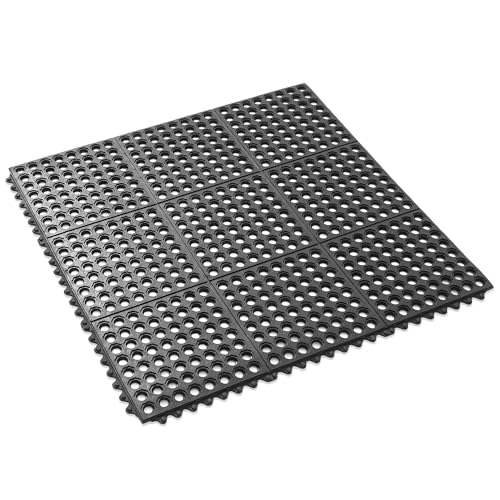
Most foam and vinyl standing mats create a relatively continuous surface, which is convenient for standing and sweeping. RITOLLO takes a different approach with raised feet and drain holes. Its 0.5-inch PVC tiles are designed to channel water away, can be trimmed around obstacles, and can be hosed down. This makes them a logical choice for a damp garage, utility area, or location where water may be tracked in.
Drainage tiles are not the same as a sealed spill-containment pad. If the priority is keeping liquid from passing through, the supplied evidence here does not establish that RITOLLO provides that function. Instead, choose it when air and water movement under the surface is more important than a closed barrier.
Consider cleaning and maintenance
Cleaning details vary by material. BalanceFrom, Performance Tool, and ProSourceFit describe soap-and-water cleaning, while Art3d lists wiping, vacuuming, or sweeping its waterproof surface. VEVOR can be wiped or rinsed, and RITOLLO is intended for hose-down cleaning through its drainage structure. Durable specifies sweeping or mopping with mild detergent. These instructions are useful when comparing a dusty workshop with a workout area where sweat, dirt, or tracked-in moisture may occur.
Before installation, remove loose debris and check that the concrete is dry and reasonably level. Interlocking tiles may be convenient to assemble, but the evidence does not support assuming that every tile system will remain perfectly flat on an uneven floor. Single-piece mats reduce seam management, while cut-to-fit products can adapt to unusual corners. Leave room for doors, tool drawers, and vehicle paths before selecting a footprint.
Select coverage conservatively
Measure the actual standing or activity zone rather than automatically covering the whole garage. A compact Art3d, FEATOL, Durable, or Guardian mat can be enough for one person at a bench. Performance Tool, BalanceFrom, and VEVOR provide 24-square-foot modular zones. ProSourceFit and SUPERJARE offer larger exercise layouts, while RITOLLO’s package is modular but does not state total square-foot coverage in the supplied specifications.
The best garage floor comfort mats are therefore the ones whose cushioning, footprint, surface, and maintenance needs align with the job. Avoid choosing only by thickness: coverage, traction, edge treatment, moisture handling, and the intended load all affect whether a mat fits the garage.
Final Recommendation
Among the top garage floor comfort mats, the ranked products differ under documented cushioning and fatigue support, coverage and layout flexibility, traction and edge safety, cleanability and garage use, and material and build design.
SUPERJARE Rubber-Top 24-Tile Flooring ranks first overall in this specification-based comparison under the published weighted criteria.
The final choice among the best garage floor comfort mats depends on the documented features that match your intended use.
SUPERJARE Rubber-Top 24-Tile Flooring is the first overall specification-based choice. Its 96-square-foot coverage, dual-layer construction, interlocking edges, detachable borders, grip, cushioning, and cleaning options give it a strong broad-area profile. It is especially suitable for a larger garage workout or equipment zone.
For deeper foam cushioning, BalanceFrom 1-Inch Puzzle Exercise Mat is a strong alternative because its 1-inch EVA construction, 24-square-foot interlocking layout, double-sided non-slip surfaces, moisture resistance, and portable construction support standing and exercise use. For larger foam coverage, ProSourceFit is practical; VEVOR suits users prioritizing a rubber-top surface; FEATOL and Durable fit compact standing stations; and RITOLLO is appropriate when drainage is the defining requirement. Performance Tool offers balanced modular coverage, Guardian supplies a cut-to-fit single-piece format, and Art3d fits smaller workbench positions.
Frequently Asked Questions
What should I look for in the best garage floor comfort mats?
Start with documented thickness and material, then check footprint, traction, edge treatment, cleaning instructions, and whether the surface is intended for standing, exercise equipment, or wet areas. A thicker mat may provide more cushioning, but a smaller workstation may not need a large tile system. Also verify that the floor is flat and clear before installation.
Are interlocking foam tiles suitable for a garage?
Yes, several selected products document garage use, including BalanceFrom, Performance Tool, ProSourceFit, and SUPERJARE. Interlocking tiles provide expandable coverage and can be disassembled, but they are best placed on a clean, flat, hard surface. Foam tiles may not be the right choice where sealed liquid containment or vehicle-specific loading is the primary need.
Which selected mat is best for a wet garage area?
RITOLLO is the clearest match when drainage is the priority. Its raised feet and drain holes are designed to channel water away, and its PVC tiles can be hosed down. That open construction is different from a sealed spill barrier, so select it for moisture management rather than assuming it will contain every liquid.
Do thicker mats always provide better garage comfort?
Not necessarily. Thickness is an important cushioning indicator, but material, surface grip, footprint, and intended use also matter. BalanceFrom lists 1-inch EVA foam, while VEVOR uses a thinner rubber-and-EVA design focused on grip and equipment use. A compact 0.9-inch FEATOL mat may be more practical for one standing station than a larger tile package.
How much garage coverage do I need?
Measure the area where you will stand, exercise, or work, and include clearance for movement and nearby equipment. Art3d suits a small position, Performance Tool and BalanceFrom cover 24 square feet, ProSourceFit covers 48 square feet, and SUPERJARE covers 96 square feet. Choose only the coverage that fits the task and leaves doors, drawers, and walking paths unobstructed.