Buying Guide
Choosing among the best granite composite double-bowl kitchen sinks starts with installation dimensions, not color. A sink that looks right may still require a larger cabinet, a different countertop opening, or a mounting method your existing surface cannot support. The products in this comparison are all documented as double-bowl sinks made from granite, quartz composite, Silgranit, or closely related stone-composite materials. This guide interprets the supplied public listing data; it does not represent hands-on testing.
Confirm cabinet and countertop fit
Measure the available cabinet before comparing bowl layouts. Several 32- and 33-inch models specify a 36-inch minimum cabinet, including the Kraus KGD-442 Quarza, Kraus Forteza KGD-50GREY, and Ruvati RVG1344ES. Treat the manufacturer’s installation documentation as the controlling source because exterior dimensions alone do not reveal the required support rails, cutout, or clearance around plumbing.
Front-to-back size matters as well. Many selected sinks are approximately 21 to 22 inches wide from front to back, while the BLANCO 441129 Precis Silgranit is listed at 18 inches. That narrower footprint may be helpful where counter depth is limited, but it can also change the available bowl area. Compare the sink’s outside dimensions with the counter edge, backsplash, faucet reach, and cabinet interior before ordering.
Pick the right bowl split
A 50/50 configuration gives both bowls similar capacity. The Karran QU-WS-880, Karran QU-710, BLANCO 443068, and BLANCO 441129 use equal-bowl designs or are listed as 50/50. This arrangement works well when washing and rinsing tasks are similar or when two people use the sink at once.
A 60/40 layout gives one basin more room for cookware and a smaller basin for rinsing, food preparation, or separating items. The Karran QU-610, Karran QU-811, Kraus Forteza, Ruvati RVG1344ES, and Karran QT-711 use this approach. The larger basin is useful for pans, but the smaller bowl may be less suitable for bulky items.
A low divider changes how the two bowls work together. The Karran QUWS-880 and QU-811 list lowered dividers, allowing some larger cookware to extend across both sides while retaining separate basins. This can be a practical compromise between a fully divided sink and a single large bowl. A standard-height divider may provide more separation but less flexibility for oversized items.
Compare mounting styles
Undermount sinks sit beneath the countertop and create a continuous surface for wiping crumbs into the basin. The Karran QUWS-880, Karran QU-610, Karran QU-811, Karran QU-710, both selected BLANCO models, and the BLANCO Precis are documented as undermount designs. This installation normally requires a compatible solid-surface counter and careful support during installation.
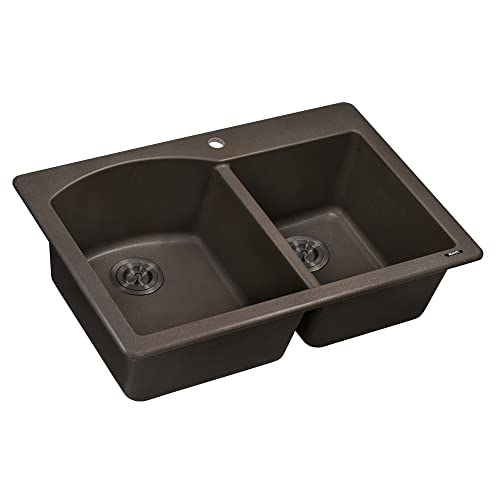
Top-mount or drop-in sinks rest on the counter rim. The Ruvati RVG1344ES and Karran QT-711 are top-mount choices in this selection. Kraus Forteza and the KGD-442 are more flexible because their listings describe both drop-in and undermount installation. That flexibility can be especially useful in a replacement project, but the exact cutout and mounting instructions still need verification.
Understand composite material claims
The listings commonly describe a blend of natural quartz or granite particles and resin. Karran states 80% natural quartz for its selected models, while Kraus describes its composite as 80% natural quartz. BLANCO describes Silgranit as quartz-sand or rock-hard granite material, and Ruvati lists an 80% composite construction. These details help distinguish a stone-composite sink from a metal or ceramic alternative.
Most selected products list resistance to some combination of stains, scratches, impact, chips, abrasion, or heat. The Karran models specify temperatures up to 535°F. These are manufacturer or listing claims, not independent test results. Follow care instructions and avoid assuming that a technical resistance claim makes the surface immune to damage.
Plan cleaning and daily care
Non-porous, smooth, or matte surfaces are repeatedly presented as easy to clean. Rounded or tight-radius corners, noted on products such as the Kraus Forteza, Ruvati RVG1344ES, Karran QU-811, and Karran QU-710, may reduce places where residue collects. Undermount installation can also simplify wiping debris from the counter directly into the bowl.
Color is part of maintenance planning. The Kraus KGD-442 and Ruvati RVG1344ES listings describe consistent or UV-stable color, while Karran lists UV-stabilized colors for its QU-810 family. Those statements describe color-retention design, not a promise against every mark. Dark finishes can show light residue, and light finishes can make some food stains more visible, so choose based on cleaning habits as well as appearance.
Check what comes in the package
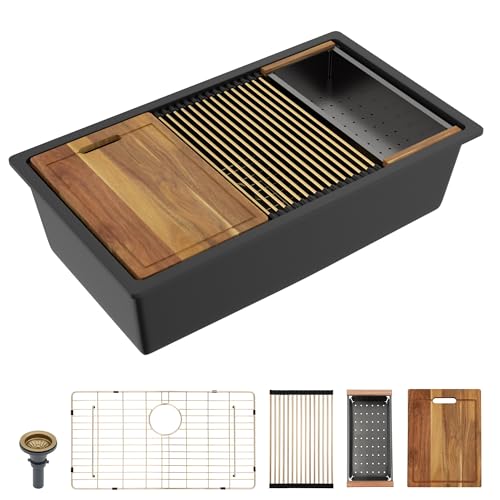
Accessory bundles vary considerably. The Karran QUWS-880 is the most workstation-oriented option, with a cutting board, drying mat, colander, and strainers. The Karran QU-610 and QU-811 include bottom grids, basket strainers, and cleaning oil. Ruvati lists matching basket strainers, mounting clips, and a cutout template. Kraus Forteza includes drain assemblies, a mitt, and a trivet.
Other models list optional accessories or separate strainers. BLANCO 443068 specifically lists the basket strainer as sold separately, while BLANCO 441129 lists grids and a colander as optional. Confirm the package contents before comparing the total project cost. Included accessories can reduce additional shopping, but they should not override a poor fit or unsuitable bowl layout.
Balance depth, storage, and workflow
Deep bowls can help contain splashes and accommodate cookware, but depth also affects the space below the sink. Selected products list depths from approximately 9 to 10 5/8 inches. Rear drains, documented on several Karran models and the QT-711, may leave more usable cabinet area, although plumbing placement still determines the final result.
For frequent large-pan washing, prioritize the larger basin or a low divider. For shared kitchens and separate prep tasks, a 50/50 model may be easier to organize. For an existing drop-in opening, prioritize top-mount or dual-mount compatibility. These practical choices narrow the field more reliably than finish alone.
Final recommendation
Karran QUWS-880 Workstation Sink ranks first overall in this specification-based comparison under the published weighted criteria.
The Karran QUWS-880 Workstation Sink is the first overall specification-based choice among these best granite composite double-bowl kitchen sinks. Its equal low-divide bowls, 80% natural-quartz construction, stated 535°F heat resistance, undermount format, and unusually broad accessory package give it the most specification-aligned combination of documented utility.
The top granite composite double-bowl kitchen sinks are not identical, so the best alternative depends on the installation. Choose the Kraus Forteza KGD-50GREY when drop-in flexibility matters, the Karran QU-610 for a complete 60/40 undermount kit, or the Ruvati RVG1344ES for a top-mount retrofit with a supplied template and drains. If equal bowls are the priority, consider the Karran QU-710 or BLANCO 443068. If counter depth is constrained, the 18-inch-wide BLANCO 441129 deserves a closer fit check.
Before purchasing, verify the cabinet minimum, cutout dimensions, bowl depth, faucet-hole arrangement, drain position, mounting method, and accessory contents. Product listings can change, and the installation guide should take precedence over a marketplace specification summary.
Frequently Asked Questions
Among the best granite composite double-bowl kitchen sinks, are granite composite and quartz composite kitchen sinks the same?
The supplied listings use both terms for stone-composite sinks made with natural quartz or granite material and resin. Karran and Kraus describe 80% natural quartz construction, while BLANCO uses the Silgranit name and describes quartz sand or granite content. Review the specific material statement for the model you are considering rather than relying on the category label alone.
Is a 50/50 or 60/40 double bowl better?
A 50/50 layout gives both basins similar capacity and suits evenly divided washing, rinsing, or preparation. A 60/40 layout provides a larger basin for cookware and a smaller basin for secondary tasks. The Karran QU-710 and BLANCO 443068 represent equal-bowl options, while the Karran QU-610 and Kraus Forteza represent 60/40 designs. Your cookware and normal workflow should determine the choice.
Can every granite composite double-bowl sink be undermounted?
No. Many selected products are undermount designs, but the Ruvati RVG1344ES and Karran QT-711 are presented as top-mount sinks. The Kraus Forteza and KGD-442 listings describe dual-mount flexibility. Always confirm the mounting method, countertop material, cabinet clearance, and cutout requirements for the exact model.
What does a low divider do?
A low divider leaves the two bowls separated while allowing some larger cookware to extend across them. The Karran QUWS-880 and QU-811 document low-divider designs. This can improve flexibility for large pans, but it provides less separation from splashes than a full-height divider.
Do these sinks include drains and grids?
Package contents differ. Karran QU-610 and QU-811 list grids and basket strainers, Ruvati RVG1344ES lists matching basket strainers, and Kraus Forteza lists two drain assemblies. BLANCO 443068 lists its basket strainer as sold separately. Check the current package details before assuming that a drain, grid, or other accessory is included.