Buying Guide
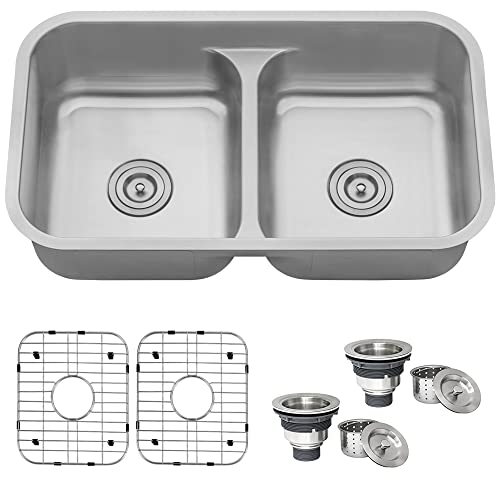
The best undermount double-bowl kitchen sinks should be compared as installation components, not just as attractive basins. A sink can have a useful bowl arrangement but still be unsuitable if its cabinet requirement, front-to-back dimension, or mounting method does not match the planned counter. The products above document several different approaches: traditional full-height dividers, lowered dividers, workstation ledges, stainless steel construction, and quartz composite surfaces.
Start with the cabinet and countertop fit
Measure the base cabinet before comparing accessories or finishes. The selected products call for minimum cabinet sizes from 35 to 36 inches, while the compact 32-inch options still need more than the sink’s nominal width in usable structure. The Karran PU53R-PK1 lists a 32-inch size, but its supplied dimensions include a 20.5-inch listed length. The Kraus Quarza lists a 22-inch front-to-back dimension, and the 33-inch SANYCASA lists a 19-inch width. These differences matter when a countertop cutout is already planned.
Undermount installation places the sink below the countertop edge for a continuous surface that can be wiped toward the basin. The Kraus Standart Pro KHU104-33, Kraus Dex KA1UD33B, Ruvati RVM4350, Lordear X64-ULS32A, and selected Karran models document undermount installation and installation components. The Kraus Quarza adds drop-in flexibility, which may help with a retrofit, but the final mounting choice still needs to match the counter material and installer plan.
Choose the bowl layout for your routine
A 50/50 arrangement gives both sides similar working space. It suits households that want to wash in one basin and rinse or prep in the other without giving up the ability to use either side for larger items. The Ruvati RVM4350, SANYCASA, LQS, Karran QU-810, and Kraus Quarza all document equal-bowl layouts or dimensions that support that interpretation.
A 60/40 arrangement creates a larger primary bowl and a smaller secondary area. It can be useful when one side handles cookware and the other handles rinsing, scraps, or food preparation. The Kraus Standart Pro, Lordear, and Karran PU53R-PK1 document this split. Before choosing one, consider whether the smaller bowl will accept the dishes and accessories you use most often.
Consider a low divider
A low divider reduces the visual and physical separation between basins while retaining two drainage areas. The Ruvati RVM4350 documents a divider 3 inches below the rim. The Lordear describes a smart lower divider, and both selected Karran composite models list low-divide designs. This format may make it easier to position a large pan across both sides, but it does not turn the sink into a single basin. Water, food residue, and cookware still interact with two separate bowl floors.
A conventional full-height divider remains useful when strict separation is more important than cross-basin clearance. The Kraus Standart Pro and Karran PU53R-PK1 provide the clearest examples of a traditional 60/40 configuration in this selection. Match the divider style to the way you wash, soak, rinse, and stack dishes rather than choosing by appearance alone.
Compare stainless steel and quartz composite
Stainless steel is the dominant material in this comparison. Gauge provides one documented way to compare construction: several selected models use 16-gauge steel, while the SANYCASA listing specifies 3-millimeter 11-gauge 304 stainless steel. The Ruvati RVM4350 and Karran PU53R-PK1 specify T-304 steel, and the Kraus models document heavy-duty gauge construction. Finish descriptions vary from brushed and satin surfaces to the Radiant Pearl finish on the Kraus Dex.
Quartz composite provides a nonmetallic alternative. The Karran QUWS-880 uses 80% natural quartz and has a concrete color, while the Karran QU-810 and Kraus Quarza use white composite construction. Their listings emphasize non-porous or hard surfaces, sound absorption, and heat-related specifications. The Quarza listing also cautions that extremely hot items may cause discoloration, so that qualification belongs in the planning decision.
Look at drainage and drain placement
Sloped floors and channels are recurring features among the selected sinks. The Kraus Standart Pro lists a sloped bottom and channel grooves; the Ruvati RVM4350 and LQS describe gently sloped drainage; and the SANYCASA uses X-shaped channels. These features are documented design details, not a guarantee of a particular real-world drainage result.
Rear-set or rear-offset drains can preserve usable bowl floor area and leave more room below the sink. They appear on the Kraus Standart Pro, Kraus Dex, Karran PU53R-PK1, Karran QU-810, and SANYCASA. Check the drain opening and plumbing arrangement as well. Ruvati notes that the included drain is for standard plumbing and that a garbage-disposal flange is not included.
Decide how much kit support you need
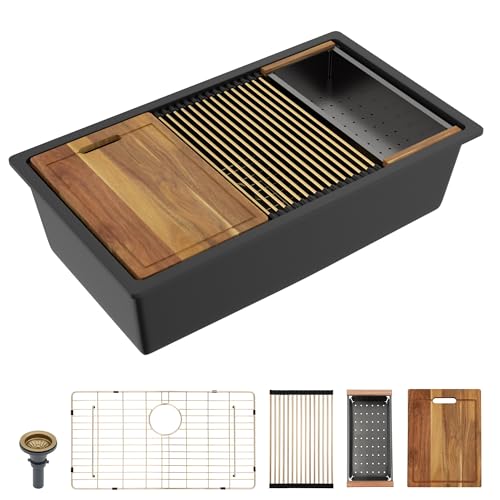
Included accessories can reduce the number of separate components to source. Bottom grids and basket strainers are listed with the Kraus Dex, Karran PU53R-PK1, and Kraus Quarza. The Lordear, LQS, and Karran QUWS-880 go further with workstation accessories such as cutting boards, colanders, drying racks, or mats. These parts may be useful, but they also need a storage location when the sink is being used for washing.
Sound-control documentation also varies. The Kraus Dex lists NoiseDefend pads, the Ruvati RVM4350 lists thick rubber padding, and several workstation models describe acoustic pads or soundproof mats. Composite products such as the Karran QU-810 and QUWS-880 emphasize sound absorption. Treat these as construction and feature comparisons rather than proven noise measurements.
Verify warranty and care details
Warranty terms differ across the selected listings, from the Kraus and Ruvati limited or lifetime coverage to Karran’s 25-year and lifetime statements and the shorter terms documented for some workstation models. Read the applicable warranty conditions before purchase, especially if the sink is part of a professional installation.
For care, rounded or R10 corners and non-porous surfaces are repeatedly presented as easier to maintain. That does not eliminate routine cleaning or protect every finish from damage. Use the manufacturer’s care instructions, confirm the exact color and model, and verify that strainers, grids, mounting hardware, and templates are included in the specific listing you intend to buy.
Final Recommendation
SANYCASA 33-inch 50/50 Sink ranks first overall in this specification-based comparison under the published weighted criteria.
Kraus Standart Pro KHU104-33 is the highest-scoring returned product and the first overall specification-based choice. Its 16-gauge stainless steel, 60/40 bowl layout, 10-inch bowls, rear-set drains, channel grooves, and included grids and strainers form the most complete documented package in this comparison.
For the top undermount double-bowl kitchen sinks with more specialized layouts, choose the Ruvati RVM4350 or Lordear X64-ULS32A when a lowered divider is important. The SANYCASA is the construction-focused alternative because its listing specifies 3-millimeter 11-gauge steel. The Kraus Dex is a strong conventional stainless option with soundproofing and protective accessories.
If the goal is a workstation, the LQS and Lordear provide documented ledges and prep accessories, while the Karran QUWS-880 brings that format to quartz composite. For a bright composite finish, the Karran QU-810 and Kraus Quarza offer white options with low-divide or 50/50 layouts. In every case, confirm cabinet clearance, countertop cutout dimensions, drain compatibility, and the exact kit contents before ordering. The best undermount double-bowl kitchen sinks are the ones whose documented specifications fit both the room and the way it will be used.
Frequently Asked Questions
Among the best undermount double-bowl kitchen sinks, what makes an undermount double-bowl sink different from a single-basin sink?
An undermount double-bowl sink installs below the countertop and divides the basin into two separate sections. That separation supports simultaneous tasks such as soaking, washing, rinsing, or food preparation. A 50/50 split gives both bowls similar space, while a 60/40 split creates one larger and one smaller work area. A low divider can provide more clearance for large cookware without removing the two-basin format.
What cabinet size do these sinks need?
The answer depends on the model. The Lordear X64-ULS32A lists a 35-inch minimum cabinet base, while the Kraus Standart Pro KHU104-33, Kraus Dex KA1UD33B, Ruvati RVM4350, and several 33-inch models list or indicate a 36-inch minimum. Do not rely on the nominal sink width alone. Check the product’s external dimensions, required mounting space, plumbing position, and the countertop cutout before installation.
Are low-divide sinks better for large pots?
A low divider may provide additional clearance when a large pot or pan spans both bowls. The Ruvati RVM4350 documents a divider 3 inches below the rim, and the Lordear and selected Karran composite sinks also document lowered dividers. This is a layout advantage rather than a universal performance claim. Users who need strict separation between washing and rinsing may prefer a conventional full-height divider.
Which selected sinks include accessories?
Accessory packages vary. The Kraus Dex, Karran PU53R-PK1, and Kraus Quarza list grids and strainers. The Lordear and LQS include workstation-oriented items such as cutting boards, colanders, and drying components. The Karran QUWS-880 lists color-matched accessories, including a cutting board, drying mat, colander, and strainers. Verify the exact contents for the model and listing selected, since accessories are not interchangeable by appearance.
Should I choose stainless steel or quartz composite?
Choose based on documented material preferences, appearance, dimensions, and care requirements. Stainless options in this guide specify gauges, T-304 or 304 steel, brushed or satin finishes, and various sound-control treatments. Quartz composite options offer nonmetallic colors, matte surfaces, and sound-absorbing construction. The Kraus Quarza listing specifically cautions that extremely hot items may cause discoloration, so review each manufacturer’s care guidance before deciding.