Buying Guide
The best handheld label makers differ mainly in how labels are created, what tape formats they accept, and how much control they provide away from a desk. Start with the task rather than the brand name. A keyboard model is useful when you want to type short labels directly on the device. A Bluetooth model is better when you prefer templates, icons, images, or phone-based editing. Some products combine both approaches.
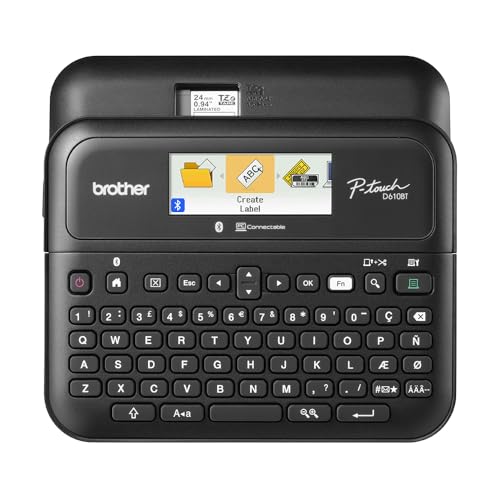
Keyboard-operated models such as the Brother P-touch PTD220, Brother P-touch PT-N10, Brother P-touch Pro PTH111, and DYMO LabelManager 280 let you create labels without opening a phone application. The PTD220 emphasizes onboard choices with 14 fonts, 11 styles, 99 frames, more than 600 symbols, and 25 templates. The PT-N10 has a full QWERTY keyboard, a built-in cutter, and memory for 10 labels. The PTH111 adds task-specific keys for cable wrap, cable flag, faceplate, and serialization.
The DYMO LabelManager 280 takes a different approach by pairing a QWERTY keyboard with PC and Mac connectivity. That can be useful when a label needs computer-based fonts, graphics, or barcodes. The Brother PT-N10 is more narrowly tied to Btag tapes, while the Brother and DYMO models above document their respective TZe or D1 tape systems.
Bluetooth models shift design work to an app. The SUPVAN E11 is notable because it also has a keyboard, giving users a choice between direct entry and app editing. The SUPVAN E10, SUPVAN T50M Pro, and Phomemo D30 are app-centered choices. Their supplied features emphasize fonts, frames, icons, images, templates, or specialized label shapes. This is attractive for decorative labels and small-business layouts, but it adds dependence on a compatible mobile workflow.
Tape width affects how much information fits on a label. The SUPVAN T50M Pro documents the broadest size range here, supporting labels from 3/4 to 2 inches wide. It also lists square, round, address, cable, jewelry, and file labels, making it particularly relevant to product information, QR codes, barcodes, and logos. By contrast, the Brother P-touch Pro PTH111 supports four TZe widths from 3.5 to 12 mm, while the DYMO LabelManager 280 supports D1 widths of 6, 9, and 12 mm.
Several compact products document format flexibility without specifying a complete width range. The SUPVAN E11 and SUPVAN E10 support both continuous and die-cut labels. The Phomemo D30 supports continuous and fixed-length tape. These formats can help when you need a custom-length strip for a shelf or a repeated fixed label for bins, folders, or classroom supplies.
Do not assume that tapes are interchangeable between brands or product families. The Brother PT-N10 specifically uses Btag tapes, the Brother models use TZe tapes, and DYMO models use LetraTag or D1 media as specified in their listings. Check the compatible system before buying additional supplies.
Consider design controls
For plain text, a small font and a few formatting keys may be enough. For more visual organization, compare the documented font, frame, symbol, and template libraries. The PTD220 and Phomemo D30 provide especially extensive design inventories, but they deliver that flexibility in different ways: the former through the device and the latter through an app. The Vixic D210S also lists 16 fonts, more than 100 frames, 800-plus symbols, barcode printing, and up to four lines.
The VolenGo H1100 adds 16 fonts, 100 frames, and 800 symbols, along with three cable modes. Its backlit LCD is a practical consideration for dim work areas. The Brother PTH111 has fewer general design elements than some rivals, but its cable and faceplate shortcuts are more directly relevant to electrical identification. Select controls based on the labels you actually make, not only on the largest number of icons.
Review power and portability
Battery design affects where labeling is convenient. Rechargeable choices include the DYMO LabelManager 280, SUPVAN E11, SUPVAN E10, and Phomemo D30. The Vixic D210S and VolenGo H1100 document USB-C power options, while the Brother PTD220, PT-N10, and PTH111 use six AAA batteries or, on some models, an optional AC adapter. The DYMO LetraTag system is not included in this top 10, but power requirements should still be checked for any alternative before purchase.
A compact body is useful for drawers, travel, classrooms, and mobile work. The SUPVAN E11 lists a 0.5-pound weight, and the Phomemo D30 lists approximately the current price. The Brother PTH111 includes a detachable wrist strap. Larger or more feature-focused machines may be more comfortable at a desk or workshop bench, even if they are less pocket-friendly.
Check label durability claims carefully
Some listings describe laminated, water-resistant, oil-resistant, abrasion-resistant, fade-resistant, or heat-resistant media. The Brother PTH111, Brother PTD220, SUPVAN E10, VolenGo H1100, and Vixic D210S provide examples of documented media properties. These statements describe the listed tape or label system, not an independent durability test. Match the media to the environment and confirm the exact compatible tape before purchase.
Final recommendation
SUPVAN T50M Pro ranks first overall in this specification-based comparison under the published weighted criteria.
The final choice among the best handheld label makers depends on the documented features that match your intended use.
DYMO LabelManager 280 is the highest-scoring returned product and the first overall specification-based choice. Its rechargeable power, QWERTY keyboard, one-touch formatting, three documented D1 widths, and PC or Mac connectivity give it a balanced profile for home and office work.
Choose the Brother P-touch PTD220 if onboard templates, symbols, and label memory matter most. Choose the Brother P-touch Pro PTH111 for electrical and cable-focused tasks, or the SUPVAN T50M Pro for wider labels and varied shapes. The SUPVAN E11 is a useful hybrid, while the Phomemo D30 is better suited to app-led creative work. Among the top handheld label makers, the right choice depends on whether direct typing, media flexibility, specialized shortcuts, or app design is most important.
Frequently Asked Questions
Which of the best handheld label makers is best for a home office?
The DYMO LabelManager 280 and Brother P-touch PTD220 are strong specification-based fits. The DYMO model adds rechargeable power and computer connectivity, while the PTD220 provides extensive onboard formatting, templates, and memory. Choose between them based on whether you prefer computer-assisted design or direct device controls.
Which selected model is best for cable labeling?
The Brother P-touch Pro PTH111 is the clearest choice because its listing specifically documents Cable Wrap, Cable Flag, Faceplate, and Serialize keys. The VolenGo H1100 also documents three cable modes and a backlit LCD, making it another relevant option for wire organization.
Should I choose a Bluetooth label maker or a keyboard model?
Choose Bluetooth when you want app templates, images, icons, or phone-based editing. The SUPVAN E10, SUPVAN T50M Pro, and Phomemo D30 follow that approach. Choose a keyboard model when you want to type directly on the machine. The SUPVAN E11 offers both methods, while the Brother PTD220 and DYMO LabelManager 280 focus on direct keyboard operation.
Which model supports the widest documented labels?
The SUPVAN T50M Pro has the widest documented range in this selection, supporting labels from 3/4 to 2 inches. It also lists several label shapes. The Brother P-touch Pro PTH111 and DYMO LabelManager 280 provide multiple narrower tape widths, so they may be better for compact file, cable, or storage labels.
Do these label makers use interchangeable tapes?
No general interchangeability should be assumed. The listings identify different systems, including Brother Btag, Brother TZe, DYMO D1, and other brand-specific media. Confirm the exact tape family, width, and format for the selected machine before purchasing refills.