Buying Guide
The best heavy-duty drafting chairs are not simply taller office chairs. They must place the user at a workable height while supporting the legs, keeping the torso aligned, and remaining stable on a raised base. The products above are compared from supplied public listing information. No hands-on testing, customer sentiment, or independent durability verification was used.
Match the chair to the work surface
Start with the height of the desk, drafting table, counter, or standing workstation. A chair that is too low can leave the user reaching upward, while one that is too high can make the work surface uncomfortable to use. Look for a stated seat-height range rather than relying only on phrases such as “tall” or “counter height.”
The BOSMILLER 7107 reaches a listed 32.7-inch seat height, while the BOLISS LB-2818HD reaches 32.1 inches. Those ranges may suit especially high work surfaces. The X XISHE chair adjusts from 22.05 to 29.33 inches, giving it a more moderate span. The Alolo 907 documents foot-ring adjustment but does not state its exact seat-height range, so shoppers should confirm compatibility before ordering.
Treat capacity as a documented specification
A heavy-duty label is less useful than a stated load capacity. Capacity is not a complete measure of comfort or long-term durability, but it is an important screening specification for larger users and demanding work settings.
The Chair Master PUHD-10000 Series and the BOSMILLER ErgoDraft 01 and Sofetura high-back models list 500-pound capacities. The WITTLONG, X XISHE, HYLONE, and BOLISS options list capacities from the current price, while Alolo lists the current price. Always interpret these figures as manufacturer or listing specifications, not as independent test results.
Check how the legs are supported
An adjustable foot ring is central to a drafting chair because the seat may be too high for the feet to rest comfortably on the floor. A ring that moves vertically can better match the user and work surface. The Alolo 907 provides one of the clearest specifications, with a 20-inch ring and 8 inches of adjustment. The Sofetura high-back model lists 7.1 inches, and the Chair Master model lists adjustment from about 3 to 12 inches above the base.
The X XISHE, BOSMILLER 7107, and HYLONE models also document adjustable foot support. When the listing does not provide a complete range, verify the details before purchase. A foot ring is not interchangeable with a conventional office-chair footrest, so consider whether you prefer a continuous ring for both feet or a larger platform-style support.
Compare lumbar and upper-back adjustment
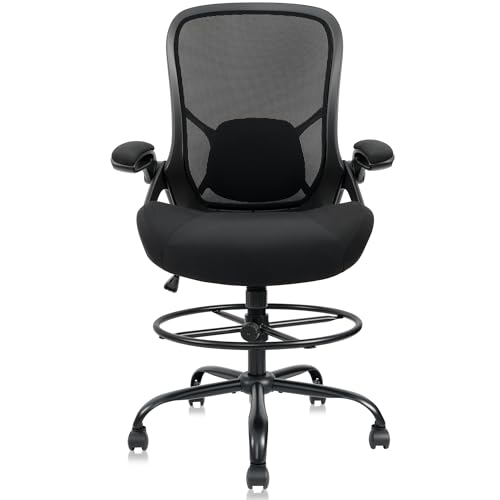
Ergonomic support varies considerably. Some chairs list only lumbar support, while others specify movement in multiple directions. The X XISHE includes a 1.2-inch height-adjustable lumbar pad. BOSMILLER’s 7107 lists 2D lumbar adjustment with both vertical and in/out movement. BOLISS documents a 3D adjustable headrest and adjustable lumbar support, and the Chair Master model lists independent back-height, back-angle, and seat-depth adjustment.
A high back can be useful when you want more upper-back coverage. The Sofetura high-back chair lists a 25.2-inch back height, while the BOSMILLER ErgoDraft 01 includes a headrest and square backrest. These features describe adjustment or construction; they do not prove that every user will experience the same comfort. Seat depth, desk height, and personal posture still matter.
Decide between rolling and stationary bases
Rolling casters make it easier to move between nearby work areas, but a stationary stool may be preferable where the chair should stay planted. The Chair Master PUHD-10000 Series uses non-rolling glides. For a rolling option, the HYLONE HL-0016-KC lists rubber wheels designed for different floor types, while the WITTLONG chair lists PU mute wheels for hard floors.
Base construction is another useful comparison point. X XISHE lists a metal base and widened metal footrest. HYLONE’s HL-0016-1 lists a 28-inch five-star base, and BOSMILLER’s ErgoDraft 01 lists a steel support tray and five-star base. A wider base may require more floor clearance, so check the chair’s footprint against the workstation.
Select upholstery for the environment
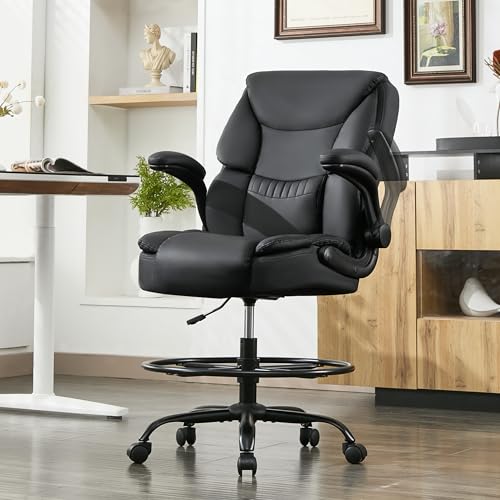
Mesh backs can promote airflow, and several selected chairs use mesh construction. X XISHE, HYLONE, Alolo, WITTLONG, and BOLISS all document mesh or breathable back materials. PU leather and polyurethane surfaces can be easier to wipe clean; the BOSMILLER ErgoDraft 01, Sofetura high-back chair, and Chair Master model emphasize leather or polyurethane upholstery.
For laboratories, workshops, salons, or cleanroom-related work, the Chair Master model is the most specifically documented choice because its listing mentions resistance to stains, punctures, water, and chemicals, plus a cleanroom class designation. Those claims come from the supplied listing and should be checked against the requirements of a particular facility.
Consider armrest clearance
Flip-up arms are useful when a chair must slide under a desk or when the user needs unobstructed side access. X XISHE, both HYLONE models, the Sofetura models, BOSMILLER, Alolo, BOLISS, and WITTLONG document arm adjustment or flip-up functionality. Before choosing, check whether the desk apron or work surface leaves enough clearance for the arms when lowered.
Final recommendation
Chair Master PUHD-10000 Heavy-Duty Stool ranks first overall in this specification-based comparison under the published weighted criteria.
X XISHE 400-Lb Drafting Chair is the first overall specification-based choice among these best heavy-duty drafting chairs because it combines a documented 400-pound capacity with adjustable lumbar support, a useful seat-height range, foot-ring adjustment, and a metal-based construction. The BOSMILLER 7107 is a strong alternative for users who need a wider seat and 500-pound listed capacity, while the Chair Master PUHD-10000 Series is better suited to cleanable, stationary work environments. Among the top heavy-duty drafting chairs, choose by work-surface height first, then capacity, foot support, and the type of base you need.
Frequently Asked Questions
What should I look for in the best heavy-duty drafting chairs?
Look for a documented load capacity, a seat-height range that matches your work surface, adjustable foot support, and a stable base. Lumbar adjustment, a thick cushion, breathable materials, and flip-up arms can improve practical fit, but they should be evaluated against the specific dimensions and tasks of your workspace.
Are 500-pound drafting chairs always the best choice?
No. A higher listed capacity is useful for screening, but it does not automatically make a chair the right choice. Seat width, seat height, foot-ring range, lumbar adjustment, base footprint, upholstery, and rolling behavior may matter more for a particular user or environment. The BOSMILLER 7107 and Chair Master models list 500-pound capacities, but their designs serve different workspace needs.
Is mesh or PU upholstery better for a drafting chair?
Neither is universally better. Mesh backs are documented on several selected chairs and may be appealing when airflow is a priority. PU leather or polyurethane surfaces are emphasized by other models for their smooth, easy-clean characteristics. Consider the room temperature, cleaning routine, and whether the chair will be used in an office, studio, lab, workshop, or commercial setting.
A foot ring is useful when the seat is elevated beyond normal office-chair height because it provides a place to support the feet. Adjustable rings are more versatile than fixed rings. The Alolo 907, Sofetura high-back model, and Chair Master PUHD-10000 Series provide especially clear foot-support specifications. Confirm the ring position and seat height together rather than judging either feature alone.
Are rolling casters appropriate for every workstation?
No. Rolling casters are useful for repositioning, but stationary glides can be preferable when stability and fixed placement are priorities. The Chair Master PUHD-10000 Series uses non-rolling glides, while models from X XISHE, HYLONE, WITTLONG, and BOSMILLER use rolling bases or casters. Match the base to the floor, available clearance, and how often you need to move between tasks.