Buying Guide
The best heavy-duty keyboard stands are not defined by a single frame shape. A useful choice depends on the keyboard’s size, the amount of extra equipment involved, the preferred playing height, and how often the stand moves. The products above are ranked from their supplied specifications, not from hands-on testing or customer sentiment.
Start with the keyboard and load requirement
First confirm the keyboard’s width and approximate weight. Several selected models explicitly fit 54- to 88-key instruments, including the Liquid Stands MS1078 and CAHAYA CY00366-1-US. The Liquid Stands MS1093 is described as fitting a width from 28.5 to 43.5 inches, which may be useful for broader table-style setups. If the load is substantial, prioritize a model with a documented capacity rather than relying only on the phrase heavy duty.
The On-Stage KS8291XX lists support for up to the current price. The Liquid Stands MS1111 and MS1078 list the current price, while the Liquid Stands MS1093 lists the current price and Yascal lists the current price. The Pyle PKST2TZ requires closer reading because it states a 400-pound overall capacity and a separate 110-pound platform capacity. Those figures should not be treated as interchangeable. A two-keyboard arrangement also needs attention to how weight is distributed across tiers.
Choose between Z-style, X-style, and table frames
Z-style stands such as the MS1078, CAHAYA CY00366-1-US, On-Stage KS7350, and Pyle PKST2TZ generally emphasize width adjustment and a broad side profile. The CAHAYA listing specifically describes under-frame legroom and pedal access. The On-Stage KS7350 can face either direction, which may help when the player must work around a wall, desk, or other stage equipment.
Double-X stands usually fold in a familiar way and can be convenient for musicians who move between practice, rehearsal, and performance. The On-Stage KS8291XX adds adjustable arm sleeves, while the Yascal design adds a triangle support bar and pedal stopper. The Amazon Basics model stays closer to a straightforward double-X format, with a stated height range but fewer published load details.
Table-style designs can be useful when the keyboard is part of a broader production station. The MS1111 includes locking wheels, straps, a headphone hook, and mounting points for compatible accessories. The MS1093 uses a collapsible table form and a wide adjustment range. These designs may be less appealing if storage space or frequent carrying is the main concern.
Match the adjustment range to your playing position
A stand should place the keyboard at a comfortable height for the way you play. The MS1078 adjusts from 22.5 to 33.5 inches, the CAHAYA model from 21.2 to 32.5 inches, and the On-Stage KS7350 from 23.5 to 36.5 inches. The Amazon Basics stand reaches 38.2 inches. These ranges are listing specifications, not a guarantee that every player will find every setting comfortable.
For seated and standing use, look for both a usable height range and a frame that remains secure after adjustment. Knobs, trigger mechanisms, locking pins, and gear controls appear across the selected designs.
Check security features beyond the frame
Contact points and restraints can matter as much as the frame. The MS1078 and CAHAYA CY00366-1-US include straps, while the Yascal model lists adjustable rubber baffles and a pedal stopper. The Pyle PKST2TZ and On-Stage KS7350 use nonslip contact areas, and the MS1093 lists foam pads and ball-joint rubber feet. These features may help limit sliding or protect the instrument, but the supplied listings do not establish performance under every playing condition.
A strap is especially relevant when the stand will be moved or used in a busy stage setup. A pedal anchor may be more useful for players whose sustain pedal shifts during performance. For home practice, protective padding and nonslip feet may be sufficient, provided the keyboard and stand are compatible.
Consider transport, storage, and setup
Portability involves more than listed weight. The MS1078, MS1093, On-Stage KS8291XX, and Yascal stand describe folding or flat-packing. The On-Stage KS7350 disassembles into sections without tools, while Fiada describes a quick-fold mechanism. These options suit musicians who regularly load equipment into a vehicle.
A table-style workstation can be more useful after setup but less convenient to carry. The MS1111 weighs about the current price according to the listing, and the MS1093 weighs about the current price. By contrast, several X-style stands have lower listed weights. Buyers should compare the folded dimensions, available storage area, and whether wheels are helpful or unnecessary for their room.
Decide whether you need a second tier
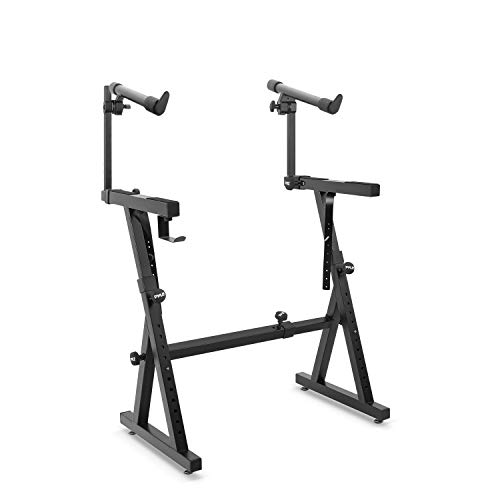
A second tier is worthwhile when a second keyboard, compact controller, laptop, or mixer belongs in the same playing area. The Pyle PKST2TZ has a removable second tier with independent height, depth, and tilt adjustments. Fiada provides an upper tier that raises about 12.8 inches and can hold a second keyboard, laptop, or compact controller. These designs can reduce the number of separate supports in a studio or live rig.
The trade-off is added structure and more careful load planning. If you use only one keyboard and want the simplest transport, a single-level Z or double-X model may be easier. If you are building a production station, the MS1111’s attachment points may be more suitable than a conventional second tier.
Verify the listing before ordering
Public specifications can change, and some listings omit important measurements. Confirm the keyboard’s width, the stand’s adjustment method, the stated capacity, and whether straps, wheels, tiers, or hardware are included. Also check the product’s current dimensions and warranty information before purchase. This comparison intentionally leaves out volatile price and marketplace-performance information.
Final Recommendation
Liquid Stands MS1078 Z-Style Stand ranks first overall in this specification-based comparison under the published weighted criteria.
The final choice among the best heavy-duty keyboard stands depends on the documented features that match your intended use.
Liquid Stands MS1111 is the highest-scoring returned product and the first overall specification-based choice. Its 250-pound stated limit, locking wheels, straps, headphone hook, and accessory mounting points make it the most complete option for a studio or expandable production setup. It is not the lightest choice, so frequent travelers may prefer the fold-flat Liquid Stands MS1078 or the On-Stage KS8291XX.
Among the top heavy-duty keyboard stands, the On-Stage KS8291XX is the clearest capacity-focused alternative, with a 320-pound stated rating and rugged double-X construction. The Pyle PKST2TZ is better suited to two-keyboard arrangements, while CAHAYA CY00366-1-US offers a balanced reinforced Z design with a broad fit range and security straps. For a simple home setup, the Amazon Basics double-X model covers the basic seated-or-standing requirement, but its listing provides less load information.
The right choice therefore depends on the setup rather than a universal winner. Select the MS1111 for expandable studio use, the On-Stage KS8291XX for documented high capacity, a Pyle or Fiada model for two tiers, or a single-level Z stand when width adjustment and legroom matter most.
Frequently Asked Questions
What should I look for in the best heavy-duty keyboard stands?
Start with a documented load capacity, a height and width range that fits the keyboard, and a frame suited to your playing position. Security details such as straps, nonslip pads, rubber feet, or pedal restraints are useful supporting features. For mobile use, also check folding, disassembly, listed weight, and storage dimensions.
Are Z-style keyboard stands more stable than double-X stands?
The supplied listings describe different stability approaches rather than proving that one shape is always better. Z-style models such as the CAHAYA CY00366-1-US and Liquid Stands MS1078 emphasize a broad frame and adjustable width. Double-X models such as the On-Stage KS8291XX and Yascal stand emphasize braced frames, locking mechanisms, or additional support bars. Compare the complete design and documented features for your keyboard.
Can these stands support an 88-key keyboard?
Several selected products explicitly list compatibility with 88-key instruments, including the Liquid Stands MS1078, CAHAYA CY00366-1-US, Yascal stand, Fiada stand, and Amazon Basics model. Compatibility does not by itself establish the safe load, so compare the keyboard’s weight with the stand’s documented capacity where one is provided.
Is a two-tier stand useful for a home studio?
It can be useful if you regularly use a second keyboard, MIDI controller, laptop, or mixer. The Pyle PKST2TZ has a removable and adjustable second tier, while Fiada provides an elevated upper level. A single-level stand may be simpler if you only need one keyboard or have limited floor space.
Do locking wheels make a keyboard stand easier to use?
Locking wheels can help reposition a rolling stand before securing it in place. Wheels add mobility, while the lock is intended to keep the stand placed after movement; always verify that the wheels and frame suit the keyboard load.