Buying Guide
The best heavy-duty fishing nets are not all designed for the same landing method. A telescoping landing net is intended to scoop a hooked fish beside a boat, pier, or shoreline. A drop net is lowered from above, a cast net is thrown to capture bait, and a pond net is shaped for controlled handling and skimming. Start by identifying that job before comparing materials or dimensions.
Choose the net style first
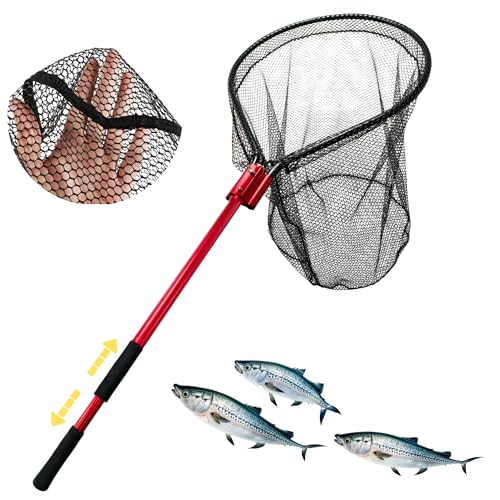
Landing nets are the most versatile option for anglers who need to secure a fish after bringing it close. The Gtouse, SIWRDTG, AQWXC, SYFRLLC, PLUSINNO, Facikono, and KastKing Brutus all document landing-net designs with handles and framed openings. These products differ mainly in reach, opening size, depth, mesh, and storage.
A drop net is better suited to an elevated fishing position. The Drasry Foldable Pier and Bridge Drop Net includes a long rope, a foldable aluminum ring, connecting poles, and a deep square pocket. That configuration is specifically relevant to bridges, piers, docks, and other locations where a conventional short-handled scoop net cannot reach the water.
A cast net is a different tool altogether. The Calamus Baitfish Cast Net uses a radius measurement, sinkers, a hand line, and monofilament mesh. It is intended for spreading over water to collect bait, not for scooping a fish already at the side of a boat. The technique, storage needs, and mesh considerations are therefore different.
For ponds, the Aquascape 98560 is more appropriate than a long saltwater landing net. Its listing identifies koi and larger pond fish, soft fine mesh, an adjustable handle, and floating-debris removal. That makes it a practical fit for pond maintenance as well as fish handling.
Compare frame and handle construction
Aluminum appears repeatedly in the selected landing and drop nets because it provides a documented combination of rigidity and manageable weight. The Gtouse, SIWRDTG, AQWXC, SYFRLLC, Facikono, and Drasry models specify aluminum construction. KastKing Brutus uses 6063 aluminum alloy components, while the PLUSINNO listing describes a carbon-fiber-style and epoxy-fiberglass-style handle.
Handle design determines where the net can be used. The Gtouse reaches 110 inches, the SIWRDTG and SYFRLLC reach 100 and 102 inches respectively, and the AQWXC reaches 85 inches. Long reach can help from a boat or elevated bank, but it can also make a net less convenient in tight spaces. A shorter or mid-length option may be easier to control in a small stream or around a pond.
Look for a secure locking method when the handle telescopes. The supplied listings describe twist locks, internal rotation locking, buttons, or retractable sections. These details matter because a long handle is useful only when it can be adjusted and held in position. The KastKing Brutus adds a folding hoop and a boat hook, while the PLUSINNO uses a foldable frame for transport.
Match opening and depth to the fish
A larger opening gives the angler more room to guide a fish into the net, but it also increases the net’s overall size. The AQWXC documents a 27-inch opening, the Facikono documents a 28-by-24-inch hoop, and the SYFRLLC lists a 25-inch opening. These are suited to anglers who prioritize coverage near a boat or shoreline.
Depth helps retain a fish after it enters the pocket. The SYFRLLC lists a 37-inch depth, while the AQWXC and Facikono list depths of 27 inches and 27.5 inches. The PLUSINNO has a 19.7-inch-deep net, and the Gtouse lists a 17-inch depth. A deep pocket can be useful during a controlled landing, but it may occupy more room when wet or folded.
Do not treat a stated load figure as a universal guarantee. The Gtouse, SIWRDTG, and AQWXC listings provide capacities of 66, 55, and the current price, respectively. The PLUSINNO listing gives different capacity information for its handle configurations. These figures should be compared with the exact version and intended fish size rather than used as a substitute for careful handling.
Consider mesh material and fish handling
Rubber, silicone, PVC-coated nylon, and monofilament each serve different purposes. Rubber and silicone mesh are repeatedly described as reducing hook snags, drying quickly, or being gentler for catch and release. The SIWRDTG, SYFRLLC, AQWXC, Facikono, PLUSINNO, and KastKing Brutus use coated or rubber-like mesh designs.
Mesh spacing also changes the net’s suitability. The SYFRLLC lists 0.2-inch spacing, the SYFRLLC and AQWXC descriptions emphasize retaining smaller fish, and the Drasry drop net uses 1.38-inch mesh for a different large-fish application. The Calamus cast net uses 3/8-inch mesh for baitfish. Choose spacing based on the fish you intend to retain, not simply on the word heavy-duty.
Plan for storage and transport
A net with a long handle and deep pocket can be effective but awkward to carry. Folding hoops, retractable handles, carrying bags, storage bags, and detachable sections address that issue. The PLUSINNO, KastKing Brutus, Facikono, and Drasry models document features that help with transport. The Gtouse also separates into two parts, while the Calamus includes storage-oriented accessories.
Check the stored dimensions when space is limited. A kayak, compact vehicle, or small tackle area may favor a foldable model over a fixed or very long net. Conversely, anglers fishing from a large boat or open pier may prefer maximum reach even if the stored package is larger.
Check freshwater and saltwater suitability
Several selected products document use in both freshwater and saltwater, including the Gtouse, SIWRDTG, AQWXC, SYFRLLC, PLUSINNO, and Drasry drop net. The Calamus cast net also describes freshwater and saltwater use and lists corrosion-resistant components. Rinse any saltwater-used net according to the maker’s care guidance and inspect connectors, sinkers, rope, and mesh before storage.
Final Recommendation
Gtouse 57–110 in Long-Handle Landing Net ranks first overall in this specification-based comparison under the published weighted criteria.
The final choice among the best heavy-duty fishing nets depends on the documented features that match your intended use.
Gtouse 57–110 in Long-Handle Landing Net is the first overall specification-based choice among these selected products. Its stated 66-pound capacity, 110-inch maximum reach, rubber mesh, and two-part storage design give it the broadest documented combination for boat, kayak, and shoreline use. It is not automatically the right choice for every angler: the Drasry drop net is more appropriate for a bridge or pier, the Calamus is the specialized bait option, and the Aquascape is better aligned with pond work.
Among the top heavy-duty fishing nets, the SIWRDTG is a strong alternative for anglers prioritizing a stated 55-pound capacity and 100-inch reach. Choose the SYFRLLC when a very deep pocket matters, AQWXC or Facikono when a large opening is the priority, and PLUSINNO or KastKing Brutus when folding transport is more important. Always compare the selected model’s opening, depth, handle range, mesh spacing, and stated capacity with the conditions where you fish.
Frequently Asked Questions
What should I look for in the best heavy-duty fishing nets?
Start with the fishing method, then compare frame material, handle reach, opening size, net depth, mesh spacing, and storage design. A large telescoping landing net suits boat or shoreline landings, while a drop net, cast net, or pond net serves a more specific purpose.
Is a rubber mesh landing net better than nylon mesh?
The supplied listings describe rubber, silicone, and coated mesh as reducing hook snags, drying quickly, or supporting fish-friendly handling. Nylon and monofilament remain useful for other designs, including the Drasry drop net and Calamus cast net. The better choice depends on landing method, fish size, and the mesh spacing required.
Do longer handles make a fishing net better?
Longer handles can improve reach from boats, piers, or elevated banks, but they may be less convenient in narrow streams or compact storage areas. The Gtouse, SIWRDTG, and SYFRLLC document especially long adjustable handles, while the Aquascape is more compact and pond-oriented.
Which net is suitable for catching bait?
The Calamus Baitfish Cast Net is the selected product specifically documented for baitfish casting. Its 6-foot radius, 3/8-inch mesh, sinkers, braided hand line, and sectioned horn distinguish it from landing nets designed to scoop a fish beside the angler.
What is the best option for pier fishing?
The Drasry Foldable Pier and Bridge Drop Net is the clearest fit because it includes a 49.2-foot rope, adjustable connecting poles, a foldable aluminum ring, and a deep square net. For a pier where the angler can bring the fish alongside the structure, a long-handled landing net such as the Gtouse may be more practical.