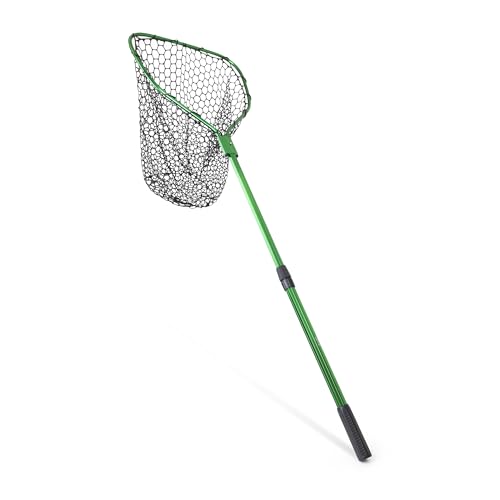
Buying Guide
Choosing among the best telescoping fishing nets starts with the landing position, not the brand name. A net used from a kayak has different priorities from one used on a riverbank or from the bow of a boat. Compare the fully extended length, hoop opening, net depth, mesh material, folded dimensions, and handle construction together. A long pole can help reach a fish beside a high bank, but a smaller floating net may be easier to control from a seated kayak.
Match reach to the fishing position
Reach is the clearest distinction between these nets. Fiblink documents a 59-to-118-inch extension, making it the selection for situations where the fish cannot be brought close to the angler. The PLUSINNO Large model reaches 6.4 feet overall and is also aimed at boat, kayak, shore, and pier use. These longer options can reduce the need to lean outward, but their larger frames may require more room in a vehicle or rod locker.
Mid-range nets are more adaptable for ordinary shore and boat use. UMT extends from 3.6 to 5 feet, while SEASPRO and the NestSprout large model cover 45-to-59 and 45-to-60 inches, respectively. The NestSprout rubber model reaches 52.7 inches and is easier to position where a large hoop is unnecessary. SARDVISA reaches only 35 inches, but that shorter range supports its compact wading and kayak profile.
Always check whether the listing describes handle length or total length. Those measurements are not interchangeable. The PLUSINNO Floating model, for example, identifies a 39-inch extended telescopic pole, while other products state a full net length. Treat the stated measurement as a planning aid rather than assuming every model measures reach the same way.
Consider hoop size and net depth
Hoop size determines how much room there is to guide a fish into the net. The SEASPRO has a documented 23-by-18-inch hoop and approximately 20-inch depth. Frabill lists a 23-by-26-inch teardrop hoop with 22-inch depth. PLUSINNO Large lists a 19.7-by-15.7-inch frame and 19.7-inch depth.
A large hoop is not automatically better. It may be cumbersome in a narrow stream, and a deep net can take more room to store. For small fish, bait, or compact freshwater setups, a smaller frame may be easier to maneuver.
Choose mesh for your handling priorities
Mesh material affects hook management, cleaning, and fish handling. The listings describe these materials as non-absorbent, easier to rinse, or less prone to snagging. Rubberized mesh can be a practical choice when the net will move between saltwater and freshwater.
Frabill takes a different conservation-oriented approach with 100% knotless micromesh, a flat bottom, and a tangle-free coating. Fiblink uses coated fine nylon mesh and describes a non-hydrophilic coating that helps the net move into water faster. The PLUSINNO Large model uses PVC-wrapped nylon mesh, described as wear-resistant, corrosion-resistant, and non-absorbent.
Avoid assuming that a material alone guarantees a particular result. The useful evidence is the combination of mesh type and the features the listing explicitly associates with it. If you regularly remove treble hooks, prioritize a documented tangle-resistant or non-snag design and leave enough room to work around the catch.
Review handle construction and grip details
Aluminum is common in this category because it provides a relatively light telescoping structure. The PLUSINNO Large listing describes an epoxy fiberglass-style and carbon fiber cloth handle, with a stated telescoping support above the current price. UMT identifies a heavy-duty aluminum handle and a 25-pound maximum landing weight.
Connection details matter because the hoop and pole form one working assembly. SEASPRO and the larger NestSprout list aluminum alloy connectors, while the KastKing Pontus uses a reinforced aluminum rib. Look for a stated locking mechanism or rotary lock when adjustment security is important.
Prioritize storage and recovery features
Foldable hoops and retractable poles can make a net easier to carry.
Floating designs are useful for anglers working over water. PLUSINNO Floating, Beyond Braid, KastKing Pontus, and SARDVISA all document flotation, foam padding, or a floating frame. SARDVISA adds a storage bag, lanyard, and belt clip; KastKing Pontus also lists a storage bag and attachment options. These accessories do not replace a suitable hoop or handle, but they can make the net easier to keep accessible.
How this comparison was scored
This is a specification-based comparison using public listing data rather than hands-on testing or customer-opinion summaries. Editorial scores weigh reach and adjustment range at 25%, hoop and net capacity at 25%, mesh and fish-handling design at 20%, portability and storage at 15%, and handle construction and control at 15%. Products were selected only when the supplied title, features, and specifications established them as complete telescoping fishing nets. Exact marketplace prices, ratings, current listing information, and popularity signals were not used in the published criteria.
Final Recommendation
PLUSINNO Large 6.4-Foot Carbon Fiber Net ranks first overall in this specification-based comparison under the published weighted criteria.
PLUSINNO Large 6.4-Foot Carbon Fiber Net is the first overall specification-based choice among these best telescoping fishing nets. Its 6.4-foot reach, deep 19.7-inch net, corrosion-resistant mesh, and stated telescoping support above the current price give it the broadest documented large-catch profile. Fiblink is the better fit when maximum reach is the primary concern, while Frabill is the more conservation-focused choice because of its knotless micromesh and flat bottom. For floating portability, Beyond Braid, KastKing Pontus, and SARDVISA offer the clearest documented designs. The top telescoping fishing nets are not interchangeable, so select by fishing position, fish size, mesh preference, and storage space.
Frequently Asked Questions
What should I look for in the best telescoping fishing nets?
Start with total reach, handle adjustment, hoop opening, net depth, and folded size. Then compare mesh material and grip details. A long net such as Fiblink suits distant landings, while a compact model such as SARDVISA favors wading or kayak storage.
Are rubber mesh nets better for catch and release?
The supplied listings describe rubber or silicone mesh as non-snagging, non-absorbent, easier to rinse, or gentler on fish, depending on the product. Frabill instead documents knotless micromesh and a flat bottom. These are documented design features, not a guarantee of handling results.
Which selected nets float?
PLUSINNO Floating, Beyond Braid, KastKing Pontus, and SARDVISA document floating designs or foam buoyancy. Floating construction may help with recovery if a net falls into the water, but it does not determine reach or hoop capacity.
Is a deeper net always preferable?
Not always. A deep net can provide more containment during a landing, but it may be bulkier to store and maneuver. Frabill, UMT, PLUSINNO Large, SEASPRO, and the larger NestSprout model list deeper nets, while smaller options may be more practical for bait, small fish, streams, or compact gear setups.
How should I verify fit before ordering?
Check whether the stated measurement refers to the handle, hoop, or full net length. Also compare net depth, folded dimensions, weight, and the type of locking or folding mechanism. The supplied listings use different measurement conventions, so matching the published dimensions to your storage space and fishing position is essential.