Buying Guide
Choosing among the best heavy-duty soccer goals starts with deciding what “heavy-duty” needs to mean for your field. A backyard goal for youth drills has different requirements from a full-size training frame used by older players. The listings in this comparison document several construction approaches, including galvanized steel, powder-coated steel, reinforced aluminum, braided nets, and portable folding or breakdown systems.
Match the goal size to the players
Size is the first practical filter. The QuickPlay Match80 and Suteck are 6x4-foot goals, making them appropriate for younger players, compact spaces, and target-oriented practice. The Match80 is specifically listed for U6-U8 play, while Suteck emphasizes youth and training use.
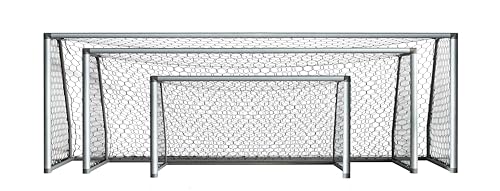
A 12x6-foot goal is a versatile middle ground. QuickPlay GS, Franklin Sports Premier, Larkon, and the FORZA Steel42 all document this format. It can support shooting, goalkeeper drills, small-sided games, and general backyard practice without requiring the space of a full-size field goal.
The 16x7-foot MOPHOTO and Mersco models provide a larger target for teen, adult, and team activities. The Pass and Vallerta options extend to 24x8 feet, which is more appropriate for regulation-scale practice or large fields. Measure the available area before choosing a larger frame, including room behind and beside the goal for safe play and retrieval.
Compare steel and aluminum construction
Steel is common in backyard and training goals because the listings associate it with galvanized, powder-coated, or corrosion-resistant construction. The QuickPlay GS uses a steel frame with locking posts, while the FORZA Steel42 specifies a 42mm round galvanized frame and 2mm wall thickness. Franklin Sports Premier, MOPHOTO, Pass, Larkon, Mersco, and Suteck also document steel or metal frames with weather-focused finishes.
Aluminum can be attractive when a buyer wants a large section size or a rust-proof frame. The Vallerta Pro Match lists an 86mm aluminum frame, and the QuickPlay Match80 specifies reinforced 80mm aluminum components with steel connectors. Those details are useful because they identify the construction more precisely than a generic “heavy-duty” label.
Do not treat a brand’s durability wording as a substitute for missing specifications. Frame diameter, wall thickness, connector type, finish, and warranty coverage offer more practical comparison points. A larger tube may support a more substantial design, but the supplied listings do not establish hands-on impact performance, so this guide does not claim that one frame will withstand a particular shot speed or force.
Examine the net and attachment system
Net material and attachment method affect setup and maintenance. QuickPlay Match80 lists a 5mm braided UV-resistant HDPE net and anti-sag support. FORZA lists a 3mm braided net, while Pass documents a square-knotted triple-twisted polyethylene net. Other selected goals use PE, HDPE, nylon, or weather-resistant net descriptions.
Attachment hardware also matters. Mersco lists 24 Velcro straps and eight U-shaped stakes; Larkon lists 36 straps and four stakes; Franklin includes self-stick straps and four steel stakes. These details indicate how the net is intended to be secured, but they do not prove that any product will remain perfectly tensioned in every weather condition. Check the supplied hardware and plan to inspect straps, clasps, and net edges periodically.
Prioritize anchoring and surface compatibility
A freestanding goal still needs appropriate anchoring for outdoor use. Ground stakes are listed with Franklin Sports Premier, MOPHOTO, Larkon, Mersco, Suteck, and FORZA. QuickPlay Match80 describes a large footprint and sturdy base bar, while other models emphasize locking posts or reinforced structures.
The surface should guide your choice. Grass and soil are the clearest fit for goals supplied with ground stakes. For any surface without compatible anchoring, follow the manufacturer’s instructions and do not assume that a freestanding frame is immovable during play.
Balance setup time with portability
Tool-free or quick assembly appears across this category. QuickPlay GS and QuickPlay GS-style locking systems use button or professional connectors; Franklin uses snap-together poles; FORZA uses an in-built locking system; and Suteck uses a telescopic snap-lock frame. These features can reduce setup friction, but large goals still require space and careful positioning.
For transport, Franklin and Larkon explicitly emphasize breakdown or carry-bag use. MOPHOTO is foldable, while FORZA describes a freestanding portable design that may require two people to move. A goal that is easy to assemble is not necessarily light or easy to carry, so distinguish setup convenience from relocation weight.
Final recommendation
QuickPlay Match80 6x4 Aluminum Goal ranks first overall in this specification-based comparison under the published weighted criteria.
QuickPlay Match80 is the first overall specification-based choice among the best heavy-duty soccer goals because it combines reinforced 80mm aluminum construction, a 5mm braided UV-resistant net, anti-sag support, weather-focused materials, and a stable youth-oriented footprint. It is the most specification-aligned fit for U6-U8 play and compact club training.
For a larger aluminum frame, Vallerta Pro Match is the better match, particularly when a 24x8-foot format is appropriate. Pass is another large-format option with a documented 2-inch galvanized steel frame and triple-twisted net. Buyers seeking a versatile 12x6-foot goal should compare QuickPlay GS, FORZA Steel42, and Franklin Sports Premier. QuickPlay GS favors outdoor readiness and locking strength; FORZA provides unusually specific frame and net details; Franklin emphasizes breakdown portability and included stakes.
MOPHOTO and Mersco are practical larger backyard choices for teens, adults, and team activities. Larkon is the most transport-focused of the selected 12x6 options because it includes a carry bag, while Suteck is the compact training-set choice. These top heavy-duty soccer goals should be narrowed by size, surface, anchoring, and storage needs rather than by a durability label alone.
Frequently Asked Questions
What size soccer goal is best for backyard training?
A 12x6-foot goal is a flexible choice for many backyard training situations because it supports shooting and goalkeeper drills without the footprint of a full-size 24x8 goal. For younger players or limited yards, a 6x4-foot model such as QuickPlay Match80 or Suteck may be easier to position. Always compare the selected size with available clearance and the players’ age group.
Are galvanized steel soccer goals suitable for outdoor use?
Galvanized steel is a practical outdoor-oriented material when the listing also documents corrosion resistance or weather-focused finishing. Franklin Sports Premier, FORZA Steel42, Pass, and Larkon describe galvanized or corrosion-resistant steel construction. Outdoor suitability still depends on correct anchoring, storage, inspection, and the manufacturer’s care instructions.
Is an aluminum soccer goal better than a steel goal?
Neither material is automatically better for every use. The Vallerta and QuickPlay Match80 listings provide substantial aluminum frame specifications, while several steel goals document galvanized or powder-coated construction. Compare tube size, wall thickness when supplied, net construction, connectors, anchoring, goal size, and portability for your specific setup.
How should a portable soccer goal be secured?
Use the included stakes, pegs, or other manufacturer-specified anchoring hardware on compatible ground. Franklin, MOPHOTO, Larkon, Mersco, Suteck, and FORZA list anchoring components. A carry bag or foldable frame improves transport but does not remove the need to secure the goal before play.
What makes the best heavy-duty soccer goals different from basic practice nets?
The best heavy-duty soccer goals in this comparison document a more substantial frame material, reinforced or galvanized construction, durable netting, anchoring hardware, or structured connectors. Those specifications can help distinguish a training goal from a lightweight net, but they are not a substitute for hands-on testing or a guarantee of performance under every playing condition.