Buying Guide
The best heavy-duty hand trucks are defined by more than a large number in the title. A useful comparison starts with the relationship between rated capacity, cargo shape, wheel design, frame material, and storage requirements. The products above span conventional two-wheel dollies and convertible carts, so the right choice depends on how and where you will move loads.
Match the capacity to the working configuration
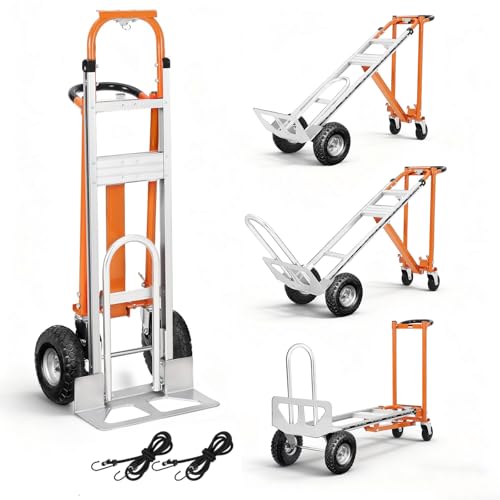
Read the capacity for the mode you will actually use. Convertible models often have different ratings for upright, tilted, and platform positions. Yonopro documents the current price in stair-climbing upright mode, the current price in tilt mode, and the current price in platform mode. Tolpassa similarly separates its 400-pound upright, 800-pound tilted, and 1,000-pound platform ratings. POWGD lists 400, 600, and the current price for its three modes.
A platform rating should not be treated as the upright rating. The COSCO Assist Series lists 800- and 1,000-pound figures without assigning each figure to a specific configuration in the supplied details, so buyers should confirm the intended mode before loading it. The same caution applies to any product whose listing provides a range rather than a mode-by-mode table.
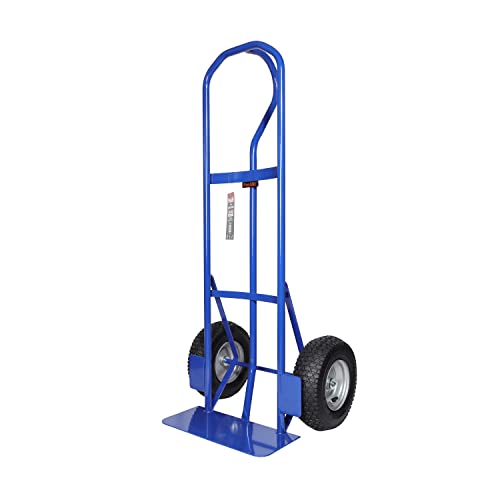
For a traditional upright appliance or box dolly, Pro-LifT documents a 1,000-pound capacity in a single primary layout. Oyoest documents the current price, while KIGEMRE gives a 650- to 800-pound range. These simpler designs can be appropriate when the load is normally tilted back and there is no need to create a flat cart.
Choose the right configuration
Two-wheel hand trucks are generally focused on lifting the nose plate under a load and tilting the cargo toward the operator. Pro-LifT uses this conventional format with a vertical loop handle and two pneumatic tires. Oyoest also uses a two-wheel layout, adding an extended frame and a larger base plate. These designs have fewer moving arrangements to consider and can suit repeated upright hauling.
Convertible models add flexibility for broad or unstable cargo. SuZhi switches between a two-wheel vertical hand truck and a four-wheel platform truck. VEVOR provides upright and platform modes, while COSCO and TLGREEN document three-in-one designs. Tolpassa, POWGD, and Yonopro go further with three or four documented modes, including tilted positions or extended support surfaces.
Yonopro is the only selected model whose supplied evidence specifically documents a six-wheel stair-climbing system. That makes it the clearest match for stairs, curbs, thresholds, and uneven surfaces. Do not assume that every hand truck with large tires is a stair climber; the feature should be explicitly stated.
Consider tire and caster design
Wheel construction affects the surfaces a hand truck is intended to handle. Pneumatic tires appear on SuZhi, POWGD, Pro-LifT, Oyoest, and Yonopro. Their listings describe cushioning, shock absorption, or resilience, which can be useful on uneven routes, but pneumatic tires also introduce an inflation requirement that flat-free or solid wheels do not.
VEVOR’s 800-pound model uses rubber wheels and brake-equipped swivel wheels. KIGEMRE uses puncture-resistant 8-inch tires, while COSCO specifies flat-free wheels. TLGREEN combines fixed rubber wheels with 360-degree swivel casters and describes the wheels as quiet and suitable for floor-sensitive spaces. Tolpassa and Yonopro specify puncture-resistant or all-terrain tire designs alongside swivel casters.
Swivel casters can help when positioning a platform cart, particularly in offices, warehouses, or narrow work areas. Brakes are a separate feature: VEVOR documents brake wheels, while TLGREEN’s supplied details emphasize swivel movement rather than brakes. Check both maneuverability and stopping features when the cart will be used on slopes or around valuable cargo.
Compare frame materials and durability evidence
Steel and aluminum each appear in the selected range. Pro-LifT uses a heavy-gauge steel tubular frame with welded joints, and POWGD and SuZhi identify reinforced carbon steel construction. These descriptions support a focus on rigid, heavy-load frames, though they may be less portable than lighter materials.
Tolpassa, Yonopro, and Oyoest use aluminum or aluminum alloy in their documented construction. Tolpassa and Yonopro describe rust-resistant or corrosion-resistant frames, while Oyoest combines reinforced aluminum alloy with carbon steel and welded joints. VEVOR uses reinforced aluminum and carbon steel. Material alone does not establish a product’s total durability, so examine the stated joints, frame sections, nose plate, and cargo supports as well.
Cargo-control features are important when moving appliances, cartons, or furniture. SuZhi includes two tightening straps and an expandable U-shaped ring. POWGD lists bungee cords, an oversized nose plate, and an integrated ring handle. Yonopro documents a wide loading nose plate and vertical frame, while KIGEMRE supplies two nylon ropes. These features can help retain a load, but they do not replace careful balancing and secure handling.
Plan for storage and operator handling
Measure both the working footprint and the folded size if the hand truck will live in a vehicle, closet, or garage. VEVOR’s 800-pound model folds flat and has removable wheels. TLGREEN lists a 3.7-inch folded profile, and KIGEMRE describes a compact folding format. COSCO and the other convertible models are more useful when you need a platform, but their larger working frames may require more storage room.
Weight matters when the cart itself must be carried between jobs. Yonopro is listed at the current price, Oyoest at the current price, and TLGREEN at the current price. VEVOR’s 800-pound model is listed at the current price. These figures are product weights, not statements about how easy a loaded cart will feel to operate.
Handle design also deserves attention. Pro-LifT documents a vertical loop handle with multiple grip points. Oyoest specifies non-slip silicone handles, TLGREEN uses a configurable handle and silent casters, and Yonopro lists an ergonomic handle. For repeated work, match the handle arrangement to whether you will push, pull, tilt, or steer a platform.
How to use this comparison
This is a specification-based comparison, not a hands-on test. Capacity figures, materials, configurations, wheel types, dimensions, weights, and included cargo-control features come from the supplied public listing data. Before purchase, verify the manufacturer’s current instructions, the exact capacity for the desired mode, route conditions, folded dimensions, and whether assembly is needed. SuZhi explicitly notes assembly, while TLGREEN and the convertible listings describe tool-free or quick mode changes in their supplied features.
Final Recommendation
Yonopro 4-in-1 Stair-Climbing Hand Truck ranks first overall in this specification-based comparison under the published weighted criteria.
The final choice among the best heavy-duty hand trucks depends on the documented features that match your intended use.
Yonopro 4-in-1 Stair-Climbing Hand Truck is the highest-scoring returned product and the first overall specification-based choice. Its documented combination of four modes, a six-wheel stair-climbing system, 1,000-pound platform capacity, pneumatic tires, swivel casters, and aluminum frame gives it the broadest stated use range in this comparison. It is especially compelling when routes include stairs or uneven transitions.
Tolpassa is the most specification-aligned alternative for a four-mode cart without the specifically documented stair-climbing focus. POWGD and SuZhi are also compelling for heavy platform work, with 1,000-pound platform ratings and useful cargo-support features. For a traditional upright design, Pro-LifT is the clearest fit; Oyoest is a lighter 600-pound option. VEVOR, KIGEMRE, and TLGREEN make more sense when folding storage, noninflatable wheels, or a slim profile are priorities. Together, these are the top heavy-duty hand trucks to compare against the capacity and route requirements of your job.
Frequently Asked Questions
Which of the best heavy-duty hand trucks is suited to stairs?
Yonopro is the selected model with a stair-climbing system explicitly documented in the supplied evidence. It uses six stair-climbing wheels and also includes 10-inch pneumatic tires and 5-inch swivel casters. Its stair-climbing upright capacity is listed separately from its platform capacity, so use the rating for the mode and load involved.
Should I choose a two-wheel or convertible hand truck?
Choose a two-wheel design such as Pro-LifT or Oyoest when you mainly tilt boxes, appliances, or other loads toward yourself. Choose a convertible design such as Tolpassa, POWGD, SuZhi, or TLGREEN when you need a flat platform or a tilted support position. More modes can increase utility, but they may also require more space and a closer review of mode-specific capacities.
Are pneumatic tires better than flat-free wheels?
Neither is universally better. The supplied listings describe pneumatic tires on several models as cushioning or shock-absorbing, which may suit uneven outdoor routes. COSCO specifies flat-free wheels, and KIGEMRE specifies puncture-resistant tires, avoiding routine inflation concerns. Select according to surface, maintenance preference, and whether the listing’s stated wheel design matches your route.
What should I check before loading a convertible cart?
Confirm the capacity for the exact configuration, make sure the frame and wheels are fully locked, and position the load over the nose plate or platform. Check for straps, bungee cords, or ropes when they are supplied. SuZhi, POWGD, Yonopro, and KIGEMRE document cargo-securing features, but those accessories do not eliminate the need to balance and secure the load properly.
Which model is best when storage space is limited?
TLGREEN documents a 3.7-inch folded profile, while VEVOR’s 800-pound model folds flat and KIGEMRE also emphasizes compact folding storage. Compare folded dimensions with the available closet, trunk, or garage space. A model’s working dimensions can be substantially larger than its stored profile, so check both before choosing.